
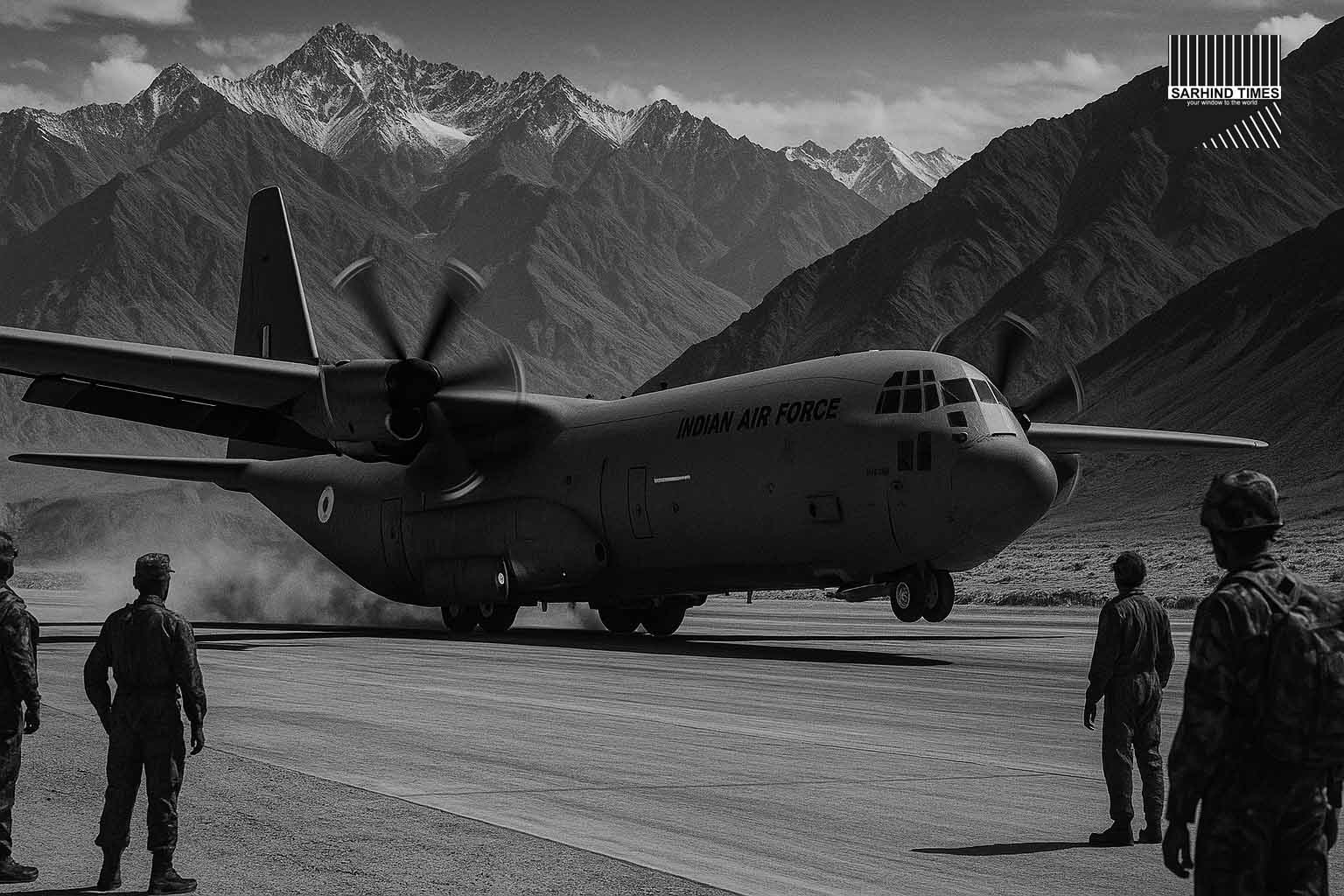
The new base at Mudh-Nyoma underscores India’s hardened position even as diplomatic thaw continues with Beijing
Dateline: New Delhi / Ladakh | November 26 2025
Summary: India has inaugurated a new high-altitude airbase at Mudh‑Nyoma in eastern Ladakh, situated only around 30 kilometres from the disputed Sino-Indian de facto border. The move signals India’s intent to deepen military readiness in the Himalayas even while diplomatic efforts seek to stabilise ties with People’s Republic of China. The dual approach — defence expansion and dialogue — reflects the evolving complexities of India’s border strategy.
What Was Announced and Why It Matters
A senior defence official confirmed that the Indian Air Force Chief landed a C-130J transport aircraft at the newly operational airbase at Mudh-Nyoma, located at approximately 13,000 feet in the Ladakh region. The base is described as capable of supporting fighter-jet operations, thereby significantly enhancing India’s aerial presence in the high mountainous terrain near the Line of Actual Control. This is India’s third major base of this kind in the region.
The proximity of the base—about 30 km from the disputed border with China—is especially notable. In a region where infrastructure is extremely difficult to build and maintain, establishing a fighter-capable base signifies a strong strategic statement. The timing of the inauguration, following months of diplomatic engagements with China, adds a layered dimension to India’s Himalayan frontier posture.
Strategic Implications: A Dual-Track Border Policy
India appears to be executing a dual-track border policy: on one side continuing military infrastructure upgrades, on the other engaging in dialogue and connectivity initiatives with China. The opening of the Mudh-Nyoma airbase sends a clear message of deterrence and operational readiness. Meanwhile, both nations have recently agreed to resume direct flights, enhance trade and reaffirm border-management mechanisms.
This dual strategy matters for several reasons. First, enhanced air-mobility in mountainous terrain increases India’s ability to react swiftly to contingencies, whether logistical or security-related. Second, it demonstrates to external observers and strategic competitors that India is unwilling to delay capability upgrades even as it talks. Third, it may influence China’s calculations—whether it triggers a proportional response, prompts faster disengagement, or modifies its posture in the region.
Operational and Logistical Challenges of High-Altitude Infrastructure
Building and maintaining an airbase at 13,000 ft presents unique challenges: extreme weather, thin air for aircraft performance, logistics of fuel and spare-parts supply, challenges of road/rail connectivity, staffing with high-altitude trained crews, and ensuring resilience of runways, shelters and radar systems. India’s achievement in operationalising this base shows a high level of engineering, logistics and political will.
Yet these challenges are ongoing. Maintaining readiness in winter months, ensuring sustainable supply chains, dealing with high-mobility adversaries and coordinate with ground forces are complex tasks. For India, the base is both an asset and a testbed for future operations in rugged terrain.
China’s Likely Response and the Regional Security Landscape
From the Chinese perspective, the new base may raise strategic concern about India’s ability to challenge air dominance, rapid deployment and monitoring in the Himalayas. Although Beijing has not issued a direct public response yet, analysts note that a few possible responses are on the table: adjusting its own high-altitude infrastructure, altering patrol patterns, accelerating construction of supplementary airfields, or perhaps seeking deeper diplomatic engagement to offset military build-up.
In a broader sense, the India-China border remains one of the most militarised regions in the world. While major clashes like those of 2020 in the Galwan Valley may have receded from immediate headlines, full disengagement and comprehensive resolution remain elusive. The base indicates that while diplomacy proceeds, both sides are preparing for a long-haul strategic competition.
How This Fits with India’s Broader Defence Strategy
For India, expanding infrastructure in the Himalayas aligns with its “multi-front readiness” doctrine. With tensions arising on multiple borders (with Pakistan, China and maritime frontiers), the country is emphasising flexibility, mobility and rapid logistic support. Airbases such as Mudh-Nyoma enhance surveillance, rapid reinforcement, casualty evacuation and logistic reach in high terrain — all crucial given the terrain’s inhospitability.
Moreover, the base supports India’s broader push for infrastructure convergence: road-lanes, tunnels, high-altitude transport corridors, radar, satellite communication and unmanned systems are increasingly interlinked in India’s territorial management model. The base is therefore not an isolated project but a node in a larger Himalayan-frontier network.
The Diplomatic Layer: Stability, Connectivity and the Economic Stakes
Interestingly, the strike-infrastructure upgrade comes at a time when India is simultaneously engaging with China for connectivity and trade upgrades. For example, both countries have agreed to resume direct flights after a five-year suspension and re-open trade points. These moves reflect a diplomatic opening.
The juxtaposition — building a major air-base while also offering connectivity — may reflect India’s desire to negotiate from strength. India appears to signal: engagement is welcome, but strategic autonomy and deterrent capability remain non-negotiable. For Indian business, this environment can be both reassuring and a caution: stability is being pursued, but underlying military competition remains real.
Risks, Uncertainties and What to Watch Going Forward
Several risks and variables merit close watching:
- Escalation dynamics: If China perceives the base as destabilising, there is a risk of military response, increased patrols or infrastructure races on either side. Diplomatic overtures might be offset by covert build-ups.
- Operational viability: Whether the base sustains high-performance operations through winter, monsoon effects and logistic supply issues. If the base falters, the strategic impact is reduced.
- Diplomatic spillovers: Upgraded infrastructure may complicate future negotiations on border mechanisms or disengagement protocols if China considers them provocative.
- Economic opportunity vs cost: High-altitude bases are expensive to maintain. India must balance defence needs with economic priorities. If funding shifts away from infrastructure or industry, opportunity cost may emerge.
What Stakeholders Should Consider
For policy-makers: The base is a strong strategic signal — but it must be backed by logistics, intelligence, integration and diplomatic communication. Defence-investment decisions should also account for dual-use infrastructure benefits (civil aviation, humanitarian response) to optimise public value.
For business and industry: Stability along the Himalayan frontier matters for supply-chains, infrastructure investment, tourism, and cross-border trade. The improvement in connectivity initiatives with China is a positive indicator, but companies must remain cognisant of border-region risks, potential shifts in investment climate and regulatory sensitivities.
For citizens and civil-society: The new base is part of India’s broader push for national security and infrastructure capability. It raises questions of land use, environmental impact in fragile mountain ecosystems and budget priorities. Public awareness and transparent oversight matter as strategic infrastructure expands.
Conclusion: A Strategic Moment in India’s Border Posture
The inauguration of the Mudh-Nyoma airbase is more than a military development; it is a symbol of how India envisions its role in the Himalayas — one of preparedness, infrastructure-edge and strategic autonomy. At the same time, the parallel diplomatic engagement with China underscores the complexity of India’s frontier policy: deterrence and dialogue, infrastructure and connectivity, realism and ambition.
If India manages to translate infrastructure commitments into operational readiness, sustain high-altitude capability and align it with diplomatic overtures, then this moment could mark a shift in India’s Himalaya-frontier strategy. The watchers of India-China relations will certainly view the coming months with close attention — as the heights of Ladakh become both a chess-board and a barometer of regional dynamics.



+ There are no comments
Add yours