
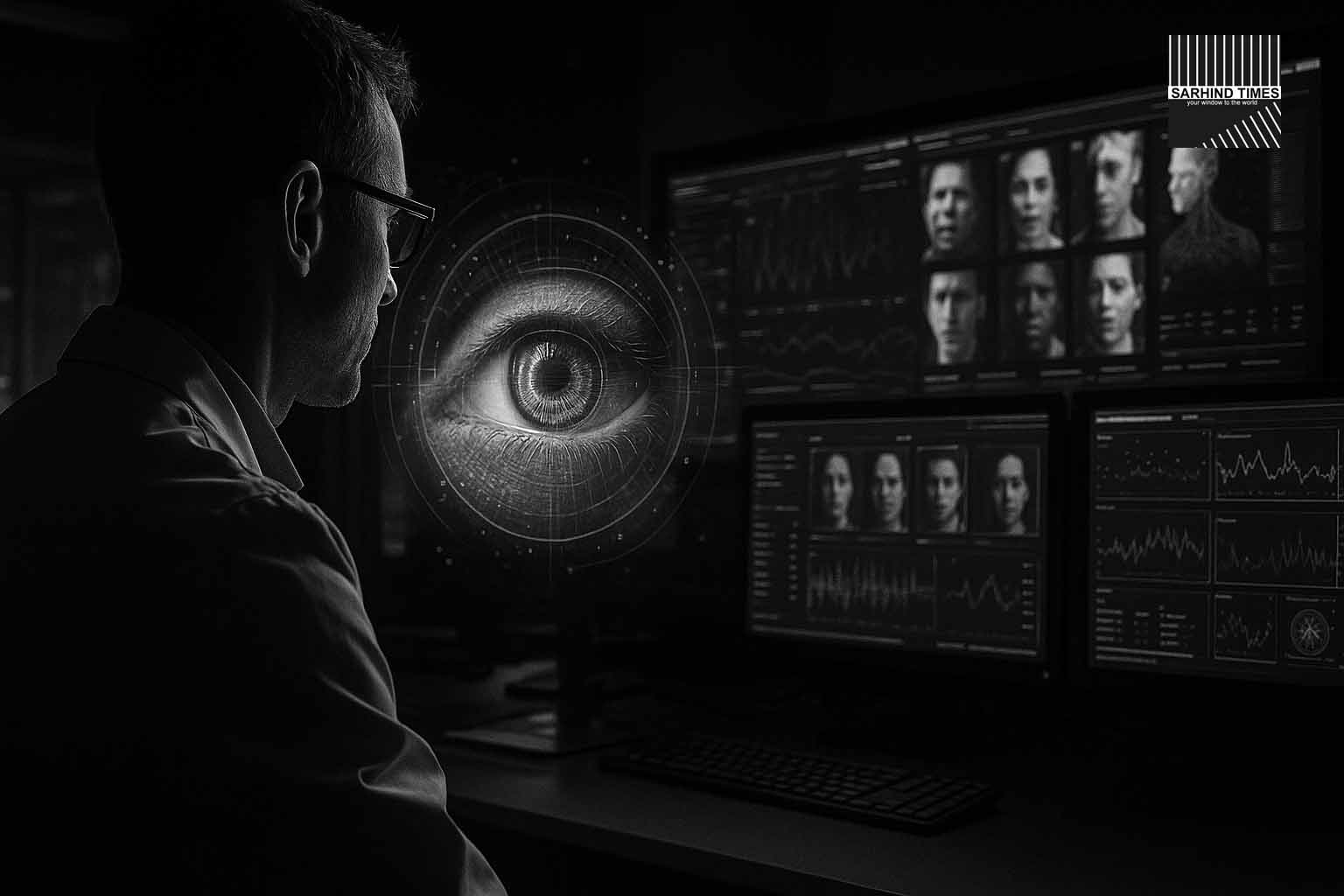
Breakthrough research promises medical and psychological applications—but triggers intense discussion on privacy, consent and future misuse
Dateline: New Delhi | 24 November 2025
Summary: A consortium of AI researchers has unveiled a new ‘Emotion-Aware Eye-Movement AI’ system capable of decoding micro-signals, emotional cues, and cognitive responses by analysing subtle shifts in eye behaviour. The technology has far-reaching implications—from mental-health diagnostics to human-computer interaction—while also raising alarms about potential misuse in surveillance, advertising, and political messaging.
Introduction: A Scientific Leap Arrives with Sharp Questions
In a breakthrough that blends neuroscience, psychology, and advanced machine learning, a global team of researchers this week revealed a cutting-edge ‘Emotion-Aware Eye-Movement AI’ system capable of interpreting human emotional states using tiny, often invisible eye-movement patterns. The tool—already undergoing controlled trials in India, Japan, Germany, and the United States—has sparked immediate excitement in the medical and tech industries, but equally intense concern among ethicists, privacy advocates and lawmakers.
As the world grapples with the explosive growth of generative AI, the emergence of affective-computing systems that can decode internal emotions adds an entirely new dimension to debates around human autonomy and psychological privacy.
The Science Behind It: How Eye-Movement Predicts Emotional Signals
According to lead scientists, the system works by studying:
- Micro-saccades—tiny rapid eye movements that reveal cognitive load.
- Pupil dilation and constriction—linked to stress, excitement, fear, or focus.
- Fixation duration—indicating interest, confusion, or emotional avoidance.
- Blink rhythm—which varies across mental states such as anxiety, calmness, or deception.
When combined with facial micro-expression mapping and large language model integration, the AI can infer emotional states with reportedly 78–86% accuracy in controlled lab settings. Researchers argue this surpasses any existing non-invasive behavioural-analysis technology.
The consortium claims the system does not read “thoughts” but identifies emotional patterns tied to biological responses. But critics insist the line between emotion interpretation and cognitive inference is thinning dangerously fast.
Potential Breakthroughs: Medicine, Psychology and Assistive Tech
While the technology risks triggering dystopian fears, several sectors see transformative possibilities:
1. Mental-Health Diagnostics
Psychiatrists argue that emotional-tracking AI could help detect early signs of depression, PTSD, dementia, and even suicidal tendencies by analysing subtle patterns invisible to the human eye.
2. Assistive Systems for Autism
Children on the autism spectrum who struggle to express emotions verbally may benefit from systems that help parents and clinicians interpret internal cues.
3. Early Detection of Neurological Disorders
Disorders such as Parkinson’s or Alzheimer’s often manifest through changes in blink rhythm or fixation patterns years before full symptoms appear.
4. Smarter Human-Computer Interaction
Emotion-aware systems could help computers adapt in real time—softening tone, slowing instructions, or switching interfaces based on user stress or confusion.
5. Trauma Therapy and Rehabilitation
Sessions could be monitored with emotion feedback loops, giving clinicians deeper insight into patient responses.
The Dark Side: Surveillance, Manipulation and Behavioural Control
Experts caution that the very features that make the system powerful in medicine could also make it dangerous in political, commercial, or authoritarian settings.
1. Targeted Advertising
Companies could theoretically analyse emotional reactions to content and tailor manipulative ads or influence decisions at subconscious levels.
2. Law-Enforcement and Interrogation
While some nations see benefits for lie-detection or threat-analysis, civil-rights groups warn this could lead to dangerous overreach.
3. Workplace Monitoring
Employers might track emotional states during meetings, interviews, or performance reviews—raising fears of psychological profiling.
4. Political Messaging
Political consultants could test campaign messages on groups and adjust narratives in real time to exploit emotional weaknesses.
5. Authoritarian Surveillance
In countries with limited privacy protections, this technology could be weaponised to track dissent or emotional responses to propaganda.
India’s Position: Innovation Welcome, But Ethics Must Lead
India has emerged as one of the early testing grounds for the system, particularly in health-tech and cognitive-science labs in Bengaluru, Hyderabad, and New Delhi.
Government officials say that while India welcomes innovation, strict ethical layers will be required. The Digital India Act’s upcoming revisions may include:
- Guidelines for emotion-measurement AI,
- Consent protocols,
- Ban on psychological profiling without explicit user approval,
- Data minimisation mandates.
India’s AI Task Force has also recommended sandbox trials before commercial deployment.
Researchers Defend the Work: “Misuse Is Not the Purpose”
The scientists behind the technology insist that their primary focus is medical and research use, not surveillance.
They argue that:
- All data is anonymised during trials.
- The system works only in controlled environments.
- No remote or covert emotion reading is currently feasible.
Still, they acknowledge that the technology could evolve rapidly, requiring strong guardrails.
Psychologists Warn of Over-Interpretation
While eye-movement correlates with emotional states, it cannot fully capture human complexity.
Psychologists warn that:
- Emotional states are contextual,
- Human expressions vary across cultures,
- AI may misinterpret biological responses unrelated to emotion.
Over-reliance on such tools, they argue, could reduce the richness of human emotion to simplistic probabilistic outputs.
Global Reaction: Hope, Suspicion, and Urgent Regulation
Countries across Europe, North America, and Asia are following the development closely.
Several EU lawmakers have raised questions about integrating “emotion tracking” into the EU AI Act’s high-risk category.
In the U.S., civil-liberty groups have urged regulators to ban emotion-recognition technology in workplaces and marketing.
Meanwhile, tech giants in Japan and South Korea have already begun exploring commercial applications in gaming, personalised learning, and mental-health coaching.
Ethics Experts Call for a Global Framework
Many argue that cross-border technology like this cannot be governed by isolated national regulations. They propose:
- International norms for emotional-data collection,
- Limits on real-time emotion tracking in public spaces,
- Explicit consent requirements for any emotion-AI deployment.
Where the Research Goes Next
The consortium is planning next-phase trials that may integrate:
- Brain-wave data (non-invasive EEG),
- Heart-rate variability,
- Cognitive-load mapping,
- Adaptive conversational AI agents.
Such combinations would make the system even more perceptive—but also far more controversial.
Conclusion: A Future of Possibility and Peril
The Emotion-Aware Eye-Movement AI marks a historic moment in the evolution of affective technology.
It promises breakthroughs in health, human-computer interaction, and scientific understanding of human behaviour.
But without clear ethical boundaries, transparency requirements, and robust regulation, it also poses risks unlike any seen in the AI era so far.
As nations scramble to keep pace, the world must answer a critical question:
Should machines be allowed to know what we feel—even when we do not express it?


+ There are no comments
Add yours