
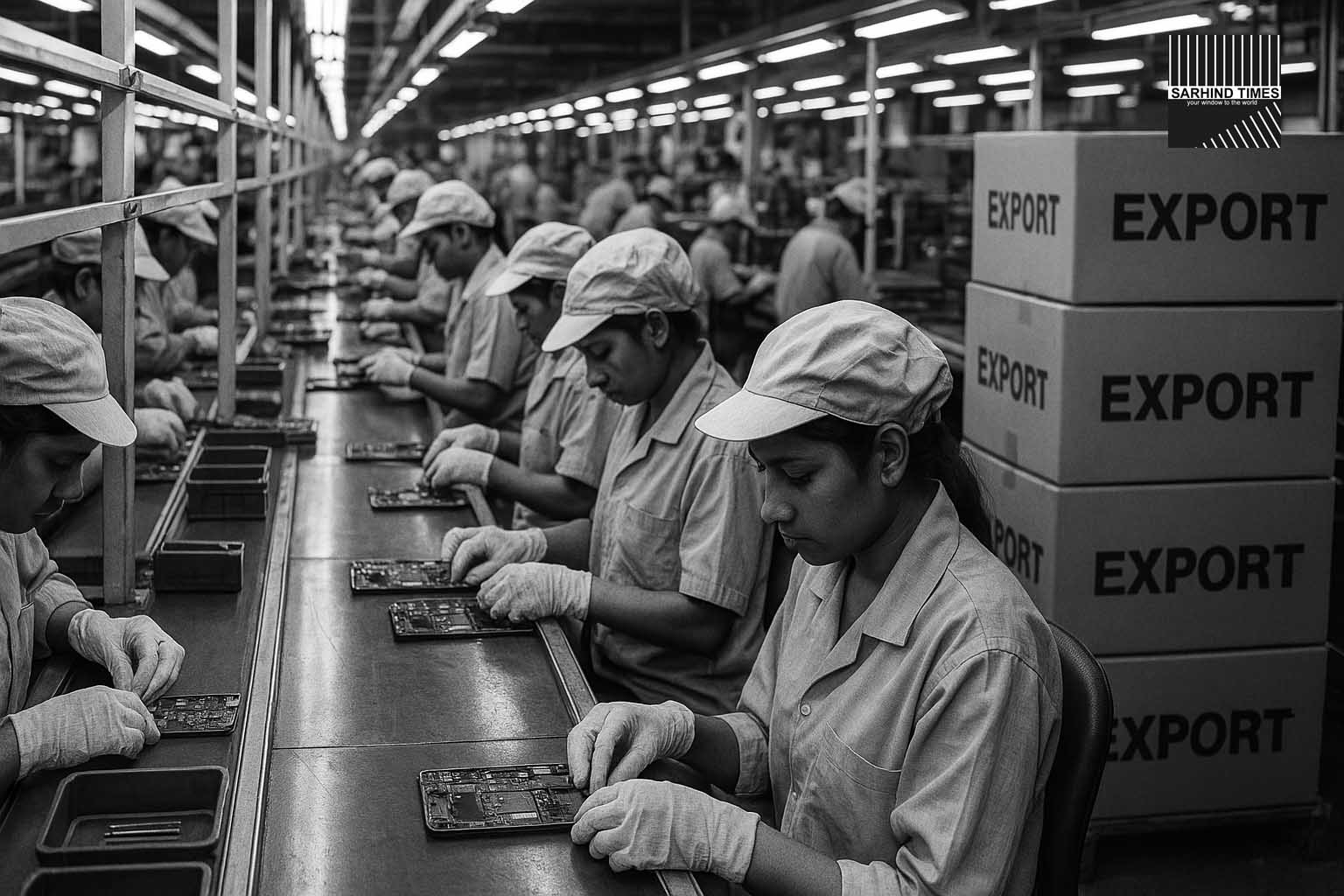
Electronics exports drive the only growth among major categories in October, with smartphones at the forefront—policy momentum, cost challenges and supply-chain shifts pinch next phase
Dateline: New Delhi | 27 November 2025, Asia/Kolkata
Summary: India’s smartphone exports reached an all-time high of approximately US$ 2.4 billion (around ₹21,274 crore) in October 2025, contributing to electronics exports becoming the only major merchandise category to grow across the month. From April to October FY26, smartphone exports have already crossed US$ 16 billion—almost half-a-year ahead of full-year 2023-24 totals. While the growth underscores India’s rising role in global electronics supply-chains, analysts flag cost-competitiveness, component ecosystem and export-climate risks as warning points.
Record export numbers: the headline
Data compiled by industry-bodies show that India exported smartphones worth approximately US$ 2.4 billion in October 2025, up from about US$ 2.0 billion during October 2024.
For the seven-month period April–October FY26, smartphone exports are estimated at US$ 16 billion (≈ ₹1,41,824 crore), nearly a 50 per cent increase over about US$ 10.6 billion (≈ ₹93,958 crore) achieved in the same period last year.
Further reinforcing the trend, broader electronics exports (which include smartphones and related devices) were the only one among India’s top ten export categories to grow in October—rising about 19 per cent year-on-year to roughly US$ 4.08 billion.
Underlying drivers of the growth
The surge in exports is being driven by multiple structural and policy factors:
– Major global smartphone brands—particularly the vendor ecosystem of Apple (via suppliers such as Foxconn and Tata Electronics)—account for approximately 75 per cent of the export volume in this segment.
– Domestic manufacturing scale-up accelerated under India’s production-linked incentive (PLI) schemes, which incentivise incremental supply-chain investment and export orientation.
– Global supply-chain shifts—brands diversifying away from China, navigating geopolitical risks and seeking alternate hubs—are favouring India as a manufacturing centre.
– Domestic export units have improved capacity, logistics, export-licensing and packaging infrastructure, enabling stronger outbound shipments even in months that are traditionally slower (such as August/September). For instance, export performance in September rose strongly (about 95 per cent year-on-year) despite seasonal headwinds.
Strategic implications for India’s electronics ecosystem
This export momentum has multiple implications:
– **Supply-chain positioning:** India is moving from being a domestic-market assembly base to a globally significant export node. The scale achieved in seven months of FY26 already exceeds full-year totals in recent past.
– **Job-creation & investment:** As export units scale, ancillary industries (components, sub-assembly, logistics) stand to gain, creating employment and deeper manufacturing ecosystems.
– **Trade-balance & export profile:** With electronics exports growing strongly while many other merchandise segments stagnate or decline, India’s export profile may shift towards higher-value manufacturing.
– **Make in India narrative bolstered:** The strong performance supports the government’s “Make in India” and self-reliant manufacturing strategies; it also strengthens India’s credentials in global tech value chains.
But cost-competitiveness and headwinds loom
For all the positives, analysts caution several risks:
– **Manufacturing cost gap vs China:** India continues to face a manufacturing-cost disadvantage of estimated 12–14 per cent compared with China, including logistics, wages, energy and scale-economies.
– **Component-ecosystem maturity:** While assembly is rising, India’s domestic ecosystem for components, sub-assemblies, display modules, camera modules and other critical inputs remains under-penetrated. Dependence on imports may restrict margin gains and resilience.
– **Global trade & tariff risks:** The relative cost-advantage may shrink if low-cost supply (e.g., from China) increases or if trade-barriers shift. For example, changes in U.S. tariff regimes could impact competitive positioning of Indian exporters.
– **Sustainability of growth volume:** Maintaining such high growth levels will require continuous capacity expansion, demand in export markets and avoidance of bottlenecks. If any one link in the supply chain slows, the momentum could stall.
– **Concentration risk:** With ~75 per cent of exports driven by Apple’s vendor network, export growth is somewhat concentrated; broader diversification (brands, models, geographies) will reduce risk.
– **Emerging inflation, energy/commodity cost pressures:** Manufacturing cost inflation (labour, energy, materials) could erode margins unless offset through efficiency gains.
What to watch in the coming months
Key indicators will help determine whether this export boom is sustainable and system-wide:
– **Component manufacturing growth:** Whether India can scale domestic production of critical components will determine long-term value capture.
– **Export market diversification:** Beyond major brands and major destinations (such as the U.S.), expansion into other geographies will reduce concentration risk.
– **Capacity utilisation & factory expansions:** Tracking announcements of new plants, capacity expansions (e.g., display modules, camera modules) and utilisation rates.
– **Impact of policy changes:** Whether PLI schemes continue, whether tariff or input advantages are maintained, and how policy evolves to retain competitiveness.
– **Cost movement:** Whether India can reduce the cost gap vis-à-vis China through infrastructure, logistics, energy efficiency, scale and liberalised regulations.
– **Broader electronics sector growth:** Whether exports extend beyond smartphones into other categories (IoT devices, wearables, laptops, etc.) to build a more diversified electronics export base.
Sectoral and policy takeaways for India
– The government now faces a shifting agenda: from simply incentivising assembly to developing full manufacturing depth (components, R&D, design).
– States hosting large electronics clusters (Tamil Nādu, Karnataka, Andhra Pradesh) and those with favourable policy & logistics will be in prime position to attract further investments.
– Infrastructure (power, logistics, ports), land-policy, labour-law clarity and ease-of-doing-business improvements will matter more than ever in locking in global manufacturers.
– Given global uncertainties (trade wars, China cost-pressure, raw-material inflation), the focus must move to cost efficiency, automation and next-gen technologies rather than just volume growth.
Conclusion
India’s smartphone export surge in October 2025 is a milestone: it highlights the country’s growing role in global electronics manufacturing and reflects the successful interplay of policy, capacity and supply-chain transition. But the path ahead is less about reaching record highs and more about sustaining competitive advantage.
In short: India has raised the bar—but whether it leaps or just lands will depend on how the ecosystem adapts to the next challenge.



+ There are no comments
Add yours