
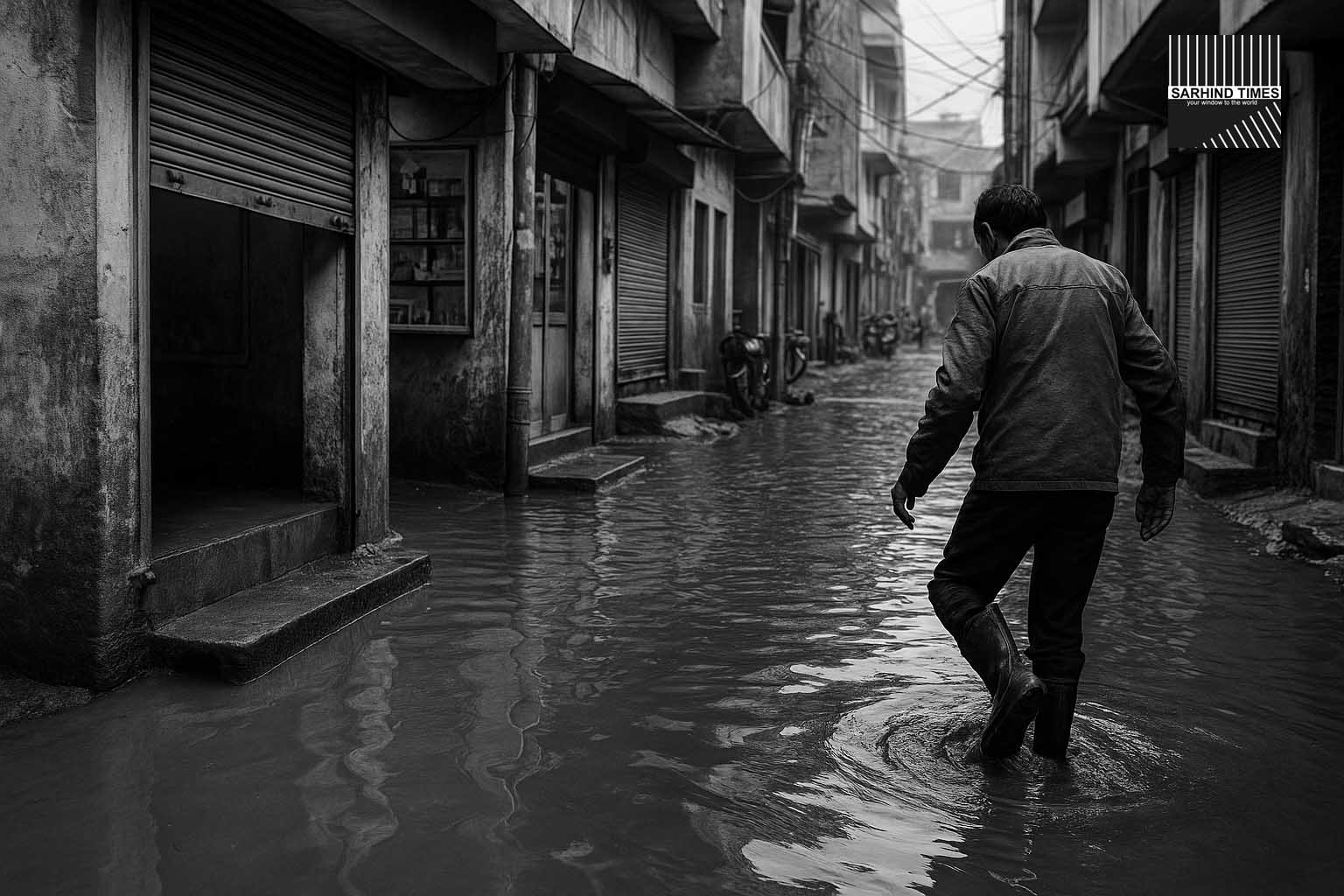
Residents say the narrow lane remains water-logged for 1.5 years, signalling deeper infrastructure and governance gaps
Dateline: Gurugram | 26 November 2025, Asia/Kolkata
Summary: A key access lane in Sector 4, Gurugram has been plagued by persistent sewage overflow and underground-pipe leakage, leaving motorists, pedestrians and shop-owners facing daily water-logging. Despite repeated complaints over 18 months, the Municipal Corporation of Gurugram (MCG) has taken little sustained action, raising questions about urban-infrastructure upkeep in one of India’s fastest-growing cities.
The situation in Sector 4: facts on the ground
A narrow lane leading into the local market area in Sector 4 has reportedly been water-logged almost daily for the past one and a half years. The cause: repeated sewage-overflow incidents and leakage from an underground pipeline, which residents say has degraded road quality and flooded shop basements.
Local shop-owners explain that despite the road being rebuilt in 2024, frequent flooding returns. Many businesses—especially those with basements—are dealing with root-water, standing six to eight inches of liquid, even when there has been no rain. A stationery shop-owner noted that he pumps out water regularly, only to find it back the next day.
Residents allege they have submitted multiple complaints to the Municipal Corporation of Gurugram (MCG) and connected agencies. One resident said the lane was initially blocked by garbage heaps, then resurfaced, and now again malfunctioning due to structural inadequacies and un-addressed drainage/sewer-issues.
Why this lane matters—and what it reveals
At first glance, this may appear as a localised civic nuisance—but the implications are broader. Sector 4 is part of the larger Gurugram urban fabric: a mixed residential-commercial zone, with high commuter foot-print, shop-density and utility demand. A persistent water-logging issue here signals several deeper issues:
– **Infrastructure backlog and maintenance deficit**: The road was reconstructed recently—yet structural under-drainage and pipeline systems appear not upgraded commensurately.
– **Drainage-sewer system mismatch**: Overflow of sewage in a “non-rain” event indicates system design or capacity failure—not just extreme weather.
– **Basement vulnerability**: Many shops/houses with basements are flood-affected; this suggests either grade/level-setting issues, lack of sump or back-flow prevention.
– **Urban governance challenge**: Repeated resident complaints over months without resolution point to weak monitoring, accountability and operational response.
– **Risk to business and mobility**: Local commerce suffers, pedestrian/motor-traffic safety drops, long-term viability of neighbourhoods may be impacted—especially in a city that trades on “premium” status.
Governance and agency-response dynamics
According to residents, the Municipality’s responses have largely been non-substantive: templated replies, staff reshuffles, commitments that the matter will be “looked into” and yet no full resolution. The new MCG official reportedly stationed two months ago claimed unfamiliarity with the persistent issue.
On the engineers’ side, responsibilities are diffused: road-surface contractors, drainage-pipe suppliers, MCG civil teams, GMDA (Gurugram Metropolitan Development Authority) involvement—yet no single “owner” seems to drive resolution end-to-end. When leakages beneath the surface cause recurring flooding, diagnostics, repair and coordination are more complex but need to be expedited given the persistence of the problem.
Implications for urban planning and resilience in Gurugram
Gurugram is one of India’s fastest urbanising cities—with skyscrapers, major corporate campuses, logistics hubs and large residential clusters. As it grows, the demands on its drainage, sewage, storm-water management and utility infrastructure swell. This incident brings to focus several planning and resilience considerations:
– **Design capacity vs actual demand**: Many urban sectors were developed rapidly, assuming standard tributary loads—but actual loads (residential + commercial + basement drainage) may exceed original design. Over time, this results in frequent overflows.
– **Integrated infrastructure upgrades lagging**: Often roads are reconstructed without commensurate upgrades of underlying sewage/drain lines or newly added commercial basements. This creates mismatch in the lifespan of systems.
– **Monitoring and maintenance cycles weak**: Upfront infrastructure costs get incurred—but ongoing maintenance, cleaning of drains, inspections, leak detection seldom get scheduled with rigour. The fact this has persisted for 1.5 years is telling.
– **Basement/in-building design risk**: Basements in a high water-table urban zone like Gurugram need robust waterproofing, sump-pumps and back-flow prevention; local shop-owners suggest these elements may have been undervalued.
– **Quality of life and economic perception**: For a city marketed as high-end and global-business-ready, persistent civic-maintenance issues erode investor confidence, resident satisfaction and brand-equity.
What needs to happen next—operational roadmap
For meaningful resolution, the following steps are recommended:
1. **Comprehensive diagnostic survey** of the lane: identify exact points of pipeline leakage, sub-grade levels, draincapacity, basement-water intrusion pathways, shop-footprint changes since original design.
2. **Single-point agency ownership**: Assign a dedicated MCG/GMDA task-force for the lane with fixed timelines for remediation, including underground line repair, drain re-design, and road-surface restoration.
3. **Permanent works upgrade**: Replace or relay the faulty underground pipeline with durable materials (HDPE/CI as appropriate), ensure drainage pipe sizes meet present and short-term projected loads, grade levels recalibrated.
4. **Basement-water pump subsidies/support**: Provide co-funding or technical support to basement-shop-owners for sump-installation and back-flow valves; this will mitigate recurring damage during heavy flow events.
5. **Resident/consumer feedback loop**: MCG should publish status updates for grievances, remediation progress and inspection records so residents know timelines and accountability.
6. **Preventive maintenance**: Once fixed, schedule regular inspections of the upgraded system, clear debris, sewage blockages, conduct CCTV pipe checks, monitor water-table levels and basement seepage.
7. **Scaling lessons across Gurugram**: The issue in Sector 4 may replicate in other sectors; once remediated, a city-wide audit of similar narrow lanes, ageing pipes and basement-flood-prone zones should be initiated.
Why the delay matters—and costs escalate
Delayed repair of such infrastructure issues is not just a matter of inconvenience—it has broader cost implications:
– Frequent pumping and ad-hoc fixes raise operational cost for shop-owners (time, manpower, equipment).
– Recurring damage to basement stocks, inventory and equipment adds losses to businesses.
– Potential health hazards: sewage overflow carries risk of contamination, foul water, damp-basement mould, vector breeding.
– Road deterioration: Persistently wet subgrade undermines road-surface integrity, leading to potholes, higher maintenance and eventual reconstruction costs.
– Reputational harm: Multi-national firms, resident welfare groups and real-estate investors may perceive the systemic issue as a sign of broader civic governance lag, impacting property values and corporate decisions.
Resident and business impact
For shop-owners in that lane, the flood of water into basements at six to eight inches depth is routine; the cost in lost sales, delayed deliveries, inventory damage, and additional pumping means profit margins shrink. Pedestrians face slip/trip risk; motor-two-wheeler riders risk engine-submersion; vehicles routing through the lane face higher risk. Over a year, such recurrent disruptions discourage walking foot-traffic, reduce shopper visits, raise insurance or repair costs.
Conclusion
The recurring sewage overflow and waterlogging in Sector 4, Gurugram should serve as a wake-up call for city authorities: infrastructure is not static—it degrades and demands ongoing investment and oversight. In a city racing ahead with skyscrapers and metro lines, the basics of drainage and sewage-management must not be left behind.
For residents and businesses alike: their patience is at an inflection point. They deserve more than “we’ll fix it soon” assurances—they need tangible, visible action. If Gurugram is to live up to its “millennium-city” promise, the maintenance of underground pipelines and surface water-management must become as high-profile as its commercial towers.
For city-leaders: now is the moment to convert disappointment into delivery.



+ There are no comments
Add yours