
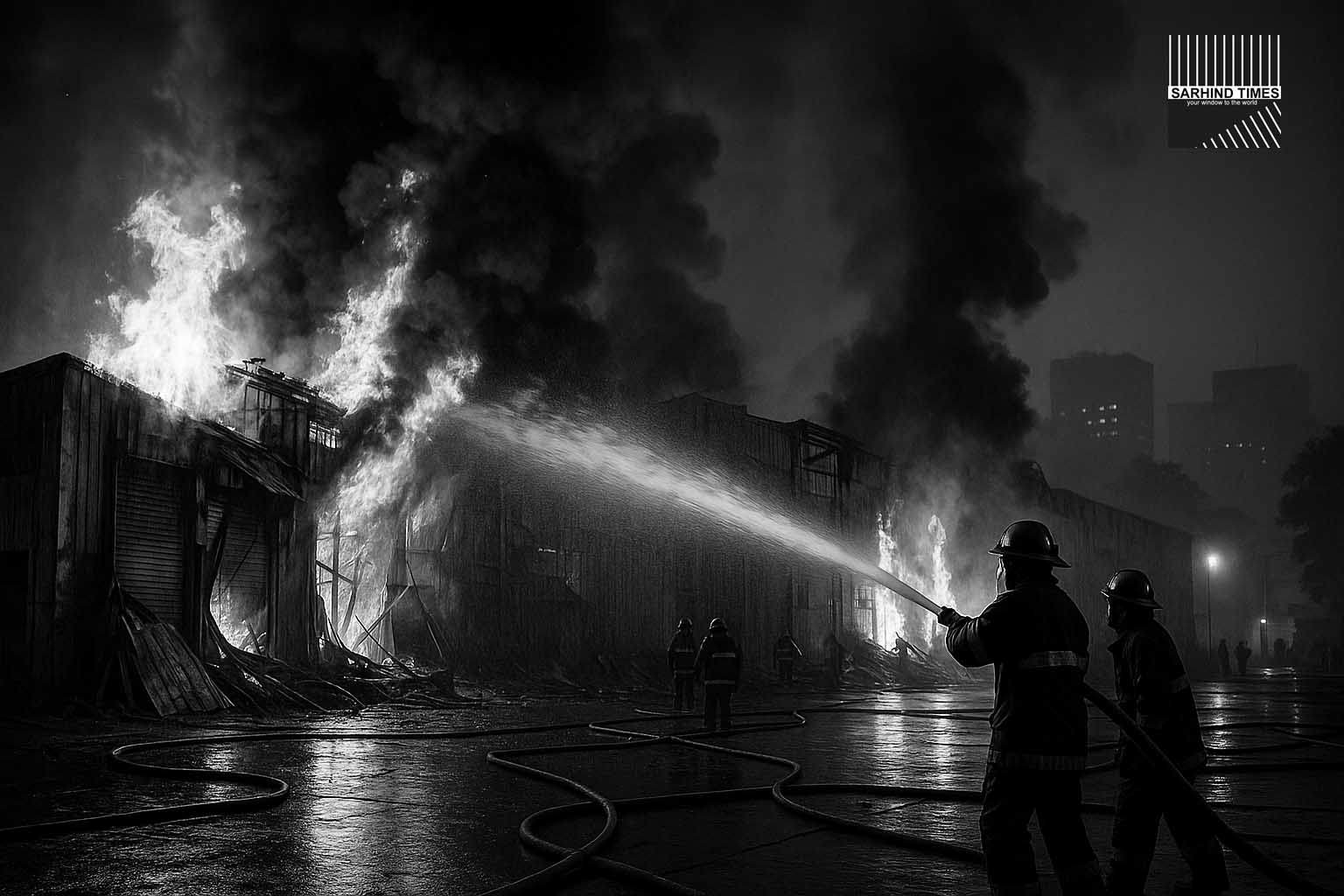
A massive blaze at a chemical storage facility exposes regulatory gaps, prompts public health concerns, and triggers a multi-agency probe into industrial safety standards.
Dateline: Kolkata | (Asia/Kolkata)
Summary: A large-scale fire that erupted inside a chemical warehouse in central Kolkata has led to a full-fledged investigation by state authorities, triggering concerns about hazardous material handling, licensing irregularities, and lapses in safety compliance. The incident, which sent plumes of toxic smoke across nearby neighborhoods, resulted in a sharp decline in air quality and prompted health advisories for residents. Firefighters battled the blaze for hours, and officials now suspect improper chemical storage and possible negligence. With similar incidents rising across urban India, the Kolkata fire has reignited national debate on industrial safety enforcement, urban zoning, and public health preparedness.
1. A sudden blaze engulfs a chemical warehouse
Kolkata woke up to dense clouds of smoke after a major fire broke out at a chemical storage warehouse in the early hours of the morning. The facility, located near a busy commercial zone, housed multiple flammable and corrosive substances, authorities said. The intensity of the flames initially prevented firefighters from entering the premises, forcing them to focus on containment using water jets and foam-based suppression systems.
Witnesses described the blaze as “massive” and “unusually fast-spreading,” raising immediate questions about what chemicals were being stored and whether the warehouse followed mandatory safety protocols.
2. Firefighters battle through toxic fumes
The Kolkata Fire and Emergency Services deployed over a dozen fire tenders, along with specialized hazardous-material (HAZMAT) response units. Firefighters, equipped with breathing apparatus, had to navigate through thick black smoke which made visibility extremely poor.
Officials confirmed that the fire was difficult to control due to the unknown mixture of chemicals inside the facility. Temporary evacuation zones were created around the warehouse to prevent civilian exposure to the fumes.
One senior fire officer remarked:
“This is not a typical warehouse fire. Chemical interactions made the flames unpredictable.”
3. Air quality drops sharply in surrounding areas
Within hours of the blaze, air quality monitoring sensors in nearby localities—such as Tangra, Entally, and Topsia—recorded significant spikes in PM2.5, PM10, and volatile organic compounds (VOCs). Residents reported burning eyes, throat irritation, and difficulty breathing.
Health authorities issued advisories urging people to stay indoors, keep windows closed, and use N95-level masks if venturing outside. Local clinics also reported a rise in walk-in cases of respiratory discomfort.
4. What chemicals were stored? Authorities begin forensic analysis
One of the biggest concerns in the aftermath of the incident is identifying the exact chemicals stored inside the facility. Warehouse documents were reportedly damaged in the fire, complicating efforts to assess the full extent of the hazard.
Initial inspections suggest the presence of:
- paint thinners
- industrial solvents
- adhesive compounds
- acids used in manufacturing processes
- flammable storage drums
The state forensic team will now collect residue samples to determine whether prohibited or incorrectly stored materials were involved.
5. Neighbours had warned about the warehouse earlier
Several local residents told reporters that they had previously raised concerns about the warehouse’s operations. Many claim the facility frequently received late-night chemical shipments, emitted strong chemical odours, and lacked visible safety signage.
One shopkeeper nearby said:
“We always feared something like this would happen. Nobody knew what they were storing inside.”
These statements have intensified scrutiny over how the warehouse obtained zoning clearance and whether authorities overlooked glaring red flags.
6. Licensing violation? Multiple agencies join investigation
Following the fire, state officials confirmed that the warehouse did not appear to have a valid updated fire safety certificate. Several mandatory checks, such as annual inspections of fire extinguishers, sprinkler systems, and chemical segregation protocols, may have been skipped.
The police, fire department, and pollution control board have jointly initiated a probe focusing on:
- Licensing validity
- Safety audit history
- Source of chemicals and supply chain partners
- Storage compliance standards
- Worker training and safety preparedness levels
The owner and management staff will soon be questioned to determine whether negligence or deliberate violations caused the incident.
7. Impact on nearby businesses and residents
The immediate vicinity of the warehouse includes multiple small manufacturing units, godowns, shops, and residential pockets. Several businesses were forced to shut down for the day due to health concerns and police cordon zones.
Residents argued that chemical warehouses should not be allowed near densely populated neighbourhoods, especially given Kolkata’s old building stock and narrow lanes that make emergency response challenging.
Urban planners have long criticized the city’s patchwork zoning patterns, where industrial and residential areas overlap without proper boundaries.
8. Concerns over environmental contamination
The West Bengal Pollution Control Board deployed teams to monitor air and soil conditions around the site. Experts fear that toxic runoff from firefighting operations may enter nearby drains, eventually impacting water bodies.
Environmental groups demanded immediate containment measures, including chemical-neutralizing agents and controlled waste disposal to prevent long-term contamination.
9. Political reactions and accountability debate
The fire triggered strong political reactions across West Bengal. Opposition leaders accused the ruling administration of failing to enforce industrial safety standards and allowing hazardous warehouses to operate unchecked.
Government officials responded by calling the incident “unfortunate” and promising strict action against any violations. They emphasized the need for updated databases of chemical storage facilities in the city.
The debate over accountability has intensified, with citizens demanding transparent disclosure of warehouses storing volatile materials.
10. The broader issue: industrial safety gaps in Indian cities
The Kolkata fire is not an isolated incident—several Indian cities have reported similar warehouse fires over the past year. Experts say this reflects broader systemic issues:
- weak enforcement of licensing rules
- lack of periodic safety audits
- densely packed industrial clusters in urban cores
- poor awareness of chemical safety standards
- absence of emergency evacuation protocols
Urban safety researchers argue that industrial governance frameworks must evolve to match the pace at which cities are expanding.
11. How firefighters contained the blaze
Fire department officials said the narrow access roads posed significant challenges during the initial response. Fire engines had to be strategically positioned to prevent the flames from spreading to adjacent buildings.
Foam-based suppression systems played a crucial role in smothering chemical-fed flames, while cooling operations continued long after the fire was brought under control to prevent re-ignition.
Emergency teams are expected to remain on-site for several days as part of post-fire safety protocol.
12. Residents demand relocation of hazardous warehouses
After the fire, several local citizen groups demanded a comprehensive survey of all chemical warehouses operating in residential or mixed-use areas. They called for relocating such units to designated industrial parks with proper fire-safety infrastructure.
Urban zoning experts agree that many Indian cities still operate under outdated land-use plans that allow dangerous industrial activities within close range of homes and schools.
13. What happens next?
The state government has promised swift action pending the investigation report. Potential outcomes may include:
- criminal charges for negligence
- revocation of licenses
- mandatory safety upgrades for similar warehouses
- city-wide chemical storage inspections
- stricter zoning enforcement
The final forensic analysis will also determine whether any banned or misdeclared chemicals contributed to the explosion risk.
14. A wake-up call for urban India
The Kolkata warehouse fire has once again underscored the vulnerabilities inherent in India’s rapidly growing urban-industrial landscape. As cities expand, the integration of safety, zoning, industrial compliance, and environmental protection becomes increasingly essential.
Cities across the country are now watching Kolkata’s investigation closely, as the findings may influence future urban safety regulations nationwide.



+ There are no comments
Add yours