
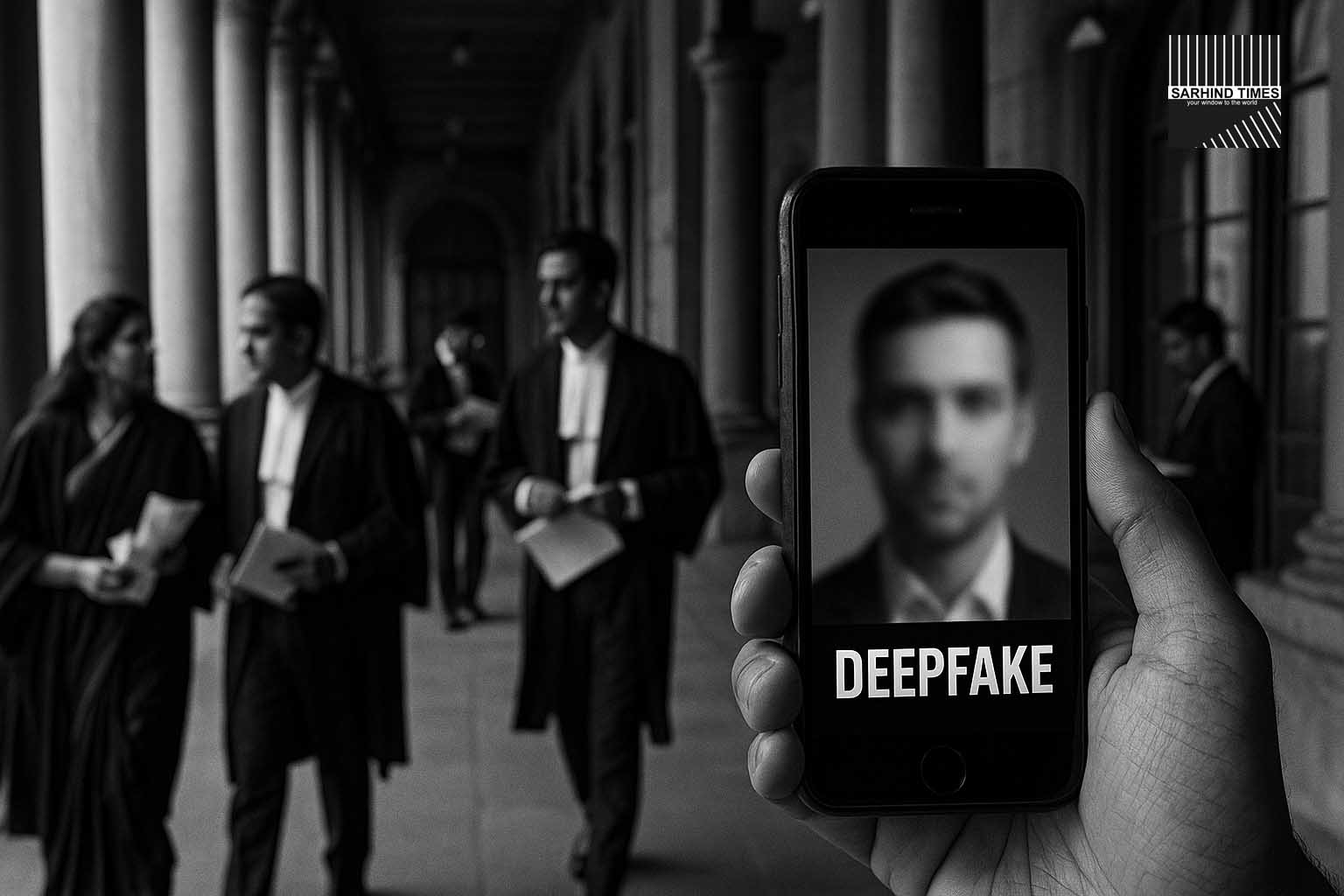
The court calls the issue “urgent and alarming” as cases of AI-generated impersonation, fraud, harassment, and political misinformation spike across the country.
Dateline: New Delhi | (Asia/Kolkata)
Summary: A High Court has formally sought a detailed response from the Central Government on the increasing misuse of deepfake technology, citing a “significant threat” to public safety, democratic integrity, and individual rights. The petition highlights rising incidents involving AI-generated fake videos, political propaganda, extortion schemes, and impersonation-based sexual harassment. In response, the court has urged the Centre to clarify existing legal safeguards and indicate whether comprehensive legislation on AI misuse is necessary. With deepfake tools now widely accessible, the case is expected to shape India’s digital safety framework for years ahead.
1. High Court steps in amid surging deepfake threats
The High Court issued a strong order directing the Central Government to provide a detailed response on the growing misuse of deepfake technology across India. Calling the matter “extremely urgent,” the Bench observed that AI-powered impersonation poses a severe challenge to existing laws, policing capacity, and digital rights frameworks.
The petition—filed by a digital rights researcher—points to multiple categories of harm: identity theft, financial fraud, political manipulation, child-safety violations, online sexual violence, and defamation. The plea argues that India’s legal system is not yet equipped to tackle the unique and rapidly evolving dangers of artificial intelligence misuse.
The court agreed that the issue needed immediate attention, remarking:
“Deepfake technology has evolved faster than regulatory safeguards. Misuse can destroy reputations, threaten national security, and destabilize democratic processes.”
2. What triggered the petition?
The petition cites an alarming rise in deepfake incidents, including:
- AI-generated videos of public figures used for political misinformation
- Fraudulent impersonation videos sent to families demanding money
- Teenagers victimized through morphed explicit images
- Corporate scams involving deepfake audio of CEOs instructing fund transfers
- Criminals using AI-generated voices to mimic relatives during emergency fraud calls
Several states reported double-digit spikes in deepfake-linked cyber complaints over the past year, while law enforcement officials admit the lack of forensic tools to identify AI-generated forgeries in many cases.
3. Court questions adequacy of current laws
India currently relies on a combination of the Information Technology Act, the Indian Penal Code, and various cybercrime provisions to prosecute the misuse of digital content. However, deepfakes present challenges that existing statutes do not directly address.
The Bench asked the Centre to clarify:
- whether current provisions effectively cover deepfake creation and distribution
- if specialized criminal definitions are necessary
- whether platform responsibilities need to be tightened
- how cross-platform tracking of AI-generated content can be enforced
- what safeguards exist against political exploitation of deepfakes
The Court highlighted the absence of explicit recognition of synthetic media as a legal category, even as the technology becomes mainstream.
4. The technology challenge: anyone can now create deepfakes
AI tools that once required advanced computing skills are now available through mobile apps, making it easier than ever to produce realistic deepfake videos or voice clones. Some apps require only a single photograph or a few seconds of audio to create convincing impersonations.
This democratization of powerful AI tools is at the heart of the legal challenge. Law enforcement agencies warn that criminal networks have begun exploiting these tools at scale for:
- loan scams
- sextortion
- political disinformation
- celebrity image exploitation
- online reputation destruction
The petition argues that without preemptive regulations, India could face a wave of synthetic-media crimes that are difficult to detect and even harder to prosecute.
5. Deepfakes and the threat to democracy
One of the petition’s strongest arguments concerns democratic integrity. Political deepfakes—videos showing candidates making fabricated statements—have already surfaced in recent election cycles.
The court observed that deepfakes can erode trust in democratic institutions and manipulate voter psychology. In a world where misinformation spreads rapidly, even a few minutes of circulation can cause irreversible damage.
The Bench stated:
“When truth becomes indistinguishable from fabrication, democratic decision-making suffers.”
6. Women and minors disproportionately targeted
The petition highlights that women, teenagers, and public-facing professionals face vastly higher risks of victimization. Several complaints involve intimate deepfakes created without consent and distributed across social media platforms.
These crimes blur the line between harassment, psychological abuse, and digital sexual violence. Victims often struggle to prove falsification, and platforms frequently take hours—sometimes days—to remove manipulated content.
Child-safety organizations also warn that deepfake tools can be used to mimic minors’ faces or voices for exploitation, making the issue particularly sensitive.
7. The Centre’s preliminary view: balancing innovation and safety
Officials indicate that the government is aware of the rising threat and has been working on digital safety frameworks, including advisories to platforms, awareness campaigns, and AI-forensics capacity building. The Centre may argue that current legal frameworks, combined with IT Rules and upcoming Digital India legislation, provide adequate tools for enforcement.
However, experts doubt whether these measures are enough to address highly sophisticated synthetic media manipulation.
8. Platforms under scrutiny: Are tech companies doing enough?
The Court’s notice to the Centre implicitly brings social media platforms into the spotlight. Platforms are expected to:
- flag and demote AI-generated content
- offer clear reporting mechanisms for deepfake material
- maintain transparency in moderation algorithms
- develop rapid takedown systems for high-risk content
- cooperate with law enforcement during forensic investigations
However, platforms often argue that automated detection tools cannot always identify sophisticated deepfakes, especially those created using generative adversarial networks (GANs).
9. Global approaches the Court may consider
The court is examining comparative global frameworks, including:
- EU’s proposal for mandatory AI-labeling for synthetic media
- US state laws criminalizing malicious deepfake creation
- China’s mandatory watermarking rules for all AI-generated content
- South Korea’s consent-based deepfake regulations
These examples may influence India’s future legislation, though the court emphasized that local socio-legal realities must guide the final approach.
10. Law enforcement challenges
Police officials admit that deepfake investigations require specialized AI forensics, which many states lack. Even when trained officers are available, the volume of complaints far exceeds forensic capacity.
Key enforcement gaps include:
- lack of dedicated cyber forensics units in smaller districts
- no standard protocol for verifying synthetic media
- limited access to high-performance computing tools
- cross-platform jurisdiction issues
The petition demands that the Centre develop a unified national deepfake response protocol.
11. The psychological and social cost for victims
Beyond legal and forensic concerns, the court acknowledged the severe psychological toll deepfake abuse takes on victims. Individuals whose images are manipulated into explicit content often face depression, anxiety, identity damage, and social isolation.
Professionals whose reputations are targeted through fabricated statements face long-term career harm, especially in politics, education, public service, and journalism.
12. The Court’s direction: What the Centre must now submit
The Court has asked the Centre to file a comprehensive affidavit addressing:
- whether specialized deepfake legislation is needed
- which agencies will regulate AI-generated content
- the possibility of mandatory watermarking of synthetic media
- whether platforms should authenticate high-risk content
- how cross-state cybercrime cases will be coordinated
- what protections will be offered to victims
The affidavit is expected within a few weeks, after which the Court may consider issuing interim directions.
13. A defining case for India’s digital future
The case is widely regarded as a turning point in India’s digital governance evolution. As AI-generated media becomes more sophisticated, the Court’s stance will influence how India defends individual rights, political stability, and public trust in the digital era.
The petition concludes that India must act before deepfake misuse becomes unmanageable, stating:
“Technology cannot operate in a vacuum of accountability.”
With the issue now under judicial scrutiny, India moves closer to establishing a comprehensive national framework to regulate AI misuse and protect citizens from emerging digital harms.



+ There are no comments
Add yours