
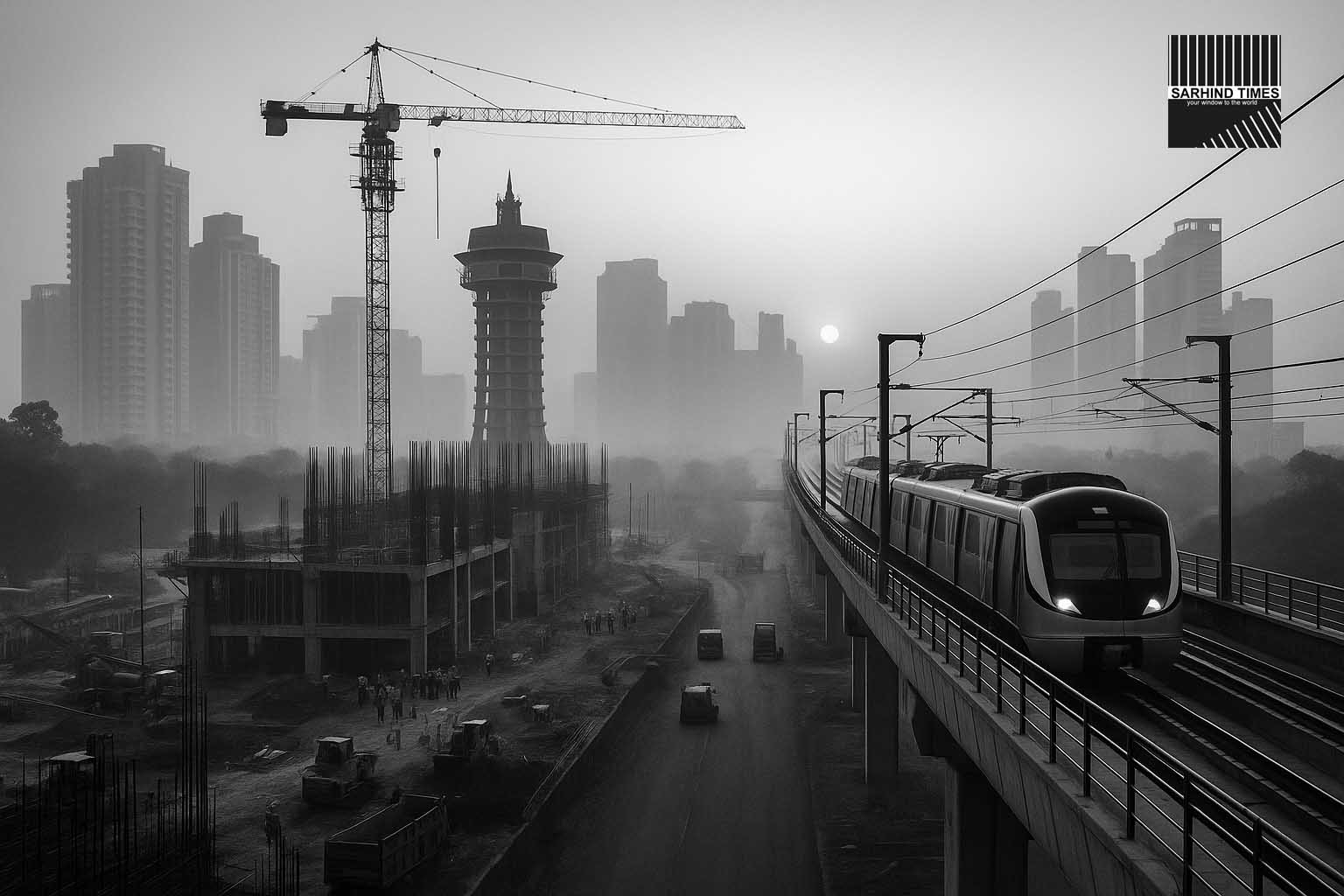
The state’s largest city outside Delhi enters a transformational phase with integrated metro transit, digital infrastructure and green-corridor expansion
Dateline: Gurugram (Haryana) | November 19, 2025
Summary: The government of Haryana has approved a landmark ₹20,000 crore development package for Gurugram city, covering a new metro extension, smart-city digital backbone, green corridor and suburban transit integration. The package represents a major investment milestone in the city’s evolution from corporate hub to urban-mobility benchmark, with significant implications for infrastructure, real-estate, governance and quality of life.
Why Gurugram needs a rethink
Gurugram has undergone a rapid metamorphosis over the past two decades. Once a quiet satellite town on the outskirts of the national capital, it has emerged as one of India’s fastest-growing urban areas, home to global corporations, high-rise offices and a booming residential market. However, this growth has come with steep costs — traffic congestion, infrastructure bottlenecks, pollution, sprawling suburbs and a fractured public-transport system.
City planners and the state government say the time has come for a strategic reset. The approved package sets out a multi-year plan to relieve deep-rooted pressures and reposition Gurugram as a “next-generation mobility city.” Officials highlight three core challenges the plan seeks to address:
- Mobility gridlock: Daily traffic jams, overloaded roads and inadequate public-transport connectivity cause productivity losses and worsen commuter stress.
- Infrastructure lag: Utility networks, digital services, urban drainage, green spaces and mixed-land-use zones have not kept pace with real-estate growth.
- Quality-of-life gap: Air pollution, limited pedestrian spaces, inadequate last-mile connectivity and urban-sprawl pressures impact resident satisfaction.
By approving the ₹20,000 crore package, the Haryana government is signalling that Gurugram’s next phase of growth must be planned, integrated and sustainable.
What the package covers
The development package is multi-modal and covers several inter-linked components:
- Metro-extension corridor: An 18-km elevated metro link from HUDA City Centre to Manesar via existing development zones and new industrial belts, expected to cost around ₹8,000 crore.
- Smart-city digital backbone: Creation of a city operations centre (COC) with IoT sensors, real-time traffic monitoring, integrated utility dashboards and citizen mobile-app interface (~₹3,000 crore).
- Green-mobility corridors: 25 km of dedicated bus-rapid-transit (BRT) lanes, e-bus fleet deployment and charging infrastructure (~₹4,000 crore).
- Urban-renewal precincts: Redevelopment of ten major micro-zones in the city (SEZs and residential plateaus) including high-density zoning, pedestrianisation and mixed-use upgrades (~₹2,000 crore).
- Public-space & environment upgrades: Expansion of city parks, tree-canopy corridors, storm-water management and sustainable drainage (~₹3,000 crore).
Officials say the plan will be implemented in phases over five years (2025–2030), with an annual budget rollout beginning in FY 2025-26. Private-sector participation via PPP (public-private partnership) model will be encouraged for metro operation, digital services and urban-renewal projects.
Financing and governance structure
The governance architecture for the plan includes a specially constituted “Gurugram Development Authority 2.0”—a board comprising state officials, private-sector representatives, smart-city specialists and citizen-advisory members. This authority will oversee implementation, handle approvals, monitor milestones and report publicly on progress.
Financing will follow a hybrid model:
- State budget allocations (approx. 40 percent).
- Central-government grants via smart-city and AMRUT-2 schemes (~25 percent).
- Infra-bond issuance backed by city income streams (parking, utility-fees, user-charges) (~20 percent).
- Private-sector investment through design-build-operate contracts (~15 percent).
The state has committed to a transparent procurement framework, milestone-linked funding releases and citizen-dashboard tracking of individual project components.
Impact on traffic and commuting
At present, car usage in Gurugram is estimated at over 1.8 million vehicles, with average peak-hour speeds in some corridors dropping below 10 km/h. The metro extension is projected to absorb 350,000 passenger trips daily within three years of operation, reducing vehicular load in key industrial zones and HUDA City Centre.
The BRT lanes and e-bus network aim to cover peripheral growth areas such as Sectors 85-95, Golf Course Road-extension, and Manesar Industrial Zone. These services will offer high-frequency connectivity with minimal fare premium over existing bus services.
Transport engineers believe that combined, the modal shift could reduce estimation of carbon-emissions from the city’s transport sector by up to 22 percent by 2030.
Real-estate and economic effects
Industry experts say the infrastructure push will send “strong signals” to real-estate developers and investors. Land values along the metro corridor (HUDA City Centre to Manesar) are already projected to rise by 15–20 percent in the next two years. Residential zones with last-mile connectivity upgrades will attract premium segments, while office developers may re-tool proposals in favour of transit-oriented layouts.
The industrial zone in Manesar, linked via the new corridor, will benefit from improved worker transit, reduced logistics delays and stronger appeal for export-oriented manufacturing hubs. The plan is expected to create more than 85,000 direct jobs under construction and 40,000 indirect jobs once full operations begin.
Urban-governance reforms and citizen services
The digital smart-city component will integrate city services — water-leak detection, waste-collection tracking, real-time air-quality alerts, permit-approval workflows and citizen grievances. Residents will access a unified “Gurugram App” to monitor services, report issues and book city-infrastructure amenities.
Authorities note that such digital reforms aim to shrink red-tape, improve municipal responsiveness and help the city move from “gig build-out” to “service depth.” This is critical as Gurugram transitions from a development boom-phase into a management-intensive urban phase.
The environmental lens: Gurugram’s push for resilience
Gurugram’s environmental stress has reached critical levels. From recurring waterlogging to alarming AQI spikes, the city has become a symbol of both economic opportunity and ecological imbalance. A major segment of the ₹20,000 crore package focuses on climate resilience — an area long neglected in rapidly urbanising Indian cities.
Urban-planning officials explain that the green-corridor initiative aims to establish a continuous ecological belt linking Aravalli foothills, city parks, water bodies and cycle tracks. These corridors will serve as “urban lungs,” reduce pollution, offer recreational space, and improve biodiversity. They will also enhance stormwater management by integrating permeable pavements, bio-swales and micro-catchment zones.
Environmental scientists say the Aravalli region — central to Gurgaon’s ecological stability — requires special protection. The new plan includes restoring degraded sections, demarcating no-construction zones, and integrating sensor-based forest monitoring. Experts warn that if Gurugram continues without ecological safeguards, heat-island effects and groundwater depletion could become irreversible.
Stormwater, drainage and flood mitigation
Monsoon flooding has become a recurring urban disaster in Gurugram. The new package allocates substantial funds to revamp drainage infrastructure with modern engineering, including:
- new underground stormwater mains sized for extreme rainfall events
- revival of natural drainage channels buried during rapid construction
- GIS mapping of all water lines and outfalls
- rainwater harvesting systems integrated with public infrastructure
Officials believe these upgrades could reduce waterlogging by over 60% in the first phase and nearly eliminate major flood zones within the next five years. Such infrastructural improvements will be vital as climate-change models predict more intense rainfall events for north India.
Pedestrian-first planning and new public spaces
Gurugram’s growth has historically centred around private vehicles, gated communities and isolated office clusters. The new plan attempts a cultural shift: creating people-centric spaces. Key priorities include:
- pedestrian plazas in Sector 29, MG Road and Cyber Hub zone
- wider footpaths and tree-lined walkways
- mixed-use zones that reduce reliance on cars
- public squares integrated with metro stations
These features aim to counter the “car dominance” that worsened congestion and reduced spatial accessibility for residents. Urban designers argue that well-planned public spaces encourage community interaction, enhance safety and improve overall urban experience.
Gurugram’s digital command centre: A new governance model
The upcoming City Operations Centre (COC) is arguably the most transformative component of the package. It will integrate:
- traffic cameras and live congestion maps
- utility dashboards covering electricity, water, waste and pipelines
- public-transport location tracking
- AI-based emergency response algorithms
- drone surveillance integration for law-and-order monitoring
The COC will act as the “nervous system” of Gurugram. It will monitor the city’s critical functions 24/7, anticipate breakdowns before they occur, and improve municipal coordination. With IoT sensors across major networks, authorities expect a 30–40% improvement in operational efficiency.
Water management and the groundwater crisis
Gurugram faces one of India’s worst groundwater depletion rates. An earlier planning failure allowed unchecked real-estate growth without corresponding water governance. As a result, multiple sectors depend almost entirely on groundwater extracted through thousands of borewells.
The new package has earmarked significant funds for diversified water sourcing:
- expansion of piped-surface-water supply from NCR plants
- mandatory dual-plumbing in high-rise buildings
- waste-water recycling plants integrated into SEZ clusters
- smart metering to reduce water losses and leaks
Authorities also plan pilot projects using treated wastewater for landscaping, construction and industrial cooling — a shift that could reduce groundwater extraction by up to 40% over the next decade.
Mitigating air pollution through transport reform
Gurugram consistently records some of India’s worst AQI levels. Transport-driven emissions remain a large contributor due to vehicle density and weak public transport. The e-bus fleet, metro corridor, BRT lanes and urban redesign aim to lower vehicular loads.
Experts note that modal-shift strategies can significantly improve air quality. Research suggests that if 15% of current car users move to public transit, particulate matter (PM2.5 and PM10) could drop by 18–25% over high-traffic corridors.
Authorities also aim to integrate a clean-energy transition for city operations, including electrifying public-vehicle fleets, deploying charging stations and linking emission sensors with enforcement mechanisms.
Affordable housing and urban inclusion
While Gurugram’s skyline is dominated by premium apartments, luxury condominiums and corporate towers, the city also struggles with growing economic disparity. Migrant workers supporting construction, manufacturing and service sectors often lack adequate housing, sanitation and transit accessibility.
The development package includes a dedicated urban-inclusion component—focused on:
- redeveloping worker housing clusters in sectors 102–111
- upgrading sanitation infrastructures near industrial belts
- providing affordable rental units linked to metro stations
- granting formal recognition to informal settlements eligible for redevelopment
This approach aims to ensure that the city’s economic rise does not come at the cost of its worker backbone.
The business and corporate response
Gurugram’s corporate sector, which includes major global firms in finance, IT, consulting, e-commerce, and manufacturing, has welcomed the package. Industry groups highlight that improved mobility, better public services and a cleaner environment will raise employee productivity and reduce business disruptions.
Some companies have expressed interest in collaborating on mobility solutions, green infrastructure, last-mile connectivity and urban-tech innovations. Large business parks are reportedly exploring partnerships to co-fund e-bus nodes and pedestrianisation zones.
Citizen response: Cautious optimism
Residents across Gurugram have reacted with cautious optimism. While many welcome the metro expansion, digital upgrades and green corridors, they also express skepticism based on past project delays, budget overruns and bureaucratic hurdles.
Citizens demand:
- timely project milestones
- transparent public updates
- strict quality control
- accountability for delays or corruption
The administration has attempted to counter public skepticism by committing to open-data dashboards that track real-time project progress — a first for any city in Haryana.
Risks and implementation challenges
Despite the ambitious scope, the project faces significant risks that could affect execution:
- Land acquisition bottlenecks: Acquiring land for metro alignment, green corridors and BRT lanes may face resistance and legal delays.
- Coordination between agencies: Gurugram suffers from institutional fragmentation with multiple authorities managing overlapping domains.
- Environmental clearance hurdles: Projects near Aravalli foothills or ecologically sensitive zones may face backlash.
- Funding and cash flow challenges: Ensuring steady multi-year financing amid state-level fiscal pressures will be crucial.
- Public inconvenience during construction: Metro and BRT construction over the next five years will inevitably disrupt major roads.
Urban-planning experts urge the state to design mitigation plans proactively to prevent long-term setbacks.
The path from corporate city to complete city
Gurugram has long been described as India’s most corporate-driven urban form — a place defined by glass towers, private roads, mega-malls and gated communities. But the city’s next phase is about becoming a “complete city”—where public infrastructure, mobility, governance, economic opportunity and environmental resilience work together.
The new ₹20,000 crore development plan attempts to shift Gurugram from a patchwork of private enclaves to an integrated urban ecosystem. Whether this becomes a reality depends on political will, administrative efficiency, citizen engagement and sustained funding.
The long-term vision: Gurugram 2035
The newly approved transformation package is not just about immediate projects; it is designed as the foundation for Gurugram’s 2035 Vision Document — a blueprint for becoming one of India’s most liveable, sustainable and intelligent cities. Officials claim the city will evolve through three major phases:
- Phase 1 (2025–2028): Metro extension construction, COC setup, drainage overhaul, smart-metering and initial green corridors.
- Phase 2 (2028–2032): Transit-oriented development (TOD), pedestrian precincts, urban renewal in high-density pockets, e-bus ecosystem maturation.
- Phase 3 (2032–2035): Global smart-city benchmarking, integrated mobility grid, digital twins for infrastructure planning, and sustainability-driven urban governance.
By 2035, the aim is for at least 60% of intra-city travel to occur via public transit, cycling or walking — a transformative shift from Gurugram’s current vehicle-dominated reality. Authorities also envision a complete digital twin of the city that simulates traffic flow, utility load, water networks and environmental parameters for better planning.
The metro corridor: A defining spine for the city
The most symbolic part of the package remains the Gurugram–Manesar metro extension. Unlike previous metro alignments that served limited clusters, this corridor will cut through diverse economic districts — corporate hubs, manufacturing zones, residential belts and transit interfaces with Delhi Metro. It is expected to fundamentally alter how citizens move across the city.
The metro stations will be designed as integrated mobility hubs, offering:
- bicycle docks
- e-rickshaw zones
- mini-bus bays
- ride-hailing pick-up points
- pedestrian plazas
This approach aims to address a long-standing issue in Gurugram — the lack of seamless last-mile connectivity despite large-scale real-estate expansion.
Urban renewal: Repairing the city’s fractured growth
Gurugram’s uneven infrastructure distribution is a legacy of its private-sector-led expansion. The new package attempts to rebalance this by focusing on urban renewal zones, especially in old Gurgaon, Udyog Vihar, MG Road belts, and pockets between Sector 14 and 17.
Upgrades include:
- modern drainage networks
- street redesign and wider footpaths
- LED street lighting with smart sensors
- traffic-calming structures
- consolidation of overhead wiring
Urban-planning experts emphasise that such renewal efforts will create equity between old and new zones, preventing economic bifurcation and enhancing overall livability.
Governance reforms: Fixing the root causes of inefficiency
At its core, Gurugram’s biggest challenge has often been its fragmented governance. Multiple authorities — MCG, HUDA, GMDA, private developers, RWAs — control isolated pieces of the city. This leads to duplication, slower decision-making and inconsistent service delivery.
The new governance model centralises monitoring under the Gurugram Development Authority 2.0 (GDA 2.0). The agency will streamline approvals, reduce inter-department conflicts, and integrate digital transparency mechanisms such as:
- public-facing dashboards
- real-time progress updates
- geo-tagged reports from field inspections
- app-based citizen feedback scoring for each department
Officials believe such reforms will build accountability and encourage data-driven governance.
Smart-city innovation node: A hub for start-ups
The package includes creating a Smart Urban Innovation Node near Cyber City — a co-working ecosystem for start-ups working in mobility, clean energy, fintech, civic-tech, urban design, GIS mapping and environment monitoring. The aim is to turn Gurugram into a global urban-tech innovation hub.
With seed funding, mentoring and access to real municipal datasets, start-ups will pilot solutions integrated directly into the city’s infrastructure grid. This model is expected to foster innovation, reduce vendor-dependence and generate high-value local jobs.
The role of public-private partnerships
Given the scale of the ₹20,000 crore package, authorities acknowledge that sustained private-sector participation is essential. PPP models will be applied in:
- metro maintenance and operations
- e-bus fleet deployment
- smart lighting systems
- public-space design and upkeep
- digital and IoT infrastructure
Experts note that successful PPPs require clear financial models, performance guarantees and risk-sharing agreements. The government aims to avoid the pitfalls of past metro PPPs in other cities by designing new revenue structures based on ridership, digital services and commercial utilization of station precincts.
Women’s safety and inclusive mobility
A key priority is making Gurugram safer and more accessible for women. The plan includes:
- AI-surveillance at major intersections
- better-lit public spaces
- women-only last-mile ride zones
- panic buttons at bus stops
- real-time monitoring at the COC
Moreover, sidewalks, cycling tracks and transit hubs will be redesigned with universal accessibility in mind, serving elderly citizens and people with disabilities. Authorities want to shift Gurugram from being a car-dependent masculine workspace city into a more inclusive, equitable urban form.
Education, health and social infrastructure
The package also addresses a long-standing gap in Gurugram’s social infrastructure. While the city hosts corporate giants, private hospitals, premium schools and luxury retail, the availability of affordable education and healthcare lags behind.
The plan allocates funds to:
- modernise government schools
- build public-health centres in high-density zones
- upgrade maternal-health units
- launch telemedicine kiosks linked to the COC
These improvements aim to ensure that economic success translates into better human development metrics.
Public sentiment and long-term expectations
Gurugram’s residents have reacted to the announcement with a mix of hope and realism. Many appreciate the comprehensive nature of the package, but they emphasise that past delays — such as incomplete roads, stalled underpasses and uncoordinated utility works — have eroded public trust.
Local communities want timely implementation, transparency and strict oversight. Gurugram’s RWAs and citizen groups have demanded:
- monthly progress reports
- roadwork completion deadlines
- open communication on diversions
- 24/7 helplines to report project issues
Civic organisations note that the success of such a large plan depends on government responsiveness and citizen cooperation.
Conclusion: A decisive chapter for Haryana’s most dynamic city
The ₹20,000 crore development package represents a historic turning point for Gurugram. It acknowledges the deep structural challenges of a city that grew too fast and too chaotically. It responds with a bold, integrated, forward-looking vision that seeks to fix the past while preparing for a high-tech, climate-sensitive future.
If executed effectively, Gurugram could become a national benchmark for smart mobility, resilient infrastructure and digital governance. But if implementation falters, the city risks falling deeper into the cycle of congestion, ecological stress and fragmented growth.
For now, residents, businesses and planners are united in one hope: that Gurugram finally receives the systems and infrastructure it has long deserved.



+ There are no comments
Add yours