
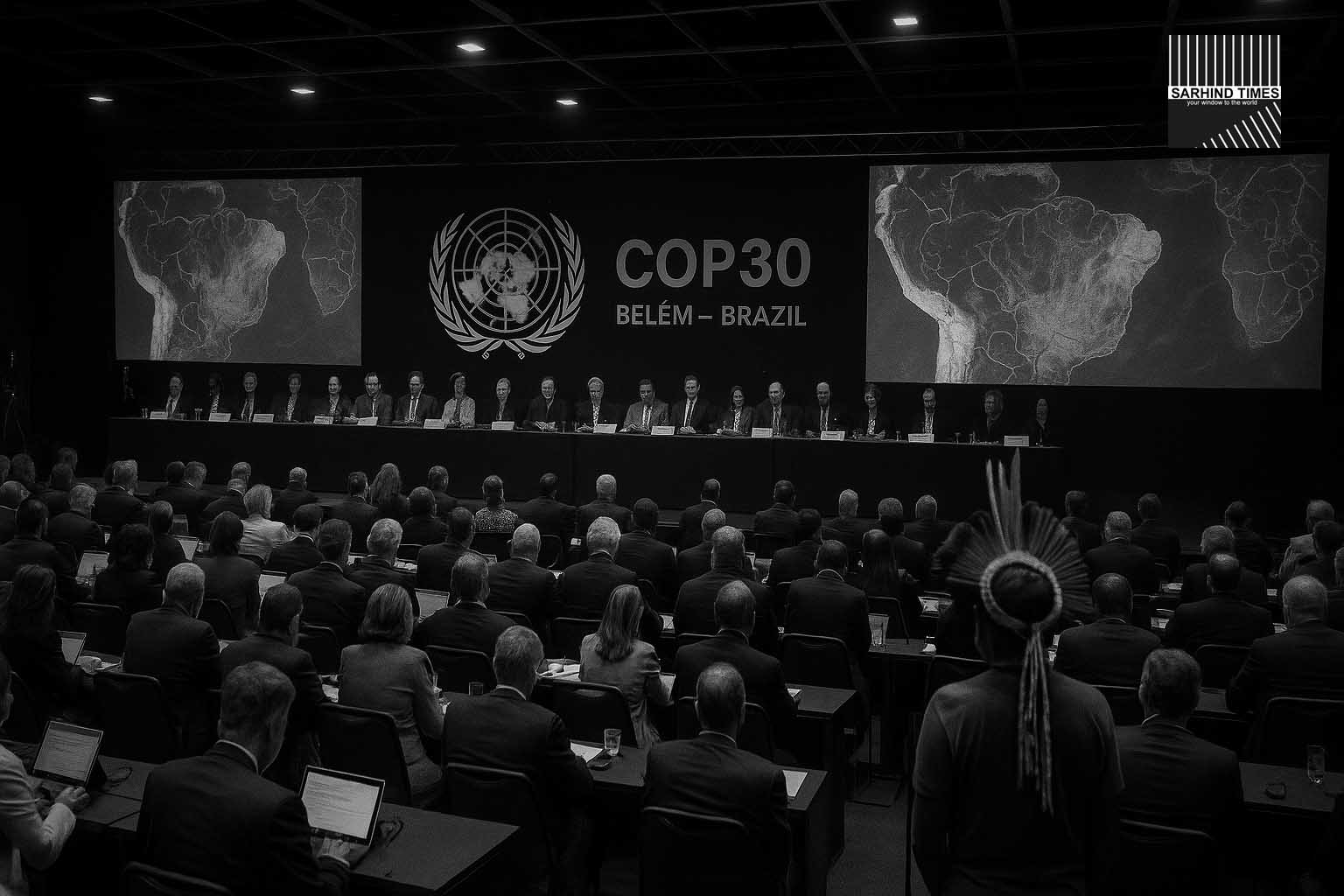
At COP30 in Brazil, the world hears a stark message: cooperation is fraying just as the planet reaches breaking point
Dateline: Belém, Brazil | 13 November 2025, Asia/Kolkata
Summary: Amid the rainforest setting of Belém in Brazil, delegates at COP30 received a blunt scientific assessment: global warming is accelerating, greenhouse gas levels are at record highs, and the 1.5 °C limit set by the Paris Agreement is likely to be breached. While new commitments were announced, including a forest-finance initiative and participation by non-state actors, cracks in international unity and weak attendance by major polluters underline how fragile the process has become.
A summit with urgency and tension
On 10 November 2025, COP30 formally opened in Belém, in the Brazilian Amazon, under a cloud of unusually stark warnings from scientists and climate-diplomats. The World Meteorological Organization’s “State of the Climate Update” released ahead of the summit showed that 2025 is on track to be the second or third warmest year in recorded history, and that greenhouse-gas concentrations and ocean heat-content have broken new records.
In his opening address, the António Guterres, Secretary-General of the United Nations, called the failure to keep within the 1.5 °C threshold a “moral failure and deadly negligence.” He warned that even temporary overshoots of that limit could trigger cascading effects such as tipping-points in ice-sheets, ecosystem collapse, mass displacement and geopolitical instability.
Against this scientific urgency, the summit atmosphere is strained. Key polluting nations have either reduced their engagement or delayed formal commitment announcements. While the Brazilian host sought to centre the rights of Indigenous peoples and the Amazon’s role in global climate regulation, observers note that the fundamental issue remains: world-leaders are not yet willing to align national interests, fossil-fuel transitions and the required finance flows.
Major themes emerging from the summit
The conference is shaped by several interconnected debates—among them climate justice, finance for forests and adaptation, technology-transfer, non-state actor participation, and the alignment (or mis-alignment) of national commitments with the science. Key themes include:
- Justice and equity: Countries from the Global South, particularly small island states and rainforest nations, are pressing developed countries to assume greater responsibility—not only for emissions but for historical inaction and the finance to compensate loss and damage.
- Forest and nature as carbon-sinks: Given the Amazon backdrop, forest preservation took centre stage. Brazil announced the intention to launch a “Tropical Forests Forever” facility aiming to mobilise roughly USD 125 billion for rainforest protection. (Though actual pledges remain partial.)
- Non-state actor momentum: The 2025 Yearbook of Global Climate Action noted that cities, regions, businesses and civil-society actors are increasingly active—95 % of nations report such stakeholder engagement in their national climate plans.
- Implementation gap: While many countries have submitted updated nationally-determined contributions (NDCs), the scale remains far off what the science demands. The WMO data show that the average global temperature is already ~1.4 °C above pre-industrial levels for January–August 2025, underscoring how little margin remains.
India’s role—and the spotlight
For India, the summit presents both opportunity and test. India remains one of the largest emitters globally while also being among the most vulnerable to climate-impacts: heat-waves, flooding, glacial melt in the Himalayas, coastal storms. The summit frames India’s next strategic moves: how to scale up renewable energy, reduce coal dependency, invest in adaptation and secure finance for loss & damage.
Indian delegates emphasised that “just transition” for vulnerable populations must feature in any outcome. They support the forest-finance focus but note that large climate investment flows must also prioritise water security, urban heat mitigation and the affordability of clean energy. Indian negotiators are expected to monitor how the Amazon initiative may align with broader global frameworks for forests and carbon-markets—and whether similar mechanisms can be applied to Indian ecosystems such as the Himalayas or Western Ghats.
Where progress is being made—and where hope flickers
The non-state actor momentum is one clear positive: private firms, cities and regions are committing to net-zero targets, low-carbon supply-chains and nature-based solutions. The Yearbook suggests that the Movement from mobilisation to implementation is underway.
The forest-finance breakthrough also hints at a shift: for the first time, major rainforest-rich nations are being positioned as recipients and stewards of large climate investment, rather than passive aid recipients. Brazil’s announcement is symbolic in that sense. But the warning lights remain red
Despite positive signals, several deep-rooted problems persist:
- Commitment insufficiency: Current national plans, if implemented, point to warming of about 2.3 °C rather than 1.5 °C—well above safe thresholds. :contentReference[oaicite:13]{index=13}
- Major-emitter ambivalence: Some leading carbon-emitting nations are either absent from key sessions or delaying formal strategy updates, which undermines the collective signal.
- Finance gap: While headline figures for forest-finance are laid out, the actual flow of funds, oversight mechanisms and deployment remain uncertain. Many adaptation-and-loss-&-damage funds are under-resourced.
- Implementation and timing: It is one thing to announce targets; quite another to turn them into policy and investment at scale. Implementation across sectors—energy, transport, industry, agriculture—lags. The climate system, however, is not patient.
What to watch in the coming months
Several milestones and risk-points could determine whether COP30 acts as launching pad or another delay:
- Submission of more ambitious NDCs by major-emitters with clear implementation plans and intermediate milestones.
- Activation and disbursement of the Tropical Forests Forever facility or equivalent large-scale rainforest investment mechanism.
- Strengthening of carbon-market rules and nature-based solutions frameworks including integrity of offsets and avoidance of double-counting.
- Scaling of adaptation finance and loss-&-damage mechanisms, especially for Global South nations.
- Technological innovation and deployment in emerging economies: scaling solar, wind, storage, green hydrogen, sustainable agriculture and circular economy models.
What this means for India and the world
For India, the stakes are high. Its future growth trajectory—dominated today by coal, heavy industry and fossil-fuel transport—must shift if it is to align with global pathways. At the same time, India can leverage advantages: large renewable-energy potential, demographic dividend, rising green-jobs and cost-competitiveness in solar and battery technology. Success will require policy coherence, infrastructure readiness, financial mobilisation and international collaboration.
Globally, COP30 may mark the moment when policymakers recognise that “business as usual” will no longer suffice. The active participation of cities, regions, business, Indigenous communities and civil society suggests the locus of change is shifting beyond national governments. But unless national governments raise ambition and match it with action, the window to stay below 1.5 °C may close. That in turn raises risk of irreversible changes: permafrost melt, reef collapse, megadroughts, climate-driven migration and global geopolitical disruption.
Conclusion
COP30 has opened at a moment of truth. The voices from Belém are blunt: the science demands far more, the time is short and the consensus is fragile. The Amazon backdrop is symbolically apt — as both a reservoir of climate-regulation and a reminder of what is at stake. For India and the rest of the world, the task is clear: accelerate action, deepen cooperation, mobilise resources at scale and translate ambition into tangible delivery.
Whether COP30 becomes a turning-point or a further delay will depend on the next few months of follow-through. But as one delegate put it: ‘We have no plan B — there is no spare planet’. The clock is ticking.


+ There are no comments
Add yours