
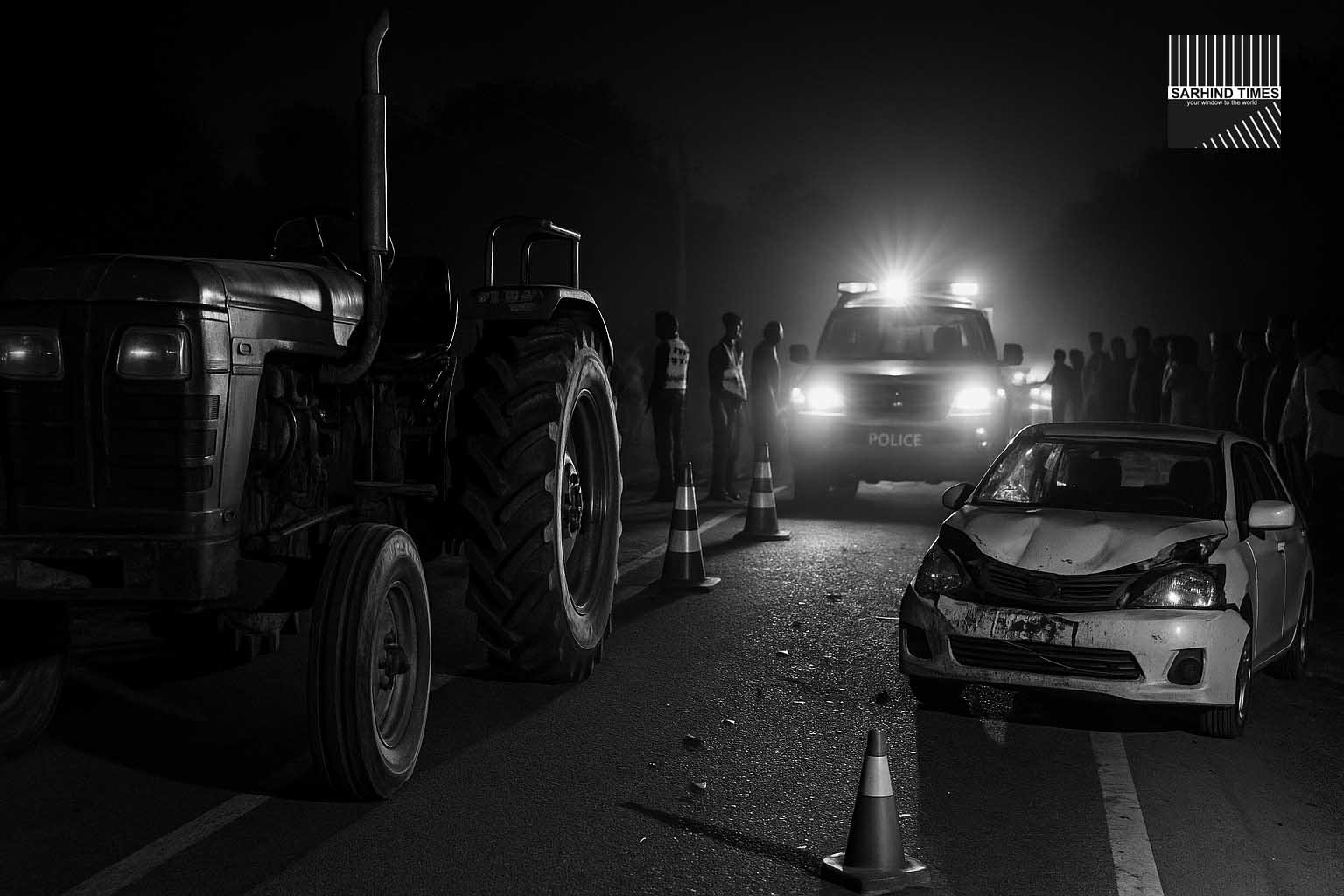
Evening ride turns fatal as heavy vehicle collides with motorbike; police call for stronger road-safety enforcement in NCR.
Dateline: Gurugram | November 12, 2025
Summary: Two teenage students lost their lives when the motorbike they were riding collided with a tractor along Sohna Road in Gurugram, Haryana. The 18-year-old and 15-year-old victims died instantly. The tractor driver was arrested after locals prevented his escape. The incident has reignited concerns about heavy-vehicle movement, road design and safety protocols in the rapidly expanding NCR suburb.
The accident and immediate response
On the evening of November 11, late in the day, two young students from Kanwarsika Village in Gurugram district set off on a motorbike towards Sohna, returning from their commitments. According to preliminary police reports, the motorbike was travelling along a regular commuting route when a tractor emerging from Rozka Village made a turn onto the same roadway. The tractor collided forcefully with the bike, causing immediate fatalities of the two riders—brothers or close friends identified as 18-year-old Sher Khan and 15-year-old Amir. Locals stopped the tractor driver from fleeing the scene while the police arrived, and the bodies were transported for post-mortem, with the investigation registered at the district police station.Witnesses say the impact threw the motorbike a considerable distance, shattering headlights and scattering debris across the road. Villagers and passers-by alerted the authorities; within minutes the police and ambulance reached the scene. Families were informed; the neighborhood is now in shock.
The driver was taken into custody under sections for negligent driving and causing death. The tractor was impounded and examined for license, weight-load and movement permit. Police are scanning CCTV footage and traffic-camera logs to determine speed, timing and trajectory of the collision.
Setting: Road context and regional risk
Sohna Road and the adjoining stretches of Gurugram are part of the National Capital Region’s rapid suburban expansion. The mix of residential clusters, commercial lanes, agricultural-link roads and industrial transport corridors creates a complex traffic mix. Heavy vehicles—tractors, dumpers, material-carrying trucks—share space with motorcycles, cars and pedestrians, often at odds in terms of speed, visibility and safety.
In this case, nighttime visibility, speed and mixed traffic appear to be major contributing factors. The stretch where the collision occurred is known to have sharp turn-entries from village lanes and inadequate lighting. Police sources point out that while heavy-vehicle movement is regulated, enforcement remains weak during peak evening hours when such collisions are more likely.
Victims and community impact
The victims’ families are reeling. Sher Khan and Amir were young students, living locally in Kanwarsika Village near the area of the accident. They were described by neighbours as friendly, diligent and engaged. Their sudden death has instilled grief and shock across the community. Local school authorities paused classes the following morning and arranged counselling for fellow students.
Villagers collected for a spontaneous vigil and urged authorities for improved lighting, road-signage and speed-barriers on the stretch. A community leader told reporters: “Two young lives gone in seconds—this must spark action, not just sympathy.” Indeed, the incident is touching nerves in a region that has seen multiple serious road accidents in recent times.
Police and enforcement response
Immediately after the collision, the Gurugram traffic police sealed the scene, recorded statements of witnesses, and filed FIRs against the tractor driver for negligent driving and causing death by negligence under relevant sections of the Bharatiya Nyaya Sanhita (BNS). They also impounded the tractor and started checking the permit and the driver’s credentials. The police spokesperson noted that “heavy-vehicles entering population zones after dark will face stricter checks going forward”.
In addition, traffic-camera logs and nearby CCTV footage are being analysed to track the path of the tractor and any earlier deviations. The local traffic control room has alerted regional units to step up night-patrolling and check vehicle permits on the stretch of Sohna Road and neighbouring sectors.
Road-safety challenges in Gurugram’s growth corridors
Gurugram is among India’s fastest-growing urban belts, with dense housing, numerous office parks, and heavy logistics and construction movement. Yet the infrastructure and traffic-management systems struggle to keep up. Road-safety experts highlight several recurring issues:
– Heavy-vehicle movement during evening and night hours, when visibility is low and driver fatigue is higher.
– Shared lanes without physical segregation for slow-moving tractors and fast-moving bikes/car traffic.
– Poor lighting and limited retro-reflective signage on key links connecting village roads to suburban sectors.
– Insufficient enforcement of load-limits, permits and driver-rest norms for agrarian or material-carrying vehicles.
– A gap in community-awareness about speed, vehicle mix and safe commuting practices for young riders, especially on bikes.
In recent weeks, a report had flagged that some roads in Gurugram have accident-rates double the national average for two-wheeler fatalities in evening hours. Though official figures are yet to be published, anecdotal evidence from police sources confirms upticks in multi-vehicle collisions, especially involving heavy-units such as dumpers or tractors.
This incident adds to a growing pattern—where student fatalities, suburban villagers and motor-bike commuters bear the brunt of mixed-traffic collision dynamics.
Broader implications: Youth safety and commuting risk
The victims being young students heightens the moral urgency and public visibility of the case. For many families, commuting on two-wheelers between dorms, tuition centres or evening classes is common; the accident underscores how vulnerable such riders are in suburban contexts.
The parents of two other local students told media that they have already begun reevaluating evening commutes and may switch to car-pools. School-association leaders are demanding better traffic-patrols during evening hours, speed-limit enforcement and designated safe-routes for students.
From a policy standpoint, the loss of young talent due to avoidable road-incidents raises questions about preventive frameworks, safe-commute programmes and targeted interventions for youth riders in high-growth zones. Family-income, education investment and future opportunity cost compound the social cost of such tragedies.
Infrastructure, design and regulatory lessons
The incident throws up key design and regulatory take-aways:
– Road-design near village-interfaces requires physical segregation or traffic-calming measures when heavy-vehicles emerge onto shared traffic corridors.
– Improved lighting and reflective-paint demarcation on rural-to-urban transition roads could reduce nighttime collisions.
– Regulations should restrict heavy-vehicle entry into mixed-traffic zones during peak evening hours unless designated access-lanes are provided.
– Traffic departments must enhance permit-monitoring systems for tractors and other heavy-units, particularly in suburban growth belts.
– Local police should coordinate with village-panchayat, resident welfare associations and schools to map high-risk routes and schedule “safe-commute” awareness drives for students and new riders.
State-response and policy momentum
Following public outcry, the Haryana state-transport department has indicated it will review permit-hours for agricultural-vehicles entering suburban roads, especially after sunset. Officials say they will explore launching “student-safe-route” schemes in fast-growing sectors like Gurugram, Manesar and Sohna.
Traffic-police leadership in Gurugram has scheduled an audit of major accident-prone links in the district for the current quarter, focusing on nighttime incidents involving two-wheelers and heavy-units. Funding for better lighting, CCTV-upgrades and emergency-response quick-alerts is expected to be pitched in the next state-budget cycle.
Nonetheless, sceptics warn that unless rule-enforcement is consistent and community-behaviour changes, the structural deficiencies will continue to result in fatal collisions—and high infrastructure investment alone won’t suffice without monitoring and maintenance.
What to watch going forward
Key indicators to monitor include:
– The number of heavy-vehicle collisions on Sohna Road and other suburban stretches over the next three months.
– Speed-variation and mixed traffic data for late-evening commute hours on major links in the Gurugram district.
– Implementation of restricted access hours or dedicated lanes for tractors/aggregates in residential suburb corridors.
– Roll-out of “student-commute-safe-route” programmes by district administration or school-associations.
– Families’ shift from two-wheeler commuting by young riders to safer alternatives—will uptake of school buses or car-pools increase significantly?
– Press releases from the state transport department or traffic police on revised permit-hours, enforcement blitzes or infrastructure upgrades tied to these accident-data.
Conclusion
The collision that claimed two young lives in Gurugram is tragic, preventable and emblematic of the risks in India’s fast-changing suburban corridors. As Gurugram continues to grow as a technology and residential hub, infrastructure and traffic systems must evolve in parallel. Two students heading home one evening should not become global-news subjects—and yet they are. Their deaths illuminate the urgent need for mixed-traffic regulation, night-commute safety frameworks and youth-focused road-policing. The residents of Gurugram, the families of the victims and authorities now face the challenge of ensuring the next generation of commuters rides home safely—not into tragedy.


+ There are no comments
Add yours