
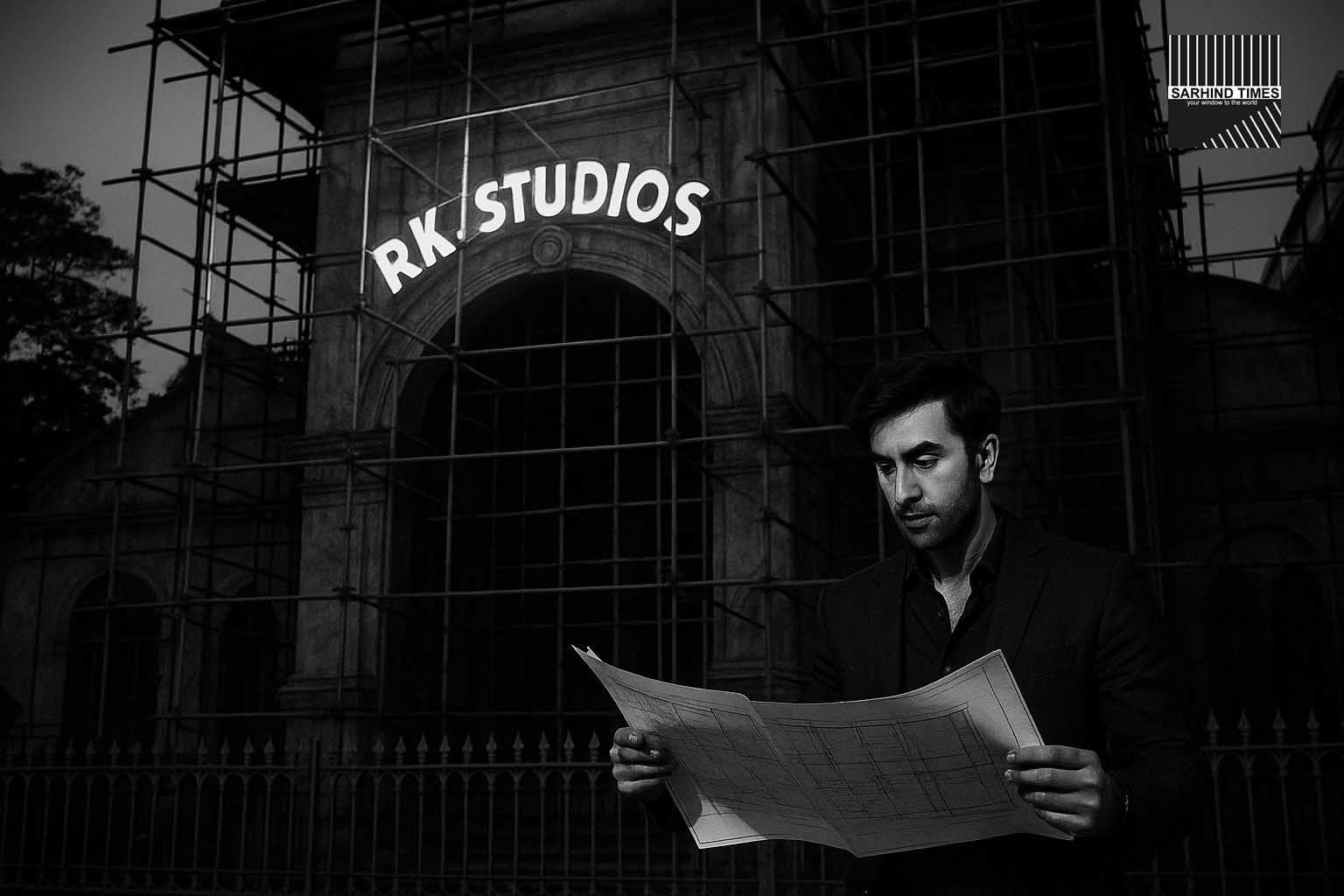
Bollywood major revives a legacy film studio while stepping into the director’s chair for the first time
Dateline: Mumbai | November 12, 2025
Summary: Bollywood star Ranbir Kapoor has announced the revival of the historic RK Studios—originally founded by his grandfather Raj Kapoor in 1948—and will simultaneously make his directorial debut under the studio’s re-launch banner. This move combines cinematic legacy with modern ambition, signalling a new phase for the Kapoor family and the broader Hindi film industry.
Reviving a cinematic landmark
The Kapoor family’s connection to RK Studios is personal and deep. Raj Kapoor established the studio in 1948, and over the decades it became a cradle for classics, housing some of the most iconic films in Bollywood history. The announcement made this week by Ranbir Kapoor signifies not just a business move but a cultural one: preserving film-heritage while adapting for contemporary production demands. According to the update, the studio campus will be modernised—old sound-stages refurbished, post-production suites upgraded, and a dedicated incubator for new-age filmmakers created.
“`
The heritage façade of RK Studios will remain intact, while the hinterland will be transformed into a multimedia hub. Renovation plans include large-format screens, motion-capture facilities, green-rooms turned into virtual-production spaces and a content-studio designed for streaming, games and immersive formats. Ranbir Kapoor, who announced the plan in a closed-door media interaction, said he wants to “honour the past while building the future of Indian cinema.”
Why this matters in the current film ecosystem
Several industry trends make this move especially relevant:
– First, the Hindi film industry is increasingly globalised—production values, international financing, streaming-driven formats and multi-language releases demand infrastructure that many legacy studios in India lack. A facility like the new RK Studios could plug that gap.
– Second, Bollywood is turning its attention to its own heritage—iconic names, legacy families and studios are re-evaluating their roles in modern content ecosystems. Reviving RK Studios is a potent symbol of this.
– Third, as digital formats gain scale (AVOD, streaming, short-form, immersive), the need for flexible studio-space and multi-modal tooling becomes clear. The announcement positions the studio as part of that shift.
– Finally, for a star like Ranbir Kapoor to step into direction signals creative ambition beyond acting-front. Bollywood often sees actors move into production and direction—but few anchor it in such a heritage project.
The project details and creative team
While full details are still emerging, me-dia reports and insiders suggest the following:
– Ranbir Kapoor will direct the first project to be produced under the revamped studio banner; sources say the film will feature Deepika Padukone in a leading role and will be co-written by Ayan Mukerji, known for his work on youthful, pan-Indian narratives.
– The studio campus renovation is estimated at an investment of around ₹150-200 crore, including land-acquisition, sound-stage upgrades, virtual production setup and residential-facility for creators.
– The production schedule for the debut film is slated to commence in mid-2026 after renovation completes, and the announcement has already stirred interest among streaming platforms for early rights.
– Ranbir Kapoor said in the press brief: “We’ll keep RK Studios’ heritage core but build an ecosystem where storytellers, tech, global crews and Indian talent come together.” He also emphasised mentoring young filmmakers through the in-house incubator.
Industry reaction and expectations
Reactions from Bollywood insiders and trade circles have ranged from cautious optimism to full endorsement. Some veteran producers highlight that the mega-studio format in India has been under-invested; many smaller studios struggle with cost, technology and talent attrition. The revival of RK Studios may help set a benchmark for large-scale content creation in India.
Several factors elevate expectations:
– Content-exports from India are rising. A modernised studio-facility in Mumbai may help capture more foreign-production work and retain Indian flagship projects domestically.
– The heritage-angle gives the revival cultural traction—fans and trade alike see this as bridging Bollywood’s golden era and current ambitions.
– The move may help Mumbai retain its status as India’s content-capital at a time Kolkata, Hyderabad, Chennai and others are aggressively building. A revived RK Studios sends a signal that Mumbai is not fading.
However, some caution that investing in physical infrastructure is only one part of the equation; building a sustainable ecosystem of creators, markets and distribution will matter. A few trade-execs note: “The headache for makers is still cost-overrun, schedule-overrun, talent shortage—not just studio shells.”
Heritage, commercial revival and creative pivot
RK Studios’ archive includes landmark films like *Awaara*, *Shree 420*, *Mera Naam Joker* and others that defined Bollywood for decades. The studio was synonymous with the Raj-Kapoor aesthetic—melodrama, music, character arcs, song-centres and star presence. In reviving the studio, the aim appears two-fold: preserve the memory of cinema’s past and create a platform for the future.
The strategic pivot is to re-position RK Studios as not just a facility for Hindi-films but as a cross-content hub: advertising, branded-entertainment, OTT originals, interactive gaming episodes and even non-fiction and experiential formats. The “studio-as-ecosystem” model is gaining traction globally; Bollywood seems to be catching up.
Potential benefits for content-creators and the no-code / automation space
For India’s broader content-creation ecosystem—including automation, translation, multi-lingual voice and avatar systems—the implications are significant:
– The presence of a modern campus with integrated post-production, multilingual dubbing facilities and motion-capture means content-creators have a local facility to deliver global-scale projects.
– With streaming platforms partnering with major studios for flagship originals, availability of high-quality studio space in Mumbai lowers barriers for creators. Developers building avatar-based video, multilingual voice, generative-AI workflows may plug into such infrastructure.
– The creative-industrial chain—from shooting, VFX, multilingual dubbing, avatar creation, and translation—benefits from consolidated studio estates. For platforms like your upcoming AI-content and exam-prep verticals, such physical anchors provide credibility, partnerships and access.
In short: the revival of a landmark studio is not just nostalgic—it may influence how content is built, scaled and distributed in India’s next decade.
Risks, execution challenges and what to watch
The overarching ambition faces execution risks:
– Renovation delays: Given the scale, completing a functional studio campus may take longer than projected or exceed cost estimates.
– Avatar/localisation demand mismatch: The studio may build for high-end production but change in consumer-behaviour or platform funding may divert focus.
– Competition: States like Telangana, Karnataka, Tamil Nadu already offer studios, incentives and talent—Mumbai will need to justify cost-differential by attracting global bookings.
– Streaming-budget pressure: As OTT models evolve, budgets are being constrained; studios need to fill with either international shoots or high-volume domestic content.
– Talent retention and labour: Indian crews often face schedule overload and cost escalation; the new studio must address this to stay competitive internationally.
Watch-points over the medium term include whether RK Studios books international projects, how its first run under the new banner performs at box-office and streaming, and whether a pipeline of new talent emerges via the incubator.
Timeline and next-steps
Key milestone dates:
– Late 2025: Final-planning, studio-renovation contracts signed, landmark announcement event.
– Mid-2026: Production begins for the first Ranbir-Kapoor-directed film under the new banner; studio becomes partially operational for external bookings.
– 2027-28: Full operationalisation of the campus, regular bookings from domestic and global content makers, launch of academy/incubator for new creatives.
The broader ambition is for RK Studios to operate at 80-90% capacity by 2028 and become a major hub for Indian original content, international co-productions and immersive formats.
Conclusion
The revival of RK Studios spearheaded by Ranbir Kapoor marries legacy and vision at a time when the Indian film industry is at a strategic inflection point. For Bollywood, it serves as a statement of intent: to not just remain rooted in history but to build scale, global-comfort and creative edge. For creators, entrepreneurs and innovators—especially in multilingual content, avatar-video or AI-based workflows—it opens a tangible anchor in Mumbai with upgraded infrastructure and industry-focus. Execution will matter, but if successful, this may mark one of the landmark studio-relaunches in Indian cinema and set a benchmark for how legacy film estates can transition into the streaming-era.



+ There are no comments
Add yours