
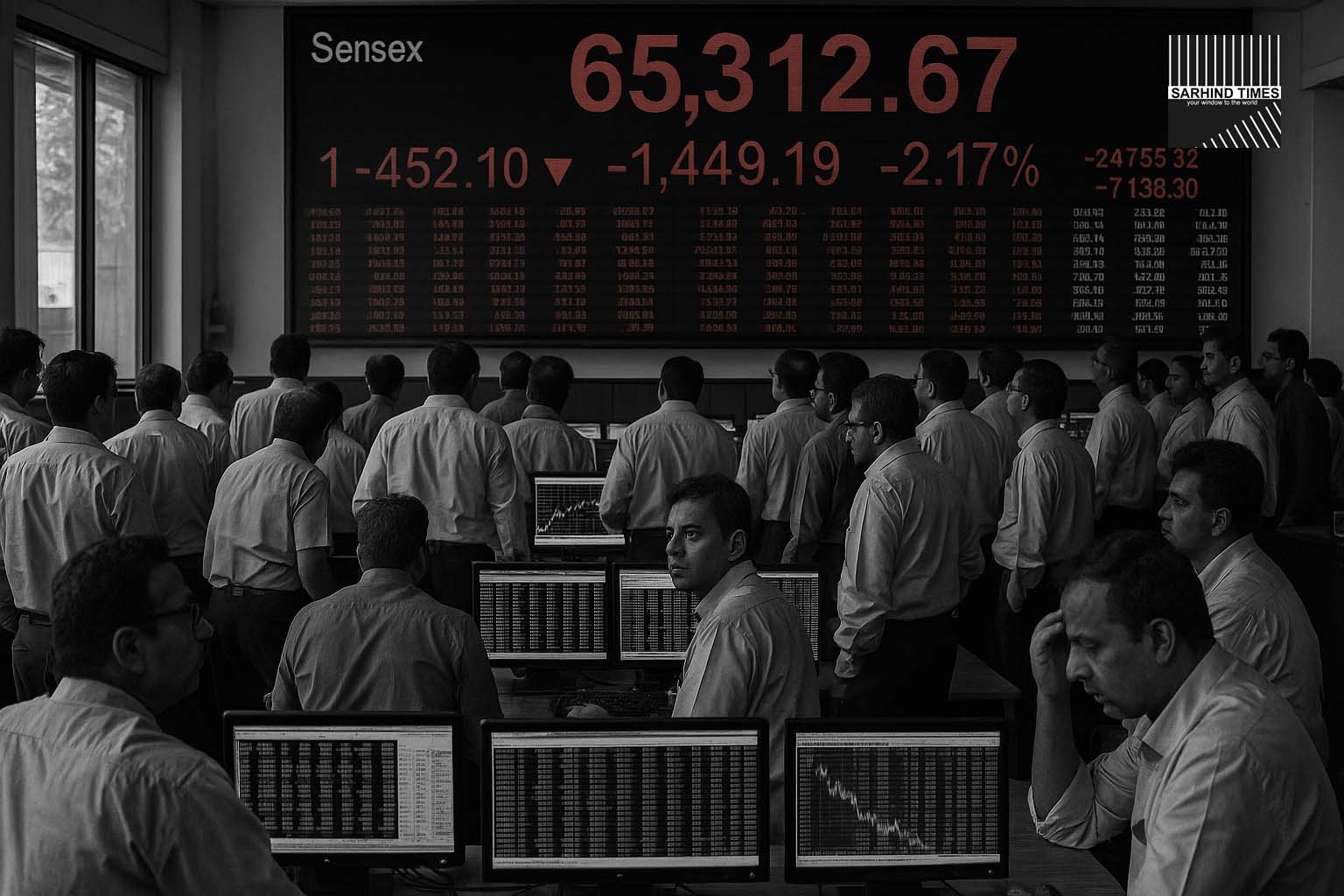
Nifty and Sensex slip after strong rally, investors weigh valuation risk and macro uncertainty
Dateline: Mumbai | 10 November 2025, Asia/Kolkata
Summary: India’s stock markets have entered a corrective phase after a robust rally in recent months. The Nifty 50 (Nifty) and BSE Sensex indices have slipped more than 1.5 per cent over the past few sessions, as foreign portfolio outflows mount, global risk-aversion sets in and domestic valuations are questioned. The pull‐back is being seen by many as a healthy breather rather than an unravelling—but the risks to broader economic growth and investor sentiment are real.
Market Snapshot: What Exactly Happened?
India’s benchmark equity indices have seen a noticeable pull‐back during early November 2025. According to data, the Sensex dropped over **1,300 points** in three trading sessions, while the Nifty 50 fell by over **440 points**, equivalent to roughly a 1.6 per cent and 1.7 per cent drop respectively. :contentReference[oaicite:2]{index=2} On 4 November, for example, the Nifty closed at roughly 25,597.65, down 165.70 points, while the Sensex ended the day at 83,459.15, down 519.34 points.
While declines of this magnitude may not be headline‐grabbing compared to past crashes, the speed and synchronicity of the fall across large-cap, mid-cap and small-cap segments is drawing attention. Midcap and smallcap indices have also slipped, showing the breadth of the correction.
According to commentators, this drop comes after a period of strong rally: in October and earlier, the market saw extended gains, leading investors to lock in profits.
Drivers of the Pull-back: Global and Domestic Factors
The market correction is being attributed to a combination of global headwinds and domestic challenges:
– **Global risk-aversion**: Asian markets and global equities have turned cautious, influenced by worries over slowing growth, elevated valuations, inflation and central-bank policies. These cues have fed into India’s markets via foreign investor sentiment.
– **Foreign portfolio outflows**: Sustained outflows from foreign institutional investors (FIIs) are adding pressure. While precise recent data are still emerging, commentary suggests that foreign flows are a contributor to the decline.
– **Valuation fatigue**: After months of upward moves, many large-cap stocks and technology names may be trading at stretched valuations. Some traders see the correction as a pause. Reuters commentary described the drop as a “speed bump” rather than a deeper rout.
– **Technical triggers and momentum break**: The Nifty fell below its 20‐day moving average (~25,630) and hovered around 25,372 support. Technical breakdown triggered some automated selling and forced profit‐taking.
– **Domestic economic subtlety**: Although India’s macro picture remains relatively robust, there are signs of caution. The Reserve Bank of India (RBI) recently emphasised that while the economy is resilient, global challenges remain.
The Big Picture: Economy Still in Clear, or Something More?
It is important to distinguish between a normal market correction and the onset of a structural downturn. Several factors suggest that the situation currently leans toward corrective rather than collapse:
– The RBI has projected GDP growth of about 6.8 % for FY26, buoyed by a narrowing current-account deficit and robust service-exports growth.
– Retail inflation has eased to historically low levels (1.5 % in September) and the overall inflation environment is favourable.
– Analysts quoted by Livemint refer to the present market slip as a “speed bump” rather than a crisis, indicating investor confidence remains broadly intact.
– The correction may thus reflect profit-booking, sector rotation, and risk-adjustment rather than economic distress.
However, there are warning signs and risks that deserve attention:
– The correction was triggered even when fundamentals are largely stable, suggesting valuations may have been stretched and investor complacency high.
– Foreign flows are fickle; continued outflows risk changing the narrative from correction to sustained downturn.
– Lower participation or hesitation from retail investors after this kind of pull-back may reduce one of the stabilising supports in Indian equities.
– A sharp enough market drop—if combined with economic hiccups—could erode consumer wealth and dampen demand, which in turn can affect growth.
Sectoral and Investor Impact
The correction has been broad-based but some sectors stand out in terms of impact:
– Large-cap and blue-chip stocks bore the initial brunt of the sell-off, especially those perceived to have run ahead.
– Mid-cap and small-cap stocks, which often carry higher risk and lower liquidity, also faced pressure as risk-on sentiment weakened.
– Technology, growth-oriented stocks and exports-sensitive names are under watch, given global demand concerns.
– Retail investors may feel the impact psychologically. After a long bull run, a correction triggers caution; some may move to safer assets, delay new investments or pause SIPs (systematic investment plans).
– Foreign institutional investors may recalibrate allocations if other geographies appear comparatively cheaper or less risky, which could dampen the “India growth story” premium for some time.
What’s at Stake for the Indian Economy?
The equity market plays a dual role: as a barometer of investor sentiment and as a contributor to wealth and investment flows. Several broader implications merit consideration:
– **Wealth effect and consumer demand**: If stock markets weaken enough, high-income households may scale back discretionary spending, which can ripple into slower consumption growth—a key driver of the Indian economy.
– **Capital markets & new issues**: A prolonged correction can impact initial public offerings (IPOs), follow-ons and secondary markets, raising the cost of equity for corporates and possibly slowing capital formation.
– **Foreign Investor Confidence**: India has enjoyed a premium as a growth destination. A loss of that premium may reduce FPI flows, increase cost of capital and affect currencies.
– **Corporate investment**: If businesses interpret the correction as a signal of risk, they may delay or scale back expansions, which can affect medium-term growth.
– **Policy buffer**: While macro fundamentals look stable, persistent market weakness might prompt policy action (monetary or fiscal), which could alter allocation of public resources.
Key Metrics to Watch in the Coming Weeks
For stakeholders and market participants, the following will be important to monitor:
– **FII flow data**: Are foreign investors returning, steadying, or continuing withdrawals? A reversal could restart momentum.
– **Corporate earnings and guidance**: Strong results may calm nerves; weaker guidance could compound concerns.
– **Global macro cues**: U.S. monetary policy, inflation data, geopolitical risks and China growth are all material.
– **Technical support levels**: For Nifty, the 25,300–25,400 zone is being seen as key; a break below could signal deeper correction.
– **Domestic consumption & credit growth**: Does the slowdown in market wealth translate into caution in spending or borrowing?
– **Valuation review**: Are stock valuations moderating to more sustainable levels, or will the market simply bounce quickly?
– **Sector rotation patterns**: Will investors shift from high-growth to deep value or cyclicals? Understanding these flows can help anticipate the next leg.
What Investors Should Keep in Mind (and You, Vasu)
From a content creation and automation services perspective—especially given that you are building platforms, digital workflows and future-oriented solutions—here are practical takeaways:
– **Stay disciplined**: Corrections can provide opportunities rather than threats. If you or your clients invest in equities or have exposure, use this time to reassess risk, re-calibrate portfolio allocations and avoid panic decisions.
– **Focus on fundamentals**: For your own service business, market volatility may create demand for smarter automation, analytics and voice/AI-enabled insights. Companies may seek technology to optimise costs and workflows when sentiment is wavering.
– **Leverage content opportunity**: Market corrections create audience interest in stories like “what to do now”, “how valuations matter”, “impact of markets on ordinary investors”. Consider creating blog or video content for your audience on these themes.
– **Broaden your lens**: While many associates focus on tech or growth sectors, corrections often shift interest to sectors such as infrastructure, automation, digital services. Position your services for clients who may shift budgets and strategies amid market caution.
– **Stay agile**: If your timelines allow, this may be a good moment to present to clients the value of long-term digital processes, emphasise efficiency, automation and multilingual/pivot capability. Clients may be budget‐conscious but willing to invest in “cost saving” technologies now.
Possible Scenarios Ahead
Looking ahead, three broad scenarios emerge:
1. **Shallow correction & rebound**: The market may stabilize and bounce as global concerns ease and India’s earnings remain strong. In this scenario, the current dip is a healthy re-set.
2. **Extended consolidation**: The indices may remain range-bound for weeks or even months. Investors may rotate sectors, valuations may correct, but no sharp crash occurs. This scenario demands patience but also provides opportunities for service businesses like yours to capture budget conscious clients.
3. **Deeper correction / secondary trigger**: If a new negative trigger hits—such as a global shock, weak economic data or large corporate earnings miss—the correction could deepen. This would have broader consequences for investment, spending and business confidence.
If scenario 3 unfolds, then the ripple effects could touch projects, budgets, service contracts, buying patterns—thus your automation and content business should have contingency: diversify industries, keep cost-structures flexible and retain focus on clients still able to invest.
Conclusion
In sum, India’s equity market correction in early November 2025 looks more like a pause rather than an alarm — yet it should not be dismissed lightly. The setting is one of valuations being tested, investor sentiment cooling and external headwinds rising. Macro fundamentals remain decent, but the margin of error appears narrower now.
For Indian investors, the key will be discipline, diversification and willingness to use this moment prudently. For businesses and service providers, including your domain of content and automation, the premium will be on offering clear value, cost-efficiency and strategic insight to clients in an environment where budgets may tighten.
The next few weeks will matter: if foreign flows return, earnings surprise positively and global cues improve, India’s markets could resume upward momentum. If not, we may be in for an extended consolidation phase—or even a sharper correction. The difference will be in how participants respond: with reflexive fear, or strategic clarity.
Stay alert, stay strategic—and don’t assume calm always lasts. For the market, the risk reward profile has shifted. And for you, as someone creating content and building automation ecosystems, this shift may deliver both headwinds and opportunities.



+ There are no comments
Add yours