
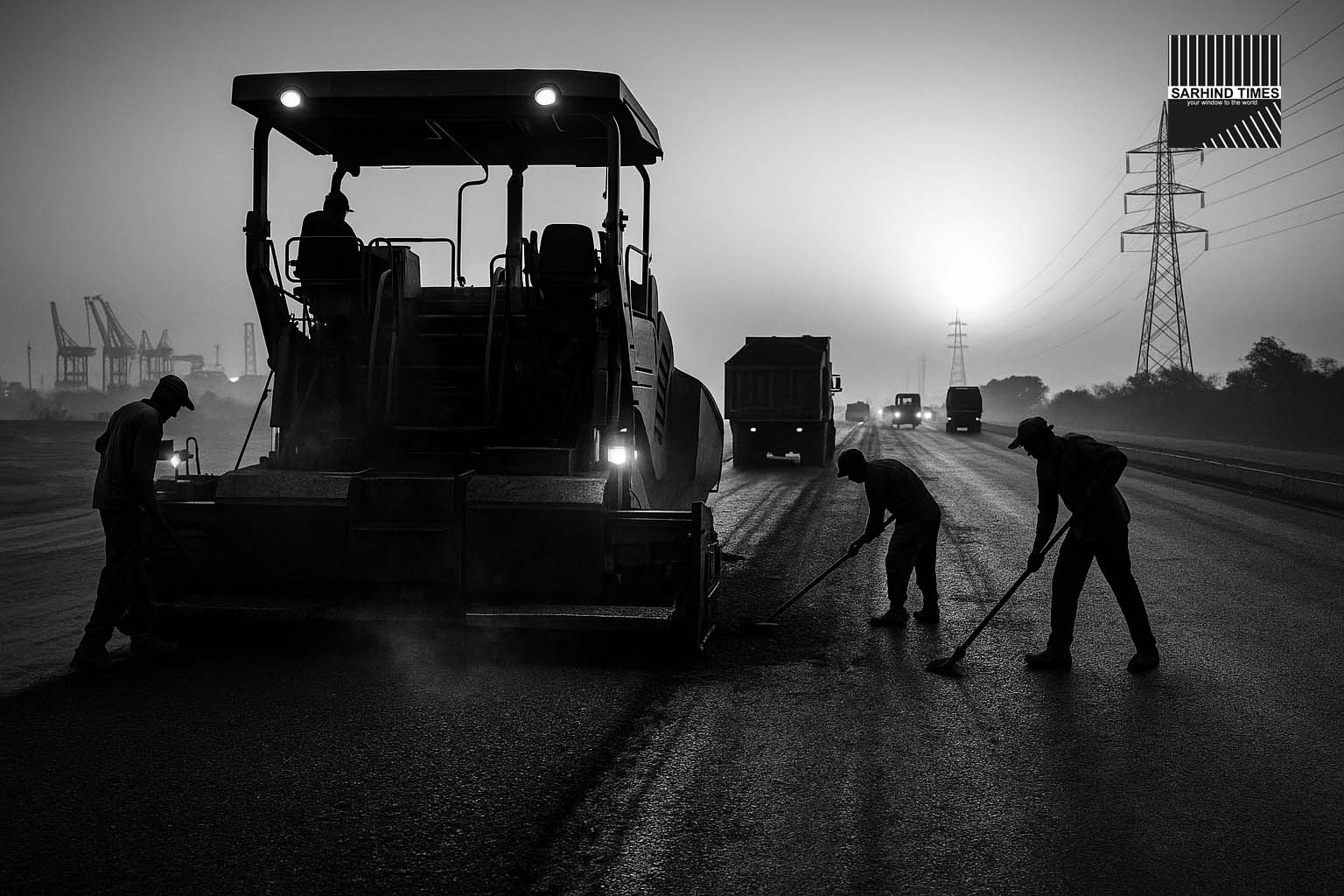
With fresh targets, PPP support and digital-highway roll-out, the transport infrastructure sector is set for a strategic reset amidst execution and funding pressures
Dateline: New Delhi | 10 November 2025, Asia/Kolkata
Summary: India’s infrastructure agenda is undergoing a recalibration. The National Highways Authority of India (NHAI) and the central government have set an ambitious target of 10,000 km of national highways for FY26, ramped up their focus on “digital highways” and announced new incentives to entice private investment into highway PPPs. While these moves reflect a sharpened intent to scale connectivity and logistics, analysts warn that land-acquisition delays, contract awards sagging to a five-year low and fiscal pressures pose significant headwinds.
Ambitious Targets, But Execution Risks Remain
The Indian government has set a target of constructing **10,000 km of national highways in FY26**, signalling a strong push ahead. Recent commentary suggests the target stems from a desire to make good on earlier infrastructure commitments and bring the momentum back on track.
However, industry data show that award of new contracts in road construction is likely to fall to a **five-year low of 25-26 km per day** in 2025-26, suggesting a serious deceleration in execution even as targets are raised. Delays in land acquisition, forest & environment clearance, and detailed project-report processing have been cited as root causes.
The contrasting signals — very high target versus slow award pace — underline the execution challenge ahead. For states, contractors and investors the message is clear: bold ambition has to be matched by faster decision-making, cleaning up of bottlenecks, and stronger governance.
Private Capital, PPPs and the “Digital Highway” Imperative
Acknowledging the need for private participation, the government is preparing sweeping changes to revive private investment into highway-PPP projects. Among the expected changes are additional financial support (viability-gap funding or upfront cost assistance) for private highway builders, adjustments to annuity/hybrid models, and better risk-sharing mechanisms between government and developers.
Simultaneously the NHAI has flagged a new thrust: developing **10,000 km of “digital highways”** by 2025. These corridors will integrate fibre-optic cables, telecom towers, electric-vehicle charging points and sensor networks along major trunk routes, effectively turning highways into smart logistics and data infrastructure.
For the logistics ecosystem, this signals an evolution: highways are no longer mere asphalt paths but nodes of connectivity — data, mobility, commerce — and that opens new avenues for tech-services, asset-monetisation and platform-based business models.
For service providers (especially in the digital/automation domain), the message is that transport infra offers not just civil-construction opportunity but end-to-end workflows: sensor management, data pipelines, no-code automation of logistics flows, voice/AI for remote monitoring — an area aligned with your automation and content business.
Regional Impacts and States’ Role (Including Your Focus)
The infrastructure effort is pan-India but state governments remain critical execution partners. Many major national-expressways traverse multiple states, and states must ensure right-of-way clearances, inter-departmental coordination and enforcement of contract timelines. Broadly, the push offers strong tailwinds for states with high growth corridors.
In the case of Haryana and nearby NCR-zones (including Gurugram), the infrastructure push matters for you strategically. Even though your home location (Gurugram, Haryana) is not the primary focus of the highway-build (which emphasises interior / green-field corridors), the logistics, data-corridor and connectivity implications ripple into the NCR ecosystem. Corporate hubs will demand better inter-state connectivity, faster goods movement, rural-urban linkages — all of which support digital/automation services tied to infrastructure workflows.
For example: rent-logistics, campus expansion, automation of facility management, smart-city systems — these ancillary services become relevant when infrastructure momentum rises. As a business offering automation, content and voice/AI workflows, you may find demand from contractors, state IT departments, asset-management firms, and logistics players in the region.
Major Announcements and Projects Worth Watching
Several recent approvals illustrate the scale of ambition:
– The Union Cabinet approved multiple highways and green-field corridors earlier in 2025, including a 120.10 km four-lane corridor in Bihar (~₹3,712 crore) and other access-controlled highways across states.
– While not exclusively linked to highways, states like Maharashtra approved a Rs. 931 crore “Super Communication Expressway” across 94.2 km connecting Bhandara-Gadchiroli, showing that regional link-ups continue apace.
– The NHAI’s digital-highway plan signals a strategic shift — integrating telecom, EV-charging, sensors within the highway matrix.
For your vantage, each of these represents potential upstream and downstream opportunities: content and automation workflows for project monitoring, documentation, stakeholder communications, translation/localisation across multi-lingual states, data-dashboards, and avatar-based training for site workers.
Bottlenecks: Land, Clearances, Funding & Mobilisation
Despite the promise, execution bottlenecks remain significant:
– **Land-acquisition and environmental clearances**: Several projects face delays because right-of-way (RoW) is not secured when contracts are awarded. The ministry has directed that 90 % of RoW and statutory clearances must be in place before awarding new projects — a move meant to improve award-to-completion ratios but which reduces pipeline in the near term.
– **Funding and cost escalation**: Rising input costs (steel, cement, fuel) and longer gestation for revenue streams (annuity payments, toll + availability models) raise concerns for private investors. Moreover, fiscal constraints at the state and central levels limit upfront investment.
– **Contract awards lagging**: As reported by infrastructure analysts, the award pace in 2025-26 may drop to ~9,000-9,500 km or lower, implying that meeting the 10,000 km target will require acceleration.
– **Quality and maintenance risk**: Some completed highways in recent past have shown early distress (potholes, cracking) due to budget constraints and maintenance deficits — a reminder that build is step one, sustain is another.
These challenges imply that while the national narrative is strong, not all projects will move at the same pace — some will be delayed, some may be renegotiated, some may go into hold mode. For you, this means that picking partner states or sectors with strong execution track-records (for example logistics hubs, smart-city linkages) may yield earlier business flows.
What This Means for the Economy and Logistics Ecosystem
The infrastructure push carries broader economic implications:
– **Logistics efficiency**: High-quality highways with digital corridors help reduce transit time, fuel costs, inventory costs and improve turnover for goods. That aids India’s competitiveness in manufacturing and exports.
– **Industrial and regional development**: Better roads attract factories, warehouses, distribution centres along the corridor — leading to job creation, regional investment and urbanisation.
– **Urban-rural connectivity**: By linking smaller cities and towns with national highways, mobility of labour, goods and services improves — supporting inclusive growth.
– **Technology and service jobs**: As highways become “smart”, demand for data analytics, IoT, automation, sensors, monitoring platforms and software increases. This aligns with India’s structural move toward technology-enabled infrastructure.
– **Fiscal ripple effects**: Infrastructure creates construction jobs, demand for materials, equipment and services. The growth stimulus from highways may help offset headwinds in other sectors. But if slowed, the drag could weigh on growth.
From a content/automation-services provider standpoint, this transition offers a context to position high-value solutions: dashboards for contractors, multilingual voice training for road-workers, content for safety compliance, automation of logistics chain milestones, avatar-led worker induction modules — all of which map neatly into your starting automation ecosystem.
Strategic Advice for Service-Providers (Especially You)
Given your focus on content, automation, multilingual voice/AI workflows, and building platforms (eg your SyncVoice AI+ project, automation via n8n) here are concrete moves you should consider in the infrastructure context:
– **Target vertical**: Infrastructure projects (especially highways) may need digital-content services for worker training, safety manuals, multilingual onboarding (regional labourers across states), compliance checklists, and voice-based instruction modules. Position your platform for that.
– **Automation workflow**: Many contractors lack streamlined process flows for project-monitoring (milestone tracking, photo evidence, defect logging, compliance sign-offs). Your n8n-based workflow automation can bring value.
– **Multilingual voice/AI**: Infrastructure sites cover labour from multiple states; multilingual voice-tools (Hindi, Punjabi, Bengali, Tamil, Telugu) can help instructions, safety training and alerts. This aligns with your avatar/voice pipeline.
– **Data dashboards**: For logistics/contractors, digital highways bring sensor data and real-time monitoring. Develop dashboards (Google Sheets/Airtable + automation flows) to capture, visualise and control such data — you can build a reference product.
– **Client acquisition**: Start targeting state infrastructure departments, highway contractors, logistics-hub developers in growth corridors (e.g., NCR, Pune-Mumbai, Bengaluru-Hyderabad). Offer pilot services aligned to your strengths.
– **Budget timing**: Infrastructure budgets often follow financial years and government procurement cycles. With many projects notified now, the next 6-12 months may see RFPs, thus positioning early is crucial.
In short — this infrastructure moment opens a business window for you, but only if you align services, build modular offers, and act early.
What to Monitor Going Ahead
To keep a finger on the pulse, watch for:
– Monthly road/expressway contract-award volumes (km awarded), to assess whether target of 10,000 km is viable.
– Updates on “digital highways” roll-out: how many km of fibre, EV-charging, sensor-networks are installed, partner lists and tender documents.
– State-level procurement announcements for smart infrastructure (NCR, Maharashtra, Telangana) and ancillary services like monitoring, survey, drone-inspection, multilingual training modules.
– Private investor/contractor sentiment: Are PPP models being revived? Are private firms bidding on projects or shying away? Funding alert-signals matter.
– Quality/maintenance issues: incidents of early distress on new highways will impact public-perception, contractor credibility and future awards.
These indicators will help you anticipate project-flows, build content/service campaigns, and allocate your effort and resources accordingly.
Conclusion
India’s infrastructure agenda is neither stalled nor smooth—but it is repositioning. The combination of high targets, private-investment incentives and the concept of digital highways speaks to a more modern connectivity paradigm. Execution remains the key bottleneck. For companies, service-providers and entrepreneurs like you, the moment offers a strategic inflection: infrastructure is becoming smarter, data-driven, language-diverse and workflow-intensive. If you can capture the intersection of automation, multilingual content and infrastructure-services early, you stand to ride that wave.
The road ahead is long — literally and figuratively. What matters is not only the km of highway built but the platforms, processes and ecosystems that enliven them. When highways become data-corridors, when worker-training becomes voice-enabled, when logistics becomes real-time and visual, the business opportunities multiply. Strap in, build your modules, and lean into the infrastructure turn.



+ There are no comments
Add yours