
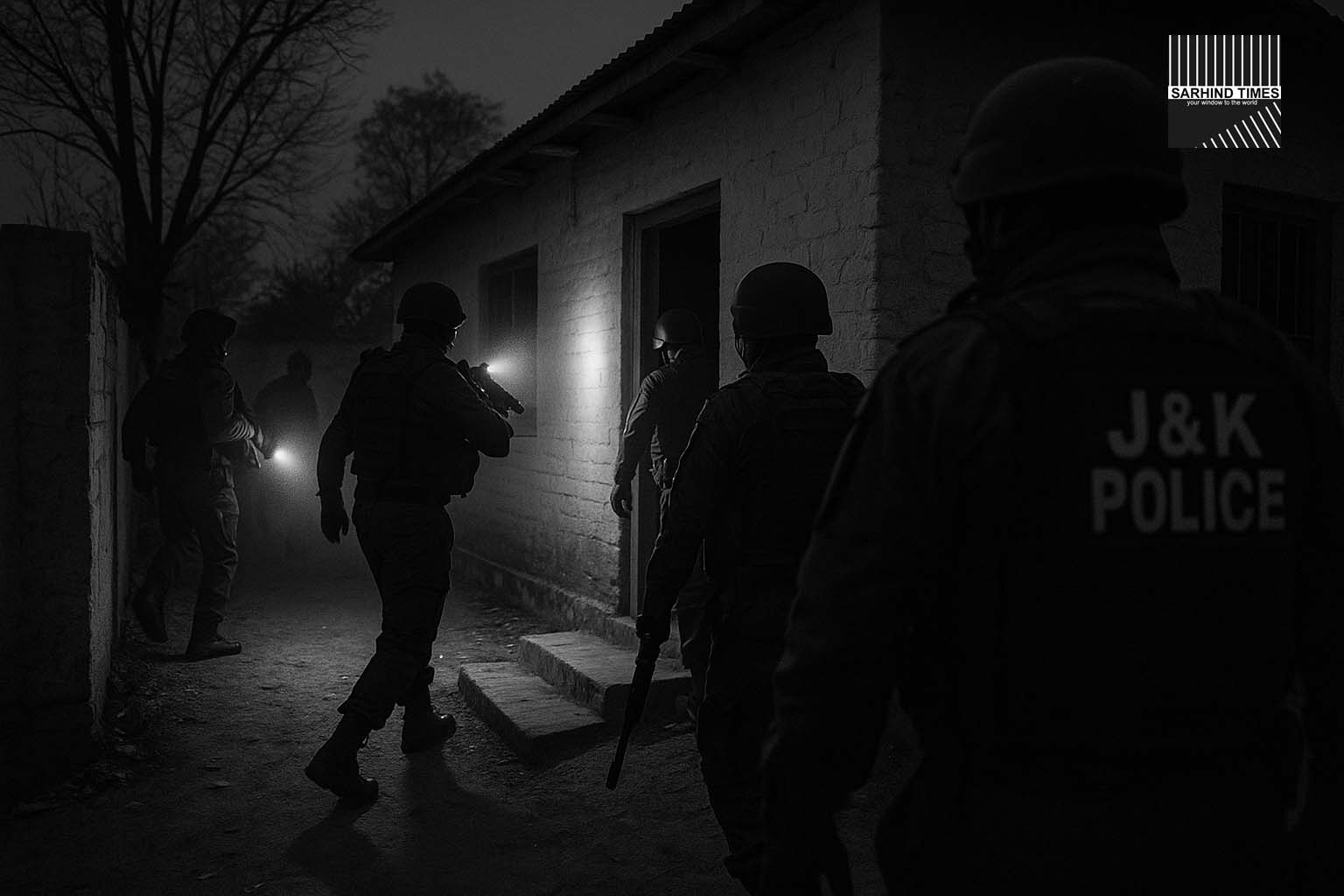
Following major enforcement actions, authorities reveal deepening concerns over narco-terror nexus and recruitment networks in J&K
Dateline: Jammu | 11 November 2025, Asia/Kolkata
Summary: The Enforcement Directorate launched multi-location raids in the Union Territory of Jammu & Kashmir, including the residence of a former minister in Kathua, over a suspected narcotics-terror funding network. Nearly simultaneously, a medical doctor from Anantnag district was arrested in Uttar Pradesh for allegedly distributing propaganda posters of the banned Jaish‑e‑Mohammed in Srinagar. Together, these actions highlight the widening surveillance of crime-terror convergence and the growing intensity of law-enforcement efforts in the region.
ED Raids Signal Sharper Focus on Narco-Terror Funding
On 7 November, the ED carried out coordinated raids at six locations in Jammu & Kashmir, including the home of former minister Jatinder Singh (Babu Singh) in Kathua, as part of an investigation into alleged funds-flows between narcotics trafficking and terror groups. According to police briefings, the probe examines complex money-trail patterns — from drug-smuggling across the porous border regions to funding of militant outfits operating in the Valley.
Kathua has come under focus recently due to its border-adjacent location and the presence of smuggling routes along the India-Pakistan International Border (IB). Intelligence agencies say the convergence of narcotics, money-laundering and terror recruitment is increasingly prevalent in J&K’s fringe zones. The raids suggest that enforcement agencies believe they have identified a network operating on multiple fronts: drug-trafficking, terror-financing and property holdings converted via illicit funds.
According to officials, the investigation is still in early phase: search of multiple properties, seizure of digital devices, banking records, and real-estate documents are underway. The involvement (or alleged involvement) of a former minister sends a signal of intent: authorities are prepared to cross political boundaries and senior-level names to tackle the evolving threat.
Analysts say the case marks a shift in J&K enforcement: from purely counter-militancy operations (encounters and patrols) toward financial-intelligence, asset-tracking and prosecution of networks that link narcotics, money-laundering, and terror. The success of this model could reshape how crime is addressed in the region.
Doctor’s Arrest Rattles Recruitment Warnings
Just two days later, J&K Police arrested a medical doctor from Anantnag, who had been working at a hospital in Saharanpur (UP). The doctor is accused of distributing posters in Srinagar calling for support to Jaish-e-Mohammed, a banned terrorist organisation. The arrest is significant in multiple ways:
– It highlights the reach of terror-recruitment and propaganda activities into professional classes and into inter-state networks (UP–J&K).
– It underscores that while physical militant activity remains, the ideological and recruitment front remains active and evolving.
– It reflects growing cooperation between state police forces (J&K and UP) to monitor cross-border/ inter-state terror links and arrest individuals engaged in support roles rather than only combat roles.
J&K’s security apparatus sees this as part of a broader pattern: professional cover, mobility between states, use of medical or other service-profiles to facilitate logistics or propaganda. The fact that the arrest was made in Uttar Pradesh but relates to posters in Srinagar emphasises the fluidity of these networks.
Implications for Security Strategy in J&K
Together, the two developments illustrate that the threat spectrum in J&K is broadening. Key implications include:
– **Narco-terror linkage**: Historically, militant financing relied on traditional funding sources. The growing use of narcotics trade as a revenue stream suggests a hybrid model where border-smuggling, logistical channels and militant funding may merge. This complicates detection and enforcement, as networks may switch between legal and illegal fronts.
– **Financial enforcement rise**: The ED’s raid signals that law-enforcement is moving upstream — tracking assets, laundering, real-estate holdings, banking flows — rather than relying only on arresting foot-soldiers. This approach may shift the risk/reward calculations for militant outfits and criminal networks.
– **Professional cover intelligence**: The doctor’s arrest shows that recruitment and propaganda efforts are not restricted to combat terrains. Monitoring of professions, inter-state mobility and propaganda channels is becoming central to the broader counter-terror strategy.
– **Border-fringe risk zones**: Areas such as Kathua, Samba, Rajouri which adjoin borders and routes are likely to remain high-intensity enforcement zones. Smuggling, illicit land use, migrant networks and property conversions all come under scrutiny. For locals, developers and businesses in these zones, the regulatory and security risk is elevated.
Policy analysts note that if India successfully disrupts the narco-terror funding model, it could reduce the operational autonomy of militant groups in J&K and improve long-term stability. But achieving this requires sustained investigations, inter-agency coordination, legal follow-through and regional cooperation.
Challenges Ahead: Legal, Intelligence and Implementation Hurdles
Despite the momentum, several hurdles remain:
– **Evidence building**: Linking narcotics trade to terror-finance demands forensic tracking of money flows, ring-ledger analysis, international cooperation and time-consuming investigations which risk being derailed by procedural delays or judicial scrutiny.
– **Political and local backlash**: Where enforcement touches political figures or elite networks, claims of misuse of power or political vendetta may surface. Ensuring procedural fairness and transparent investigation will be critical to maintain legitimacy and public trust.
– **Inter-state coordination**: As the doctor’s case shows, networks span states (UP to J&K). Seamless cooperation across jurisdictions, integration of databases, shared intelligence frameworks and unified action protocols are necessary but still developing.
– **Asset recovery & prosecution**: Arrests alone won’t suffice. Success depends on asset-seizure, conviction, dismantling of network nodes and long-term disruption. In regional cases where assets may be hidden or repatriated, legal loopholes can blunt the impact.
– **Continuous vigilance vs episodic action**: Enforcement spikes are good for signalling, but without constant monitoring, networks can regenerate. Institutionalising detection, tracking, financial-intelligence units and local community engagement is essential.
For J&K’s civil society and economic stakeholders, the message is mixed: while improved security and rule-of-law are positive, business owners, property-developers, educational institutions and service-providers must be aware of heightened regulatory scrutiny, especially around property ownership, funds movement, rentals, cross-border workers, and unexplained cash flows.
Regional Economic and Social Impact**
The enforcement activity may have broader repercussions:
– **Tourism growth vs security perception**: Kashmir has been pushing tourism revival; high-profile raids or terror-financing breaks can reassure potential tourists and investors that security is tightening. But if publicised too heavily or without context, they may amplify perception of risk.
– **Property and real-estate market caution**: In border-adjacent zones such as Kathua, Samba, Udhampur where illicit property conversions or drug-money laundering may have occurred, lenders and investors may revisit risk assessments. Title verification, origin of funds and developer background may become more rigorous.
– **Service-sector opportunities**: Given increased focus on artificial-intelligence, financial-intelligence, surveillance systems and monitoring logistics, local IT/automation firms may find demand for digital-forensics, workflow automation and voice/AI platforms. If you operate in content/automation space, this is a relevant signal.
– **Social trust and community policing**: As enforcement intensifies, community cooperation becomes critical—anonymous tip-lines, local informant engagement, and rehabilitative initiatives for youth at risk will be important. If enforcement is perceived as heavy-handed or discriminatory, local alienation can rise.
It is therefore vital for local stakeholders—businesses, institutions and residents—to stay informed, adopt enhanced compliance (money-trail tracking, rental agreements, asset-transparency) and engage proactively with security/administration as the enforcement environment evolves.
What to Monitor Going Forward**
Several signals will indicate how deeply this narco-terror angle is addressed:
– Progress in the ED investigation: arrests, asset-seizures, charge-sheets filed and eventual convictions. Are senior-level figures behind the network being grounded?
– Changes in funding patterns of militant groups in J&K: public disclosures, intelligence leaks, white-paper summaries. If narcotics financing is hit, shifts in tactics may appear.
– Cross-state data-sharing frameworks: whether J&K coordinates seamlessly with UP, Punjab, Haryana, Delhi in tracking professional recruitment, rental markets, suspicious funds.
– Property-market indicators in Kathua/Samba/Border zones: Are titles being challenged more, are banks tightening lending, are rental segments being audited?
– Public-security metrics: incidence of terror attacks, drug-seizure volume trends, links of narcotics arrests with militancy-records. If operational networks are weakened, attacks may fall or shift in pattern.
For you—working in content creation and automation—this means opportunities to build:
– Process-automation tools for property title verification, transaction tracking, rental-agreement monitoring.
– Voice/AI-modules for compliance training of SMEs in J&K and border districts, screening funds, regulatory awareness.
– Content modules for financial-intelligence awareness: “How to ensure your money-trail is clean in J&K border-zone business”, “Tenant/land-owner risk checklists”, “Professional hiring due-diligence in J&K”.
The enforcement surge sets a backdrop; your value will come from integrating that into services and workflows for clients in the region.
Conclusion**
The recent enforcement push in Jammu & Kashmir marks a shift: from battlefield engagements to financial-intelligence, criminal-finance and cross-border recruitment disruption. For security, governance and economy alike, this pivot is significant. But the test lies in sustained follow-through—not just raids, but convictions, networks dismantled, assets repurposed, and local systems strengthened.
For businesses, service-providers and residents in J&K’s border fringe zones, the message is clear: the environment is changing—risks are higher but so are opportunities for compliance-safe growth. Positioning ahead of that shift is smart; assuming the old “business-as-usual” environment will remain is risky.
As the administration, enforcement agencies and judiciary mobilise, the ripple effects—legal, economic, technological—will reach deeper into J&K’s property markets, labour markets, service sectors and content ecosystems. How the state transitions from reactive-raid mode to proactive-system mode will define whether this enforcement moment delivers long-term stability, or becomes episodic.
The lens may have shifted from mountains and militants to money, markets and mobility — and in that shift lie both challenges and openings.



+ There are no comments
Add yours