
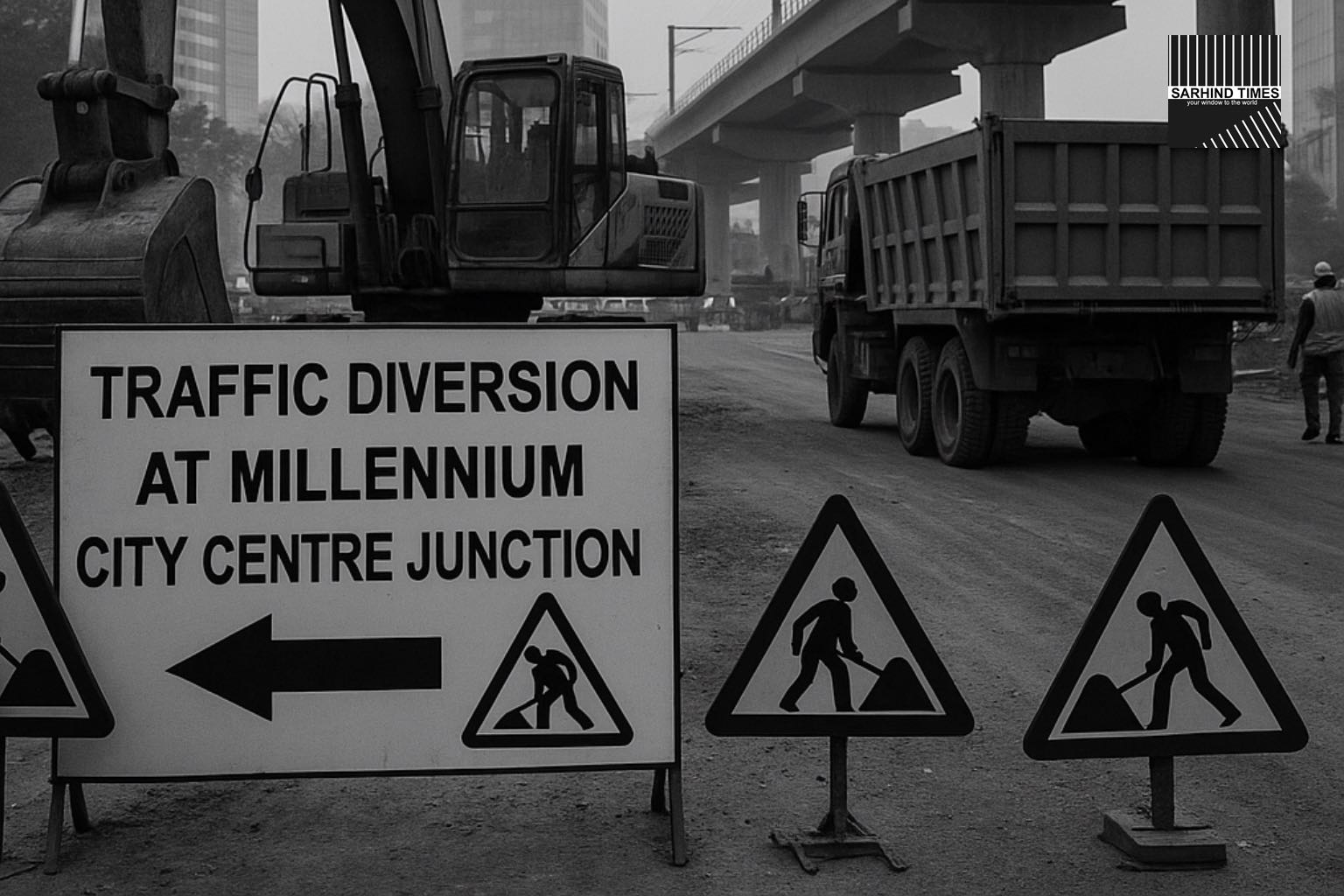
Major traffic intervention planned at one of the city’s busiest junctions ahead of new metro construction
Dateline: Gurugram | 09 November 2025
Summary: At the junction of sectors 27, 29, 43 and 44 in Gurugram, a key infrastructure upgrade is underway. The Gurugram Metropolitan Development Authority (GMDA) has proposed an underpass estimated at around ₹80 crore to alleviate traffic congestion, coinciding with the commencement of the next phase of metro construction by Gurugram Metro Rail Limited (GMRL) at the Millennium City Centre location. Detailed traffic diversion plans and construction schedules have already been drawn.
Why this junction matters
The Millennium City Centre junction is critical for Gurugram’s mobility matrix. It links Golf Course Road, Subhash Chowk, Signature Tower and many other arterial roads. During peak hours, this junction alone handles nearly 9,200 passenger car units (PCUs)—a staggering traffic load. As the city expands upward and outward, congestion here has become a persistent bottleneck.
“`
With the metro expansion now entering construction near this hub, authorities say failing to address the vehicular-conflict potential would risk snarls not just during civil works but for years to come.
The underpass plan and traffic management framework
GMDA’s proposal outlines an under-pass beneath the busy intersection at an estimated cost of approximately ₹80 crore. The formal board meeting scheduled for 10 November will decide administrative sanction for the project.
Parallel to this, GMRL is beginning preparatory work on the new metro station at the same junction, with traffic diversion plans already in train. A detailed plan is being finalised in consultation with the Gurugram Traffic Police and civic bodies.
The combination of metro station construction and underpass is a strategic double-investment: one for mass transit expansion, the other for road traffic decongestion.
Construction timeline & critical milestones
According to officials, the underpass is slated to proceed once GMDA board approval is received. In tandem, GMRL’s civil works will commence soon after initial preparatory activities. The traffic diversion for the metro station area is expected to begin imminently so as to minimise disruption.
The co-location of both projects means traffic planning has to be more robust than typical metro construction alone. Vehicular diversions, pedestrian rerouting, signage, and coordination between agencies will all be necessary.
What this means for commuter experience
For the many thousands who pass through this nodal point each day, the intervention promises relief—though perhaps not immediately. The underpass promises uninterrupted flow beneath the junction, reducing dependency on signalised crossings and reducing wait times. Over time, the metro station will provide a transit alternative that may reduce road traffic volumes.
However, commuters should brace for transitional pain. Traffic diversions, narrowed lanes, temporary closures, and working zones are likely to increase congestion in the near-term. Officials emphasise that this is the necessary short-term cost to secure long-term gains.
Urban-mobility context and strategic importance
Gurugram is part of the National Capital Region and has been growing rapidly as a hub for business, real-estate and high-end residential development. With that growth has come severe strain on road infrastructure. The city’s Comprehensive Mobility Management Plan (CMMP) notes that nearly half of the road network functions at speeds below 30 km/h due to congestion.
The metro expansion and underpass intervention form part of a broader approach to upgrading urban mobility here: modal shift (from car to metro), grade-separation of conflict zones (underpasses/overpasses) and integrated traffic management. These reforms are essential if the city is to sustain its growth trajectory without choking its transport system.
Governance and inter-agency coordination
The project involves multiple agencies: GMDA for the underpass, GMRL for the metro station, Gurugram Traffic Police for diversions and enforcement, and civic agencies for signage and public communication. That coordination will be key. As one official noted, “If each body operates in its own silo, we risk delays and disruption that may outweigh the planned benefits.”
Civic bodies are already mandated to ensure comprehensive public outreach—hoardings, local resident meetings, real-time traffic updates and alternate route mapping. Without this, the risk of public frustration and avoidable congestion rises sharply.
Financials, land use and long-term payoff
The underpass, at roughly ₹80 crore, is modest in the scheme of major infrastructure but its strategic value is high because it addresses the most critical pinch point in the city’s network. The metro station cost is significantly higher, though official figures for this particular node are yet to be confirmed.
Land acquisition is not seen as a major hurdle for the underpass because the junction already exists and the intervention largely uses existing road footprint. But careful staging is required so that traffic flow is maintained while the structural work progresses.
Risks and challenges
Several risks need mitigation: first, the transitional phase may worsen congestion; second, if diversion signage is poor or residents are not informed, the impact may be amplified; third, budget overruns or delays typical of infrastructure projects could erode stakeholder trust; and fourth, the metro station’s civil work must ensure minimal impact on surrounding commercial-residential zones, especially given the nearby Signature Towers and the high-density environment.
Another challenge is maintaining coordination with ongoing construction in adjacent sectors and commercial zones. Residential and business establishments in the area are likely to be sensitive to disruptions, noise and temporary loss of parking or lane access.
Resident and business sentiment
Residents and business owners around Golf Course Road, Signature Tower and Subhash Chowk express cautious optimism. Many welcome the long-term relief but are apprehensive about interim disruptions. As one business owner in Sector 29 put it: “Any reduction in congestion will help our hospitality footfall, but we hope the diversion phase doesn’t kill business for the next 6-9 months.”
Local civic groups are calling for firm timelines and regular traffic-flow updates so that residents and commuters can plan. They also emphasise the need for protected pedestrian pathways, alternate route signage and real-time alerts via mobile apps or social media.
What to watch next
Key milestones to monitor in the coming months include: the board approval for the underpass, commencement of full-fledged metro civil work, public disclosure of traffic diversion routes, signage rollout, lane-closure schedules, and interim metrics such as travel-time reductions or bottleneck clearances.
In the medium term, success will be measured by improved traffic speeds through the junction, increased use of the metro station once operational, and a visible uplift in commuter experience. If managed well, this junction upgrade could become a blueprint for addressing other snarled nodes across Gurugram.
Conclusion
The combination of a new metro station and an underpass at Gurugram’s Millennium City Centre junction signals a decisive push to solve one of its most persistent mobility challenges. The approach recognises that expansion of transit infrastructure alone is not enough—road-network improvements and traffic management must go hand in hand.
For commuters, businesses and residents, the value lies in improved access, time savings and reduced fuel costs. For planners and city managers, the success of this intervention could define whether Gurugram can move from traffic-congested growth to mobility-efficient growth.



+ There are no comments
Add yours