
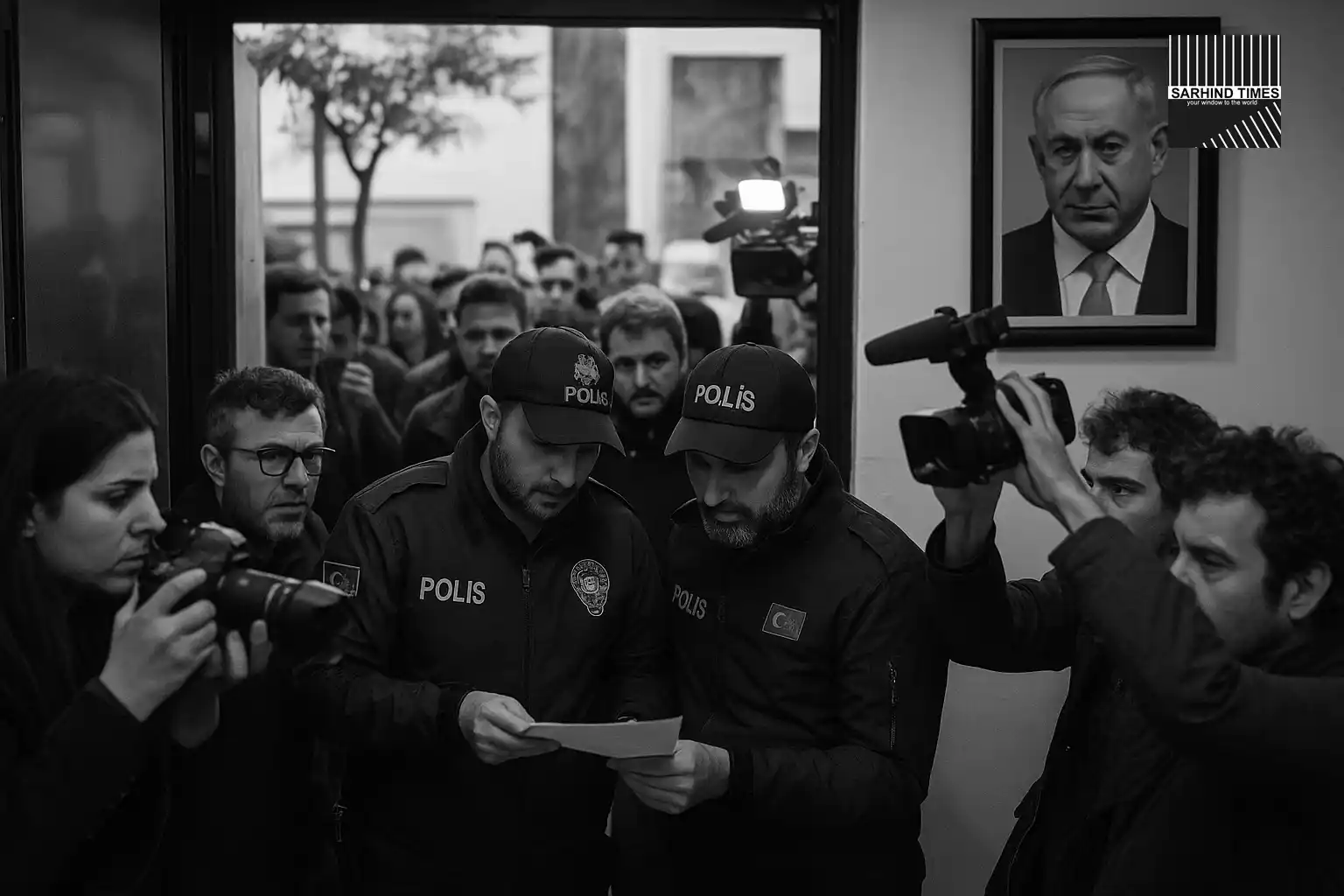
An unprecedented move by Ankara escalates tensions in the Middle East, confronts international law dynamics, and signals a new front in geopolitical posture
Dateline: Istanbul | 8 November 2025, Asia/Kolkata
Summary: The Turkish government has officially announced arrest warrants for Israeli Prime Minister Benjamin Netanyahu and senior Israeli officials, accusing them of genocide in the ongoing conflict. The move marks a rare invocation of international justice rhetoric by a key regional power and heralds fresh diplomatic fallout, complicating bilateral relations, alliance calculations and legal norms around wartime accountability.
1. The announcement and its immediate context
On Friday morning, the Turkish government announced that it had issued arrest warrants under domestic and international statutes for Israeli Prime Minister Benjamin Netanyahu and several senior officials of his government. Turkish officials described the warrants as being based on charges of “genocide, crimes against humanity and war crimes” related to Israel’s military operations in the Gaza Strip and Gaza-adjacent territories.
Turkey’s foreign ministry stated that it was acting in accordance with its obligations under international law and the Genocide Convention, and that the accused individuals were being sought through Interpol channels and other legal mechanisms. Turkish diplomats also informed the Israeli embassy in Ankara of the decision. In public remarks, Turkey’s President said the move was intended to “send a clear signal that impunity will not be tolerated.”
For Israel, the announcement was unexpected and has immediately triggered alarm at the highest levels. The Prime Minister’s office responded that the charges were groundless, politically motivated, and would be answered through diplomatic, legal and security channels. Senior Israeli officials indicated that the move would damage the bilateral relationship with Turkey, which had been volatile but cooperative in several strategic areas.
2. The background: Israel-Turkey relations and Gaza conflict
The announcement must be seen against the larger backdrop of Israel’s military campaign in Gaza, which has drawn international scrutiny and criticism over civilian casualties, damage to infrastructure and allegations of disproportionate use of force. Turkey has been one of the most vocal states in condemning Israel’s actions, mobilising diplomatic protests and appealing to international forums. Over the past two years, Ankara has positioned itself as a leading advocate for Palestinian rights in regional and global forums.
Historically, Israel and Turkey have had a complex relationship: once robust defence and tourism ties were disrupted by the 2010 Mavi Marmara incident and subsequent tensions. Recent years saw a cautious rapprochement, but the Gaza war has sharply reversed that trend. Turkey’s issuance of an arrest warrant for Israel’s leader thus marks a clear escalation.
3. Legal basis and international-law dimensions
Turkey’s government cited multiple international treaties and domestic statutes. The Genocide Convention (1948) obliges state parties to prevent and punish genocide. Turkish lawmakers amended domestic legislation to allow their courts to take action where war-crimes, crimes against humanity or genocide are alleged — even when committed abroad, if Turkish-national or Palestinian-Turkish victims are involved or if the acts are of a universal-jurisdiction nature.
In the announcement, Turkish officials alleged that Israeli operations had caused “systematic destruction of civilian infrastructure, mass casualties among non-combatants, forced displacement and deprivation of essential humanitarian supplies” in clear violation of international humanitarian law. That, the officials contend, meets the threshold of genocide or at least crimes against humanity.
Israel disputes the legal characterisation entirely, arguing that military operations were undertaken in self-defence, that civilian casualties were carefully avoided, and that Turkey has no jurisdiction. Israel’s legal teams say the arrest warrants are “null and void” and raise questions of diplomatic immunity, head-of-state protection, and the viability of enforcement beyond Turkish territory.
4. Diplomatic fallout: bilateral and regional consequences
The announcement has several immediate diplomatic implications:
- **Turkey–Israel bilateral relations**: The two countries, which had a cautiously improving relationship, are now facing a sharp fracture. Israel is reported to be reconsidering its diplomatic interactions with Ankara and may scale back cooperation in energy, defence exports and tourism sectors.
- **Regional Muslim-majority states**: Other regional players such as Qatar, Egypt and Jordan may view Turkey’s move as opening a new front in the Palestinian-Israel diplomacy. Some may quietly support the action; others may worry about escalation or being drawn into legal precedent-setting actions.
- **Global alliances**: Turkey, a NATO member, is now at odds with Israel — itself supported by major western powers. This may place Turkey in a complex position within NATO discussions and regional security partnerships. Western capitals are watching closely how this will affect supply-chain security, intelligence cooperation and arms exports.
- **International institutions**: The move increases pressure on bodies such as the International Criminal Court (ICC) and the United Nations to clarify jurisdiction questions, head-of-state immunity and the viability of universal-jurisdiction arrests. Turkey may push for an ICC referral or seek to expand its prosecutorial reach.
Diplomatic correspondents say that Israel will likely lodge an immediate protest, possibly recalling its ambassador, suspending cooperation in key areas, and warning of reciprocal legal or security steps. Turkey has said it is ready for potential escalation and will “not be intimidated”.
5. Reaction from global stakeholders
Global reaction has been swift and divided:
- The United States, a staunch Israel ally, expressed surprise and urged resolution through dialogue and international structures rather than unilateral prosecutorial actions. Washington reiterated that any legal steps should go through multilateral institutions like the ICC.
- The European Union acknowledged Turkey’s right to pursue legal measures, but emphasised that diplomatic fallout should be managed carefully and that intensity of the warrant may hamper future regional cooperation on security and migration.
- Human-rights organisations noted the action as a rare use of external jurisdiction, arguing it signals growing appetite for accountability over wartime actions; some cautioned about politicisation of international justice processes.
- Israel asked its friends to block Turkey’s effort to secure extradition or enforcement of the warrants, asserting diplomatic immunity protocols protect sitting heads of government and that enforcement outside Turkish soil is unlikely.
6. What enforcement means — and the practical barriers
Legal watchers stress the gap between issuing arrest warrants and actual enforcement. Some key points:
- **Head-of-state immunity**: Many jurisdictions recognise that sitting heads of government enjoy immunity from prosecution in foreign courts unless immunity is waived. Turkey’s claim hinges on challenging this immunity for alleged war crimes and genocide.
- **Extradition**: Since the accused reside outside Turkey and are unlikely to enter Turkish jurisdiction voluntarily, the warrants may have symbolic rather than operational effect. Israel and other countries may refuse cooperation.
- **Multilateral law enforcement**: Turkey may attempt to issue INTERPOL “red notices” and push for ICC involvement. But Israel is not party to the Rome Statute; that creates a key barrier to ICC referral unless UN Security Council acts.
- **Diplomatic shielding**: Even if a warrant remains unenforced, the announcement may hamper travel of the accused to Turkey and possibly to allied jurisdictions that may consider Turkey’s demand. It may impose a reputational cost rather than immediate legal risk.
7. Strategic implications for the Middle East and beyond
This development is not confined to legal semantics—it has strategic consequences:
- Turkey may use this move to enhance its leadership role in the Muslim world and gain diplomatic leverage on the Palestinian question.
- Israel will face increased pressure in Middle Eastern capitals and at the United Nations, compelling it to recalibrate its diplomatic posture and future military-political strategy.
- The precedent of a country issuing charges against another country’s leader may embolden similar moves elsewhere, potentially destabilising the norms of international relations.
- Major powers like the United States, China and Russia will observe the outcomes, since the incident touches on alliance cohesion, rule-of-law dynamics and regional security arrangements.
8. Domestic political angle in Turkey and Israel
For Turkey’s government, issuing the warrants supports several domestic political goals: it reinforces its credentials as a defender of Muslim-majority interests, boosts nationalistic support, and provides a high-profile external issue for domestic messaging ahead of election cycles. It also helps shift the narrative from economic challenges at home to a foreign-policy assertiveness abroad.
In Israel, Prime Minister Netanyahu faces both diplomatic isolation and domestic scrutiny. While public focus remains on security and military operations, the incident adds a fresh layer of international legal risk and may become a point of contention in Israeli parliamentary debates and opposition critiques. The extent to which this legal escalation influences Israeli policy is likely to grow in coming weeks.
9. Possible scenarios and what happens next
Several trajectory scenarios are possible in the weeks ahead:
- **Diplomatic de-escalation track:** Turkey and Israel may engage in quiet bilateral talks, possibly mediated by a third country, to roll back the arrest warrants or convert them into a separate investigation framework. This would preserve some cooperation in energy, trade and security.
- **Legal escalation track:** Turkey may push the case into international courts, issue red notices, or press the United Nations to refer the matter to an adjudicatory body—possibly increasing pressure on Israel’s leadership.
- **Regional ripple effect:** Other countries may follow Turkey’s example and issue similar legal actions, especially if Turkey frames the move as part of a broader “accountability for war” campaign; this could prompt diplomatic reticence, retaliatory legal measures and shifting blocs of alliance behaviour.
- **Security and operational fallout:** Israel may respond by cutting cooperative intelligence, halting military-industrial collaboration with Turkish firms, or reconsidering defence ties in the region; Turkey may reciprocate in areas such as migration management or regional security partnerships. The running cost may be high for both sides.
10. Wider implications for India and global readers
Though this is not an Indian-dominated story, the repercussions are relevant to Indian and global audiences. India maintains diplomatic relations with both Israel and Turkey and has positioned itself as a potentially neutral actor in the Middle East, seeking energy ties, defence cooperation and technology partnerships with Israel, while also cultivating friendly ties across the Muslim world. A diplomatic rupture between Turkey and Israel might compel India to recalibrate its approach — balancing ideological alignment with strategic interest.
For global readers, this incident underscores evolving norms in international justice: the notion that sitting leaders may face legal exposure for wartime conduct is gaining traction, even if enforcement remains circumscribed. It also demonstrates how mid-sized powers like Turkey are leveraging legal instruments as part of foreign-policy strategy in a multipolar world.
11. Risks and uncertainties ahead
Uncertainties remain: whether Turkey will maintain follow-through on the warrants or whether they become symbolic; whether Israel will respond with legal or diplomatic counters; whether third-party countries will become involved in enforcement; whether the action triggers broader legal precedents or is contained as a diplomatic standoff.
Further risks include escalation of hostilities, breakdown of previously stable cooperation in defence and trade, disruptions in regional migration and intelligence flows, and potential for wider regional alignment shifts. If left unchecked, this incident could mark the beginning of a new pattern of unilateral legal geopolitics, complicating alliance-based diplomacy.
12. Conclusion: Accountability meets geopolitics
The arrest warrants issued by Turkey for Israel’s prime minister represent more than a headline—they reflect a changing era in which legal instruments intersect with geopolitics, where national identities, alliances and international norms collide. They show how states are increasingly willing to use judicial mechanisms as diplomatic levers.
Whether this becomes a lasting shift toward greater accountability in wartime or a diplomatic flashpoint that cools off quickly will depend on whether enforcement follows and how other states respond. For now, the decision sends a clear message—leaders can no longer assume they are beyond scrutiny, even if actual accountability remains a complex path.



+ There are no comments
Add yours