
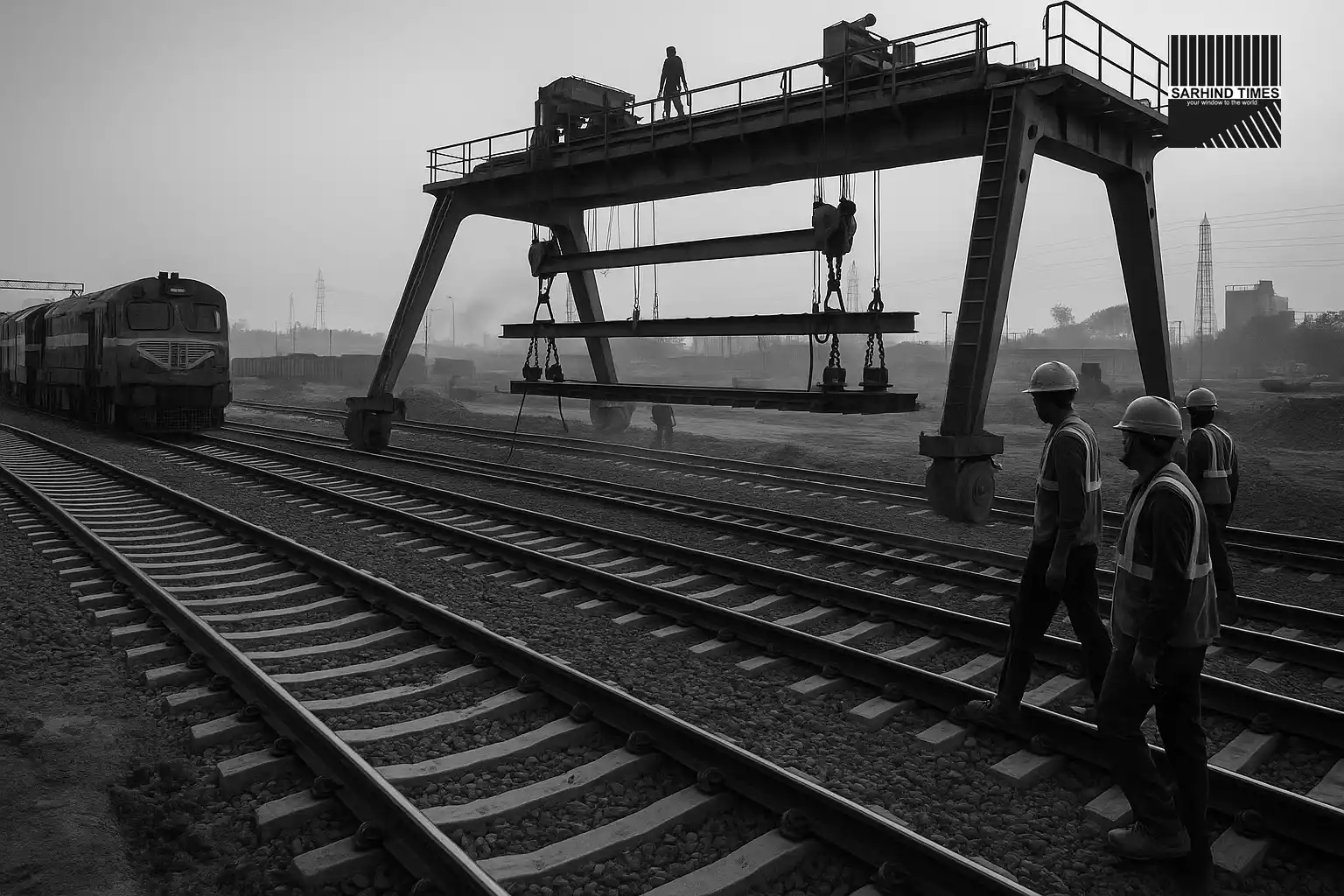
Indian Railways sets to add ≈894 km of tracks across four states in one of its largest capacity-expansion drives in recent years
Dateline: New Delhi | 8 November 2025, Asia/Kolkata
Summary: The Dedicated Freight Corridor Corporation of India Ltd (DFCCIL) and Indian Railways have been handed a major boost with government approval of four multitracking rail projects worth a combined investment of **₹24,634 crore**, adding around **894 route-kilometres** of track. These projects are designed primarily to ease freight bottlenecks and enhance logistics capacity across Maharashtra, Gujarat, Madhya Pradesh and Chhattisgarh, aligning with the national logistics and economic growth agenda.
1. The approval and project details
On 7 October 2025 the Cabinet Committee on Economic Affairs (CCEA) gave clearance to four multitracking projects under Indian Railways, totalling an outlay of approximately **₹24,634 crore**. The projects will add around **894 route-kilometres (rkm)** of enhanced track capacity across the states of Maharashtra, Madhya Pradesh, Gujarat and Chhattisgarh. The investment is being directed into upgrading existing lines by adding additional tracks (double or more) rather than entirely new corridors, thereby improving freight, passenger and mixed traffic flows.
The announcement emphasises that the enhanced routes will support freight movement of an additional **≈78 million tonnes annually**, underlining the logistics-capacity rationale.
This marks one of the most significant single-wave capacity expansions in Indian Railways in recent years.
2. Why the timing and strategic rationale matter
India’s freight and logistics sectors are under growing pressure from rising industrial output, export ambitions, modal-shift goals (from road to rail) and infrastructure bottlenecks. The railway network, despite its vast scale, has for long carried mixed traffic (passenger + freight) and suffered capacity constraints—especially on key commodity flows such as coal, containers, steel, cement and food-grains.
The multitracking projects directly address these constraints by:
– Creating additional lines on heavily trafficked corridors, reducing congestion and increasing throughput.
– Enabling faster, more reliable freight movement which in turn lowers logistics cost—a competitive imperative for industry and export sectors.
– Aligning with national policy push (such as the PM Gati Shakti initiative) to integrate transport-mode efficiency and create a more resilient supply-chain architecture.
By approving such a large investment now, the government signals urgency in tackling infrastructure bottlenecks and supporting India’s manufacturing and trading ambitions in the next phase of growth.
3. Freight capacity expansion: what it implies
Freight movement has been a challenging area for Indian Railways due to mixed-traffic constraints and slower transit times compared to road. The new projects are intended to help remedy this. With an additional 78 million tonnes of freight capacity targeted, key implications include:
– Commodity flows such as coal (for power), steel (for construction), cement (for infrastructure), food-grains (for supply-chain resilience) and containers (for trade) will particularly benefit.
– Better rail-freight means less pressure on road networks, reduced congestion, lower fuel consumption and improved environmental footprint.
– For rail users (industry, exporters, large consumers), more reliable schedules, reduced delays and potentially competitive tariffs over time.
– For Indian Railways, higher freight revenues, better asset-utilisation and improved economies of scale.
4. Where the projects are and what they cover
While the publicly available summary does not list each route in full detail, the four states earmarked (Maharashtra, Gujarat, Madhya Pradesh and Chhattisgarh) are significant freight-states:
– In **Maharashtra** and **Gujarat** the emphasis is likely on port-link, industrial cluster and container flows, given Gujarat’s major industrial base and coastal export terminals.
– In **Chhattisgarh** and **Madhya Pradesh** heavy commodity flows (steel, minerals, coal) dominate — improving track-capacity here addresses critical supply-chain bottlenecks for heavy industry.
– The expansion of existing lines rather than entirely new corridors indicates incremental enhancement of crucial freight arteries rather than greenfield routes.
This blend of states and commodity profiles suggests a strategic spread across both export-oriented logistics and domestic heavy-industry supply-chains.
5. Implementation, timelines and execution risks
With major approvals in place, the next phase will hinge on execution — a known challenge in Indian infrastructure. Key factors include:
– Land acquisition (if any), environmental clearances, track-laying, signalling upgrades and commissioning of the enhanced tracks.
– Coordination between Indian Railways, state governments, public-sector units (PSUs) and contractors for civil works, signalling, electrification and auxiliary infrastructure.
– Ensuring minimal disruption to existing traffic during construction, especially since many of the lines will continue operating live traffic.
– Monitoring cost-escalation, contract management, material procurement (rails, sleepers, signalling gear) and timely execution.
– Institutional readiness: maintenance regimes, workforce planning and asset-utilisation during enhanced-capacity phase.
Historically, infrastructure projects in the rail sector have faced delays due to multiple causes; tracking these projects against schedule will be critical to realising their benefits.
6. Related context: recent rail-freight and corridor milestones
The multitracking approval comes at a time when Indian Railways has posted early signs of freight momentum. For example:
– Up to October 2025, Indian Railways reported cumulative freight loading of **935.1 million tonnes** (mt) in FY 2025-26, a growth of 3.1 % year-on-year. In October alone, freight revenue reached ₹142.16 billion.
– The Dedicated Freight Corridor Corporation of India (DFCCIL) recorded a **48% surge in train-operations** on its freight corridors in FY 2024-25, moving goods over a cumulative distance of 11.5 million km.
These numbers underline that capacity investment is now being matched by usage momentum—a favourable sign for the infrastructure push.
7. Broader economic, regional and policy angle
The rail-tracks investment links with multiple broader initiatives:
– **Logistics cost reduction**: In India, high logistics cost (as percent of GDP) has been a competitive handicap; enhancing rail-freight capacity contributes directly to reducing cost and transit times.
– **Regional development**: By improving connectivity in states rich in minerals, heavy-industry and export-clusters (Chhattisgarh, Madhya Pradesh) the infrastructure helps inclusive regional growth, job-creation and industrialisation beyond metro-centres.
– **Sustainability**: Rail freight is far more energy-efficient and less carbon-intensive than road; scale-up of rail freight aligns with India’s climate-goals and transport decarbonisation agenda.
– **Modal shift & multi-modal integration**: These projects complement initiatives such as port-rail link upgrades, logistics parks, expressways and industrial corridors, pointing to an integrated transport ecosystem rather than siloed investments.
– **Policy signalling**: The approval conveys that government remains committed to infrastructure as a growth lever, even as global headwinds rise; it also signals to private investors, industry and states that rail-logistics infrastructure will be scaled.
8. What this means for stakeholders and business-watchers
For industry sectors (steel, cement, mining, coal, containers), this capacity expansion offers a potential competitive edge: faster, more reliable rail-movement, enhanced link-to-market and lower logistics-risk. For investors, infrastructure and logistics asset-classes may gain further attention as rail upgrades create ancillary opportunities (rail-sidings, logistics nodes, intermodal parks). For local-governments and states, improved rail capacity may lead to new industrial investments, export-park growth and employment diffusion.
In particular, for those involved in content creation or analysis (like you, Vasu), key angles to watch include: the timeline of project implementation, regional-impact case-studies, comparative cost-benefit of rail upgradation versus road, deep dives into industrial clusters benefitting from rail logistics, and tracking freight-traffic growth post commissioning.
9. Indicators and watch-points ahead
To follow the trajectory of these investments, some key indicators will be valuable:
– Percentage of route-kilometres commissioned each quarter post-approval.
– Incremental freight-tonne-kilometres (FTK) on upgraded sections.
– Change in average freight transit time, dwell time, loading/unloading time in sections after upgrade.
– Freight-tariff movement, especially if reduced cost or improved reliability lead to volume growth.
– Modal-share shift: increase in rail freight share relative to road freight on major commodity flows.
– Regional investment announcements in industrial/port/logistics clusters linked to the new rail capacity.
– Budget execution rate, cost-escalation and debt/financing status of these upgraded lines.
10. Conclusion: a big push, but delivery will define value
India’s approval of ₹24,634 crore for four rail-multitracking projects marks a major infrastructure decision. It is not just about adding tracks—it is about enhancing logistics capacity, reducing supply-chain friction, enabling regional industrial growth and supporting the country’s wider economic ambitions.
Yet, as with any large infrastructure push, the difference between announcement and delivery will determine real impact. Commitment to execution, coordination across agencies, integration into logistics chains, and monitoring outcomes will all matter. If done well, this investment wave could shift India’s rail-freight dynamics for years to come; if delayed or partial, much of the potential uplift will remain unrealised.
For now, stakeholders will watch closely as the ground-work begins and the promise of modernised rail-logistics starts to meet the demands of a rapidly evolving economy.


+ There are no comments
Add yours