
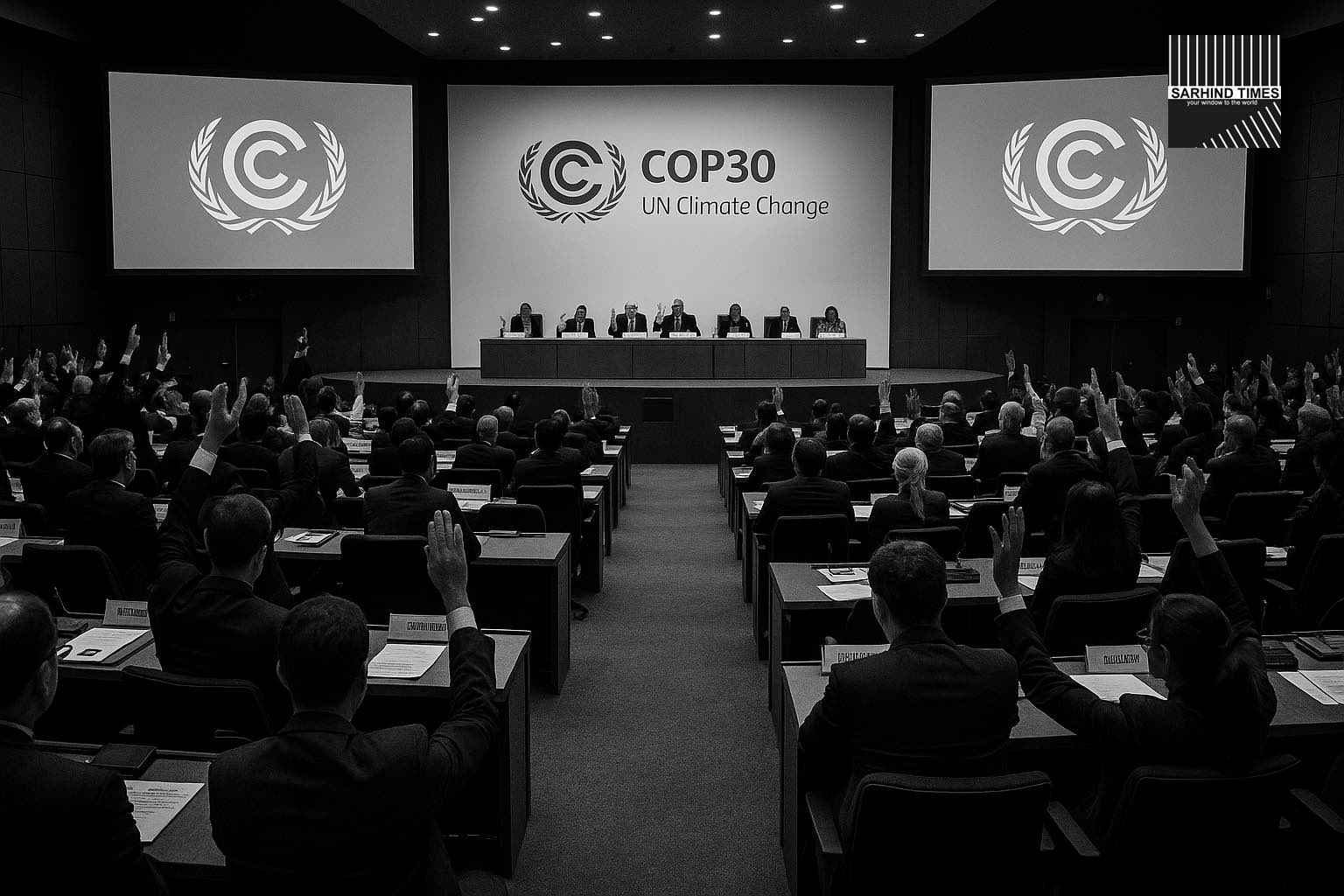
At the global climate summit in Morocco, India reaffirms its dual aims of industrial growth and climate resilience while emphasising needs of the Global South.
Dateline: New Delhi | November 7 2025
Summary: During the COP30 talks, India positioned itself both as a driver of renewable-energy growth and as a voice for climate-vulnerable countries demanding stronger finance flows and equitable transition mechanisms. Key messages included accelerated clean-energy targets, a call for “loss & damage” funding, and alignment of India’s manufacturing ambition with green goals.
Backdrop: COP30 and India’s Evolving Climate Agenda
The 30th Conference of the Parties (COP30) to the UN Framework Convention on Climate Change (UNFCCC) is being held in Marrakesh, Morocco in late 2025. The arena has emerged as the principal world stage for climate diplomacy, with nearly 200 countries negotiating emissions reduction, climate-finance flows, adaptation-measures and accountability frameworks. India entered the summit with a sharpened agenda: combining its ambition as a major economic power with the developmental needs of its population and large-scale infrastructure build-out.
India’s position is rooted in a long-standing narrative: the Global South must not bear disproportionate burden of climate transition, and climate action must be integrated with growth, employment, energy security and manufacturing. The country’s stance at COP30 emphasises three pillars: decarbonisation, adaptation-resilience and equity in climate finance.
Key Announcements and Commitments by India
During the summit, India reiterated its target to achieve 500 GW of renewable-energy capacity by 2030 and accelerated plans for green hydrogen, EV manufacturing and grid modernisation. The delegation announced that India will:
- Launch a “National Green Industry Mission” with an investment target of US$100 billion over the next decade to promote domestic clean-energy manufacturing.
- Seek to establish a “South-Credit Facility” — a proposed international mechanism to channel concessional finance from developed countries to vulnerable emerging economies, with India as a founding member.
- Commit to doubling its adaptive-capacity investment by 2035, focusing on coastal resilience, urban-flood management, agricultural adaptation and early-warning systems.
- Propose a new “Technology Transfer & Know-how Platform” under the UNFCCC umbrella, aimed at enabling emerging economies to access low-carbon manufacturing equipment and green-technology licensing on favourable terms.
Finance and Loss & Damage: India’s Diplomatic Pitch
One of the most consequential battlegrounds at COP30 is the question of “loss & damage” finance — mechanisms to compensate countries for irreversible climate impacts. India used the platform to underscore that large developing nations face climate burdens despite having contributed less historically to emissions. The Indian delegation pressed for:
- Operationalisation of the Loss & Damage Fund with a replenishment mechanism aligned to real-sector needs (for example, flood-damage reconstruction, agricultural loss compensation, coastal erosion adaptation).
- Favourable terms for country participation in global carbon-markets, enabling India to channel carbon-credit flows into domestic sustainable projects.
- Increased share of public-finance flows to adaptation (currently only ~20 per cent of global climate-finance flows) to be raised to 50 per cent by 2030.
Implications for India’s Domestic Transition
India’s engagement at COP30 has tangible domestic ramifications. If India-led green-industry and adaptation initiatives receive international anchoring, the expectation is that manufacturing employment, export competitiveness and infrastructure resilience will gain a boost. Some key implications include:
- A potential shift in industrial policy: domestic manufacturing clusters (for solar panels, wind turbines, EVs) may receive enhanced subsidies and global investor interest, aligning with India’s “Make in Green” narrative.
- Urban resilience programmes: enhanced adaptation financing may accelerate city-level interventions in flood-prone zones, informal settlements and high-heat regions—benefitting vulnerable urban populations.
- Energy-system transformation: The renewable-capacity target and grid-modernisation efforts will require increased investments in storage, transmission, and battery manufacturing—opening new industrial pathways.
- Regional role: India’s leading voice in Global South climate diplomacy may influence its standing in multilateral structures such as BRICS, G20 and the Indian Ocean Region climate framework.
Challenges and Critiques Ahead
While the announcements are ambitious, experts caution several constraints:
- The large financing gap: India’s green-industry mission and adaptation targets demand huge capital, of which a large share must be private and global. Mobilising this at scale is non-trivial.
- Technology-and-manufacturing bottlenecks: domestic supply-chains for solar, batteries, hydrogen remain nascent; scaling requires time, investment and regulatory clarity.
- Balancing growth and emissions: India remains reliant on coal for a sizeable share of electricity—transition must manage industrial, social and fiscal costs.
- Global-north trust deficit: While India calls for “South-Credit Facility”, developed-country skeptics demand stronger deliverables and monitoring frameworks to release large concessional funding.
Regional and Global Ripple Effects
India’s posture at COP30 is likely to influence regional climate initiatives and global investor flows. By positioning itself as a green-manufacturing destination and adaptation hub, India is attracting clean-industry capital. At the same time, by emphasising equity and loss-&-damage finance, India is signalling that climate governance must be inclusive and fair—not only growth-centric.
For other developing countries, India’s steps may create a template: large-scale manufacturing plus adaptation investments, financed through international partnerships and domestic innovation. For developed countries, India’s strong stance adds pressure to deliver on promised climate-finance flows and technology-transfer commitments.
What to Watch in 2026 and Beyond</p
Several key indicators will validate whether India’s COP30 commitments translate into action:
- Progress on the “National Green Industry Mission”—announcement of large manufacturing projects, investment commitments, green-jobs creation.
- Operationalisation of the “South-Credit Facility”—structure, fund size, participating countries and India’s role.
- Increase in adaptation-finance flows to India and metrics of resilience improvements (e.g., flood-reduction in vulnerable zones, enhanced urban-heat programmes).
- Integration of India’s domestic climate-policy instruments—carbon markets, clean-energy auctions, industrial clusters—with global frameworks and investment flows.
Conclusion
As the world negotiates the pathway from ambitious climate targets to practical transition, India has emerged as both challenger and partner: insisting on growth rights, demanding justice for vulnerable states and opening avenues for green transition partnerships. The COP30 outcomes reflect this dual role. For India, the real test will not be announcements—it will be execution. If it delivers, India could place itself at the centre of the global green industrial wave and shape climate governance for years to come. If not, the rhetoric may lose momentum.
At the summit in Marrakesh, India’s message was clear: growth, equity and climate-action must go hand in hand—and the world must move together.
“`
**Categories & Tags**
Categories: Environment, International
Tags: COP30 climate adaptation India, global climate finance commitments 2025, UN climate change conference Morocco, India climate diplomacy 2025, green transition Global South, India renewable energy target 2030, climate resilience investment India, global carbon markets India position, India climate adaptation funds, international climate summit outcomes India
* [timesofindia.indiatimes.com](https://timesofindia.indiatimes.com/city/pune/maharashtra-declares-leprosy-notifiable-registration-of-patients-mandatory/articleshow/125024359.cms?utm_source=chatgpt.com)
* [timesofindia.indiatimes.com](https://timesofindia.indiatimes.com/life-style/health-fitness/diet/national-institute-of-nutrition-and-icmr-issue-17-point-dietary-guideline-for-indians-details-inside/photostory/122906350.cms?utm_source=chatgpt.com)
* [timesofindia.indiatimes.com](https://timesofindia.indiatimes.com/india/ayush-ministry-signs-mou-with-who-to-create-module-for-traditional-indian-medicine/articleshow/121394203.cms?utm_source=chatgpt.com)


+ There are no comments
Add yours