
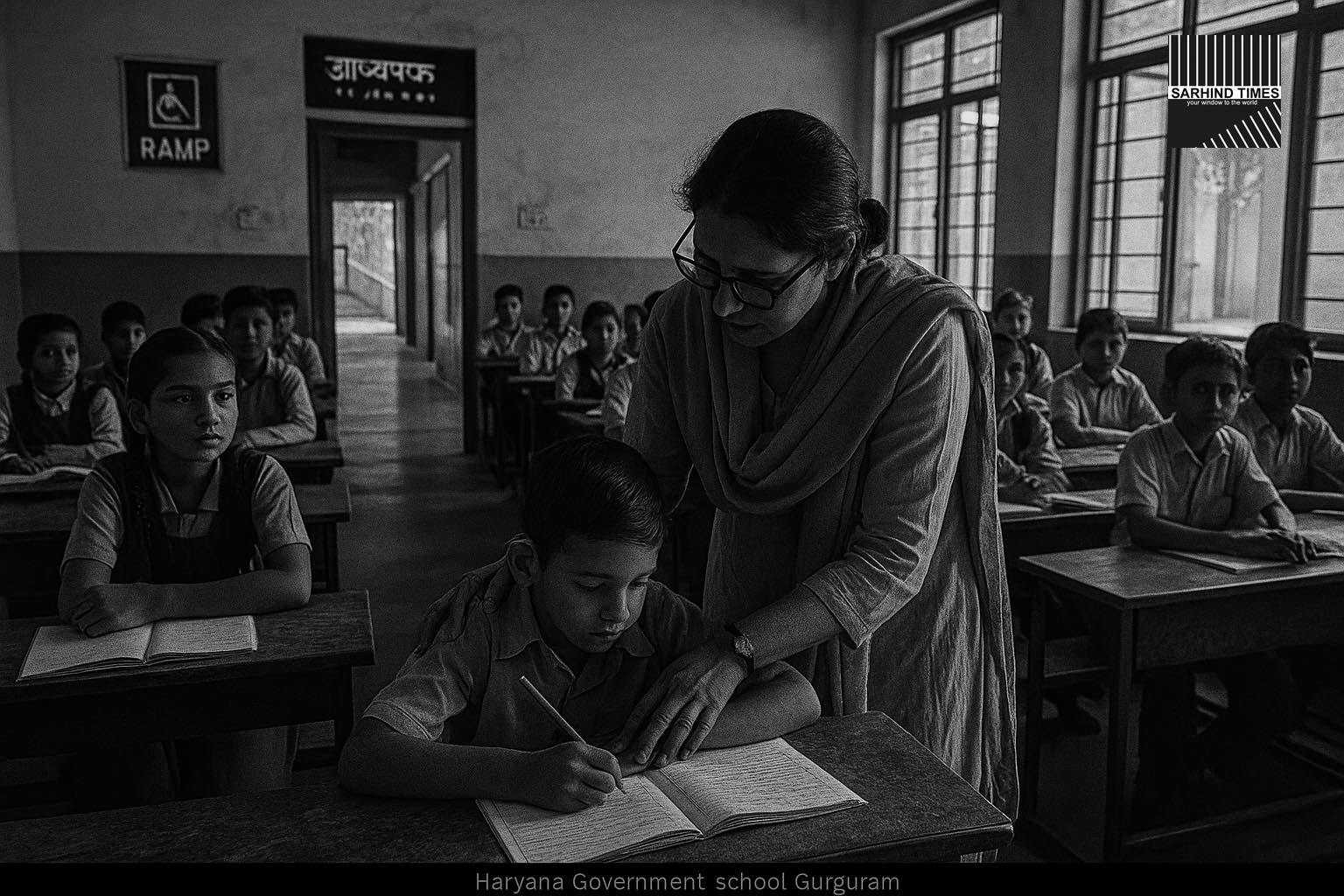
The state issues “Haryana State Inclusive Education Guidelines, 2025” to integrate children with disabilities into mainstream classrooms across Gurugram and beyond.
Dateline: Gurugram | November 7 2025
Summary: The Haryana School Education Department has notified the new “Haryana State Inclusive Education Guidelines, 2025”, mandating inclusive provision for children with special needs in every school—government, private or aided—in the state. The guidelines align with national education policy frameworks and lay down infrastructure, pedagogy and teacher-training requirements to bolster genuine inclusion.
Why the Reform and What It Entails
Experts and education-advocacy groups have long pointed out that while India has progressed in expanding access, inclusive education for children with disabilities remains a weak link in many states—and in Haryana the challenge is pronounced in rapidly expanding urban districts like Gurugram. The need for formal guidelines becomes particularly acute given rising enrollments, growing awareness of rights under the Rights of Persons with Disabilities Act, 2016 and the obligations under the National Education Policy 2020 (NEP).
The new guidelines mark a structured response: emphasising early identification of children with special needs, integration into regular classrooms, preparation of Individualised Education Plans (IEPs), physical-access infrastructure such as ramps, Braille signage and accessible toilets, and capacity development of educators for inclusive pedagogy. They apply to all schools from pre-primary to senior-secondary level in the state. A senior state official noted that over 60,000 children with special needs are enrolled in government and private schools in Haryana, and that the guidelines aim to ensure that these children are not left in segregated settings but supported within mainstream classrooms.
Key Provisions of the Guidelines
Among the most important components of the document are:
- Early Identification & Assessment: Schools must conduct screening of all students annually; children identified as needing support must undergo formal assessment within 90 days.
- Individualised Education Plans (IEPs): A teacher-counsellor team in each school must prepare IEPs for identified students, outlining learning goals, accommodation-needs, assistive devices and review schedules.
- Infrastructure & Accessibility: Every school—whether government, aided or private—must install ramps, widen doorways, provide accessible toilets, visual and tactile signage and accessible water-points by December 2026. Schools with more than 500 students must have a dedicated resource-room.
- Teacher Training & Sensitisation: All teachers will receive in-service training in inclusive pedagogy and disability awareness; pre-service teacher-education courses (B.Ed/M.Ed) will include modules on inclusive education.
- Assistive Technology & Learning Materials: Schools are encouraged to provide Braille materials, screen-reading software, hearing-aid compatible systems, large-print textbooks and adapted pedagogy for children with cognitive and physical disabilities.
- Monitoring & Accountability: Each cluster of schools will have a “Cluster-Inclusive Team” monitoring implementation; district-level inclusive-education officers will submit quarterly reports to the Directorate of School Education.
- Parental Engagement & Community Outreach: The guidelines lay down norms for engaging parents of children with special needs in planning, review meetings and feedback loops, and for holding awareness camps in communities.
Implementation Focus in Gurugram and Urban Areas
In Gurugram district, known for its high migrant population, fast urbanisation and stark inequality pockets, the rollout carries particular significance. Schools in sectors where students hail from diverse socioeconomic backgrounds will face specific challenges: ensuring assistive provision for children whose parents may have limited resources, coordinating with private-schools, and monitoring learning outcomes.
The district administration has indicated that the first phase of implementation will cover all government schools in Gurugram by March 2026—with private/unaided schools to comply by December 2026. Schools are being asked to submit audit of accessible infrastructure by November 2025. A senior district education officer confirmed that training of 850 teachers across 120 schools in Gurugram has already started; materials and guidelines will be rolled out in forthcoming weeks. The resource-room requirement is expected to be met in at least 60 schools by June 2026.
Alignment with National Education Policy and International Commitments
The guidelines are aligned with the NEP 2020 which demands equitable and inclusive education for all students and stresses that children with disabilities should be supported in mainstream classrooms wherever possible. The guidelines reflect an integrated approach: inclusion is not treated as a side-stream but as embedded within mainstream schooling. They also resonate with India’s obligations under the United Nations Convention on the Rights of Persons with Disabilities (CRPD), of which India is a signatory.
By setting state-wide standards and timelines, Haryana is signalling a shift from ad-hoc compliance to systematic governance of inclusive education—especially in urban-peri-urban districts where private schooling is widespread and public-private coordination becomes complex.
Challenges Ahead and Policy Considerations
While welcome, the implementation faces several hurdles:
- Resource constraints: Upgrading physical infrastructure, installing assistive-technology and staffing resource-rooms will require budget allotment and procurement. Schools in informal settlements and private unaided settings may lag.
- Teacher readiness: While training is being rolled out, ensuring teacher confidence, capability and attitude change for inclusive pedagogy is a long-term endeavour.
- Coordination with private schools: Large numbers of private schools in Gurugram may be reluctant to resource-heavy adjustments; ensuring compliance and monitoring will be key.
- Change in pedagogy & assessment: Inclusion demands not only physical access but adaptions in teaching, assessment, peer-integration and support services (speech therapy, occupational therapy) which are less developed in many urban schools.
- Data-tracking & outcomes: Ensuring that children with special needs are not merely present in classrooms but achieve meaningful learning outcomes will require robust data systems and monitoring.
Broader Impact and Implications for Stakeholders
The guidelines carry multiple implications:
– For students and families: Children with disabilities now have clearer rights and expectations of inclusion rather than being relegated to separate institutions.
– For schools: Schools will need to review infrastructure, train staff, adapt curriculum and engage with parents proactively. Resource-rooms and IEPs become standard, not optional.
– For sectors and private actors: Educational technology firms offering assistive devices, screen-reading software, inclusive-curriculum tools and teacher-training modules for inclusion may find growing opportunities.
– For governance: District-education offices will need to expand oversight capacity, collect data, inspect accessibility compliance and coordinate across government and private schools.
– For equity and social justice: In urban districts like Gurugram, where private schooling is predominant, ensuring that children with disabilities from low-income families are not excluded becomes a measure of both educational and social-justice policy.
What to Watch Next
Several indicators will show whether the guidelines translate into outcomes:
- Number of schools audited and upgraded with accessible infrastructure (ramps, toilets, resource-rooms) by December 2026.
- Percentage of children with special needs identified and with IEPs in place in government and aided schools across Gurugram by mid-2026.
- Teacher training completion rates in inclusive-pedagogy modules and feedback on their confidence and practice.
- Academic achievement and retention rates of students with special needs compared with peers—monitoring dropout, progression and examination performance.
- Compliance in private/unaided schools and level of parental engagement in inclusive-education processes.
Conclusion
Haryana’s Inclusive Education Guidelines 2025 mark a significant step in the state’s educational reform journey—particularly in a dynamic urban district like Gurugram. By embedding inclusive education into the mainstream system—with infrastructure, pedagogy, monitoring and student-rights focus—the state is addressing a long-standing gap. The challenge now will be translating policy into practice: securing resources, adapting mindset, strengthening private-school oversight and ensuring that children with special needs gain not only a seat in the classroom but meaningful learning and access.
For Gurugram specifically, the reform underscores how urban education must evolve to be inclusive, responsive and equitable—aligned with growth, diversity and social change. If implemented well, the guidelines could become a model for other fast-growing Indian cities and districts.



+ There are no comments
Add yours