
Jind, Haryana | 4 November 2025
Dateline: Jind, Haryana | 4 November 2025
Summary: Hundreds of farmers in Haryana’s Jind district have mobilised in a large-scale tractor march and sit-in demonstration against the state government’s proposed Industrial Model Township (IMT) near Uchana Kalan, along National Highway 152D and the Delhi-Katra Expressway corridor. The farmers claim that consent for land acquisition has been uploaded without genuine approval, that fertile agricultural land is being annexed unfairly, and they demand immediate cancellation of the project unless strong safeguards are guaranteed.
Origins of the conflict and the IMT plan
The flash-point for the unrest lies in the government’s announcement of an upcoming Industrial Model Township (IMT) near the town of Uchana Kalan in Jind district, located along the alignment of the Delhi-Katra Expressway and National Highway 152D. The IMT is expected to occupy more than 3,000 acres of land, much of which currently supports agricultural production and is held by local farmers and land-donor households. Many of the affected properties are under high‐yield cultivation—particularly wheat, mustard and cash cropping—but are being targeted for conversion for industrial and mixed-use infrastructure.
Farmers in and around Uchana Kalan have been raising concerns for months. They allege that the consent mechanisms used by government agencies to mark acquisition-readiness have been opaque, that “consent” entries have been uploaded on official land-portals without proper village-level consultation or verification, and that compensation and livelihood safeguards are vague at best. The IMT design is being positioned as part of Haryana’s broader push to industrialise and attract investments into northern rural districts. But for local farming communities, the issue is one of land security, economic fairness, and future livelihood.
Mobilisation and the tractor march
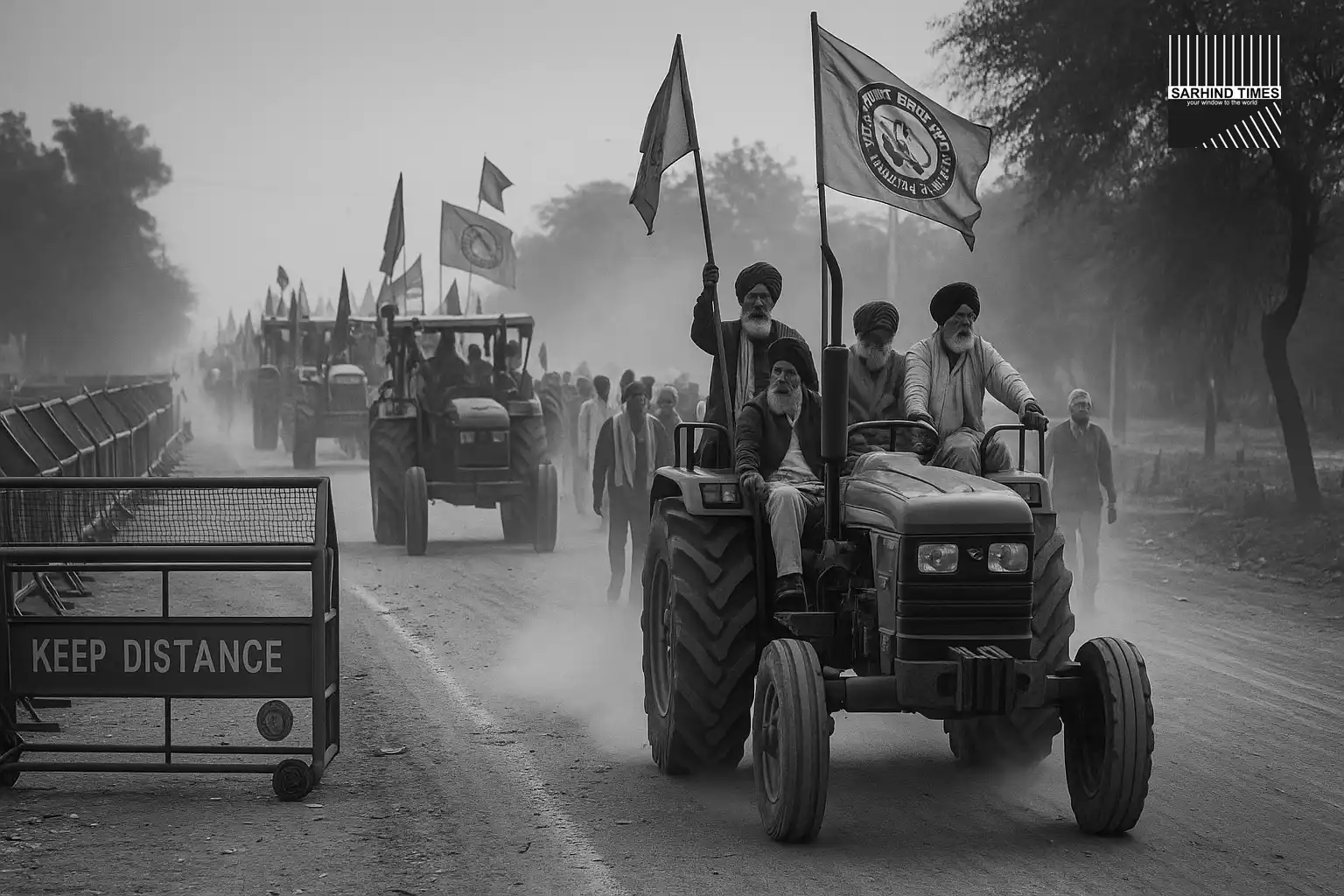
On Friday morning, hundreds of tractors assembled at the mini-secretariat area on Gohana Road in Jind town. Farmers, led by local union leaders including Sushil Narwal, Dharampal Khatkar and Ravinder Hasanpur, held a sit-in demonstration outside the building, burning effigies of state policymakers and staging protest songs and slogans. Their demands included: immediate cancellation or suspension of the IMT project, full disclosure of land-acquisition plans, assurance of livelihood rights, high compensation rates tied to current land values, and guarantee of alternate employment for impacted families.
Among the key triggers was the allegation that government consent submissions on the land-portal showed entries made on behalf of farmers without their knowledge. One protester explained, “They uploaded our names, clicked consent boxes, but we neither signed nor were present in the meetings that the portal claims we attended.” A memorandum submitted to the Deputy Commissioner’s office on behalf of the farmers demanded that the entire portal-consent record be audited and the IMT project halted until transparent, inclusive consultations are held.
Farmers’ grievances: land, livelihoods and trust deficit
At the heart of the protest are several structural concerns. First, the nature of acquisition: historically, farmers accuse previous land‐acquisition programmes in Haryana of delivering undervalued compensation, failing livelihood transition support and leaving families landless. They fear the IMT project may replicate such outcomes unless safeguards are strong.
Second, livelihood impacts: The “model township” framing suggests that land will be repurposed for factories, warehouses, mixed-use developments and logistics nodes — but farmers emphasise that many land-owners rely on agriculture or leasing plots to tenants. Once land is converted, the rental income, agricultural wage employment and ancillary activity may evaporate. They ask: what will replace that functional ecosystem?
Third, consultative process: Farmers assert that the notification of the IMT project advance has created an atmosphere of inevitability, pressuring villages to acquiesce. They argue that meaningful consultation — village-assembly level dialogue, independent valuation of land, livelihood planning, alternate land allotment or job quotas — has not been undertaken. The claim of “uploaded consent” exacerbates distrust in official processes.
Government response and assurances
The Deputy Commissioner, Jind, Mr Mohammad Imran Raza, addressed the protesters later in the day, acknowledging some of the concerns and stating that an investigation would be launched into the consent-upload allegations. The administration said it would verify village-level data on the portal and promised to constitute a committee comprised of villagers, agriculture-department officials, revenue-department officials and independent experts to review compensaton rates and acquirement impacts.
However, the government clarified that the IMT project is at a conceptual stage and no final tendering or land-handover has yet occurred. The Haryana Industries Department reaffirmed that the IMT is intended to generate employment, logistics-linkage with the Delhi-Katra Expressway, attract investment and boost the regional economy. Officials emphasised that compensation rates will be set higher than past acquisitions and that priority employment will be given to local residents. But they also cautioned that delays may raise project cost and investor interest risk.
Stakeholder perspectives: industry, farmers, policymakers
From the perspective of industrial-policy planners, the IMT is part of Haryana’s drive to deepen its industrial footprint beyond the NCR belt. With land-acquisition consolidated and expressway infrastructure growing, the state sees potential for logistics hubs, export-oriented units and new manufacturing clusters. Proponents argue that rural districts such as Jind can become benefit-zones if land is converted, if jobs are created and if ancillary services follow.
Conversely, farmers remain sceptical about past track-record: they cite instances where earlier industrial projects in Haryana delivered fewer jobs than promised, where land values appreciated only for developers, and where ecological or displacement costs were borne by local communities. A local farmer said: “For us, the land is not just asset but livelihood. When it goes to an IMT, we hope the job and rental incomes will come back — but who guarantees that?”
Legal and policy angles
The land-acquisition issue in Haryana is governed by the Right to Fair Compensation and Transparency in Land Acquisition, Rehabilitation and Resettlement Act, 2013, and subsequent state rules. Farmers argue that the hustling of “portal consent” without proper physical signature violates the spirit of these laws, which require social-impact assessment, consent-of-land-owners, and livelihood support. In addition, some analysts point out that the concept of “model townships” in high-growth corridors tends to privilege large developers and out-of-district occupation, potentially exacerbating regional inequality and land dispossession unless managed carefully.
The protest also overlaps with the Delhi-Katra Expressway development, a major expressway likely to create corridor-land pressure and speculative inflation. The farmers worry that once expressway proximity is monetised through acquisition, conversion and leasing, traditional agriculture may be sidelined.
Regional and future implications
The Jind protest highlights a broader dynamic in Northern India: as infrastructure and industrial corridors expand, rural land-owners are increasingly repositioned as suppliers of land, but the question of whether they become beneficiaries of post-conversion value remains contested. The outcome in Jind may set precedent for how acquisitions in Haryana’s less-urbanised districts are handled — with implications for land-rights, agrarian livelihoods and industrial strategy.
If a negotiated settlement emerges — with transparent consent, fair compensation, local job quotas, leasing-mechanism for farmers and infrastructure investment in villages — the IMT could become a model for inclusive transition. If not, the risk of protracted agitation, project delays and social instability grows. For the state government, the balancing act will involve negotiating investor timelines, land-owner rights and rural economic futures.
What this means for farmers and the local community
For the farming households in Jind, the situation is urgent. Many face two uncertain futures: continue farming in a district increasingly earmarked for industrialisation and expressway-sprawl, or give up land and expect non-farm livelihoods that may never fully materialise. The protest asserts that acquisition must not be replaced by precarious employment, and that land-donors must capture a part of the upside of conversion rather than only receive nominal compensation.
The local villages also worry about ecological and service-delivery impacts: water-table pressure if industrial units come in, road-traffic increase, dust and noise pollution, pressure on public utilities, and potential marginalisation of small-tenant farmers. Ensuring that villages receive infrastructural upgrades, schooling, healthcare and opportunity will be critical to realising inclusive growth.
What comes next: negotiation and possible outcomes
In the short term, the Deputy Commissioner’s investigative committee is expected to begin its work in the next two weeks. If farmers’ consent-concerns remain unaddressed, more widespread blockage of highways and longer sit-ins are likely. For the government, a compromise package may involve revised compensation, lease-back models where farmers can rent land to developers, local employment guarantees, and phased acquisition linked to project-activation. Industrial-policy watchers will be keen on how quickly final implementation approvals are rolled out and whether investor timelines remain unaffected. Longer-term outcome will depend on whether the IMT project becomes inclusive of local communities or remains primarily investor-driven.
Concluding thoughts
The protest in Jind once again places the spotlight on the tension between land-intensive industrial development and agrarian livelihoods in India’s growth narrative. It raises questions about how rural land-owners share in the transition from agriculture to industry, how consent and compensation mechanisms function in fast-changing corridors, and whether state policy recognises the rights of land-donors beyond mere monetary compensation.
For Haryana, the stakes are high: the IMT near Uchana Kalan could shape the region’s future — either as a catalyst for jobs and infrastructure or as a further node of agrarian dislocation. The way the government and farmers navigate this junction will matter not just for this project, but for how the state manages its land-development strategy going forward. Negotiation, transparency and meaningful inclusion will be essential if the transition is to be both economically powerful and socially equitable.



+ There are no comments
Add yours