
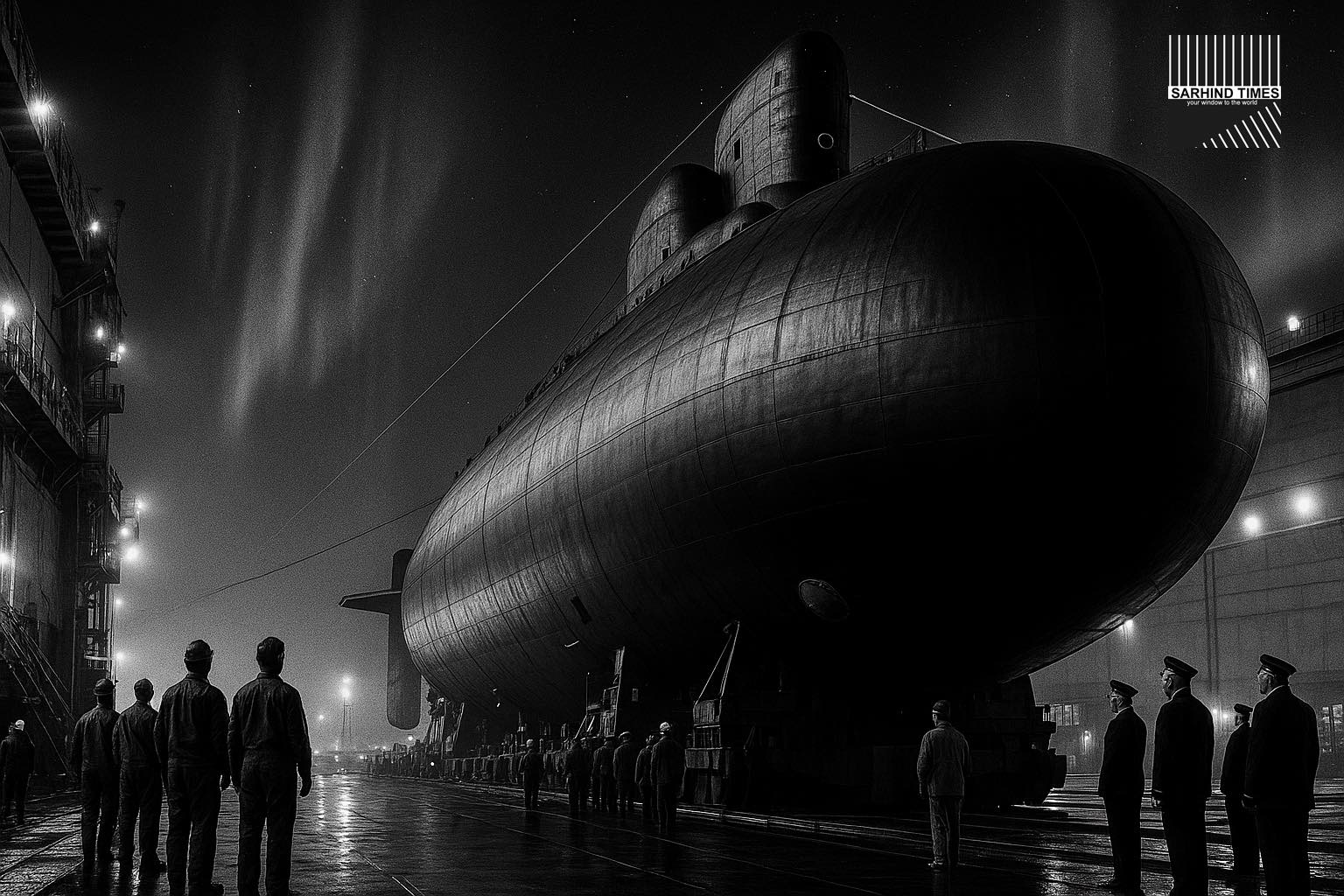
Moscow’s launch of advanced undersea nuclear-weapon system signals deepening arms race and global maritime shift
Dateline: Moscow / Severodvinsk | 4 November 2025
Summary: Severodvinsk’s Sevmash shipyard hosted a high-profile launch by Russia of its new nuclear-powered submarine Khabarovsk‑class submarine, designed to deploy the underwater nuclear drone Poseidon torpedo — often referred to as a “doomsday missile”. The move is being viewed by defence analysts as a bold escalation in underwater strategic weapons and a fresh challenge to global deterrence norms.
The launch: what happened and what was announced
In a televised ceremony at the Sevmash shipyard in Severodvinsk, attended by the Russian Defence Minister Andrei Belousov and Navy Chief Admiral Alexander Moiseyev, the nuclear-powered submarine Khabarovsk was officially launched. According to Defence Ministry statements, the vessel has been engineered to carry advanced underwater weapons and robotic systems, notably the Poseidon underwater drone which earlier this week was claimed to have undergone a successful test.
Belousov described the event as a “significant moment” for Russia’s maritime capabilities, stating that the vessel would enable the country “to successfully ensure the security of our maritime borders and protect our national interests in the world’s oceans.” Reports emphasised that the Khabarovsk-class submarine is optimized for deployment of the Poseidon system — described as a nuclear-powered unmanned underwater vehicle with inter-continental range and deep-sea stealth capabilities.
The launch follows Russian President Vladimir Putin’s announcement days earlier that the Poseidon drone had been successfully tested, including activation of its nuclear power unit, and that no known system could intercept the weapon.
The weapon system: Poseidon and the new underwater deterrent
The Poseidon drone (sometimes called a nuclear-powered torpedo) has been described by Russian officials and state media as representing a “new category” of strategic weapon: one that travels underwater at depth over long range, carries a nuclear warhead (reportedly up to two-megaton yield in some analyst estimates), and can be launched from submarine platforms including Khabarovsk.
While independent verification of all claimed performance metrics is lacking, it is widely accepted that the system marks a shift from traditional ballistic-missile deterrence toward a second-strike under-sea capability. Publication detail show that the Khabarovsk is the “mother submarine” designed to carry and launch the Poseidon drone at mission-readiness, which may complicate tracking and interception by adversaries.
The weapon has been dubbed by some Russian officials as a “doomsday missile”. Senate Defence Committee chair Andrei Kartapolov said it is “capable of wiping out whole coastal nations”. Deputy Security Council Chairman Dmitry Medvedev used similar language calling it “a strategic deterrent beyond anything previously deployed”.
Global strategic implications and escalation risk
The launch and official disclosure come amid heightened tensions between Russia and Western alliances, particularly with respect to the war in Ukraine and Arctic/maritime competition. The introduction of the Khabarovsk-Poseidon combination raises several strategic-implication issues:
- Deterrence shift: Traditional nuclear deterrence is built around missile silos or submarine-launched ballistic missiles (SLBMs) appearing above water; an underwater, stealthy torpedo-drone changes the dynamics of tracking, warning and defence. It potentially lowers the threshold of detection and increases uncertainty for adversaries.
- Arms race acceleration: Analysts say the development risks prompting rival states (notably the United States and parts of NATO) to accelerate their own under-sea/anti-submarine warfare capabilities, prompting a new arms-race frontier in submarine drones and under-sea nuclear systems.
- Maritime domain pressure: Countries with long coastlines (such as U.S., UK, Japan) may feel heightened vulnerability; the under-sea domain is inherently hard to monitor, and the new system increases the complexity of defence postures for coastal states.
- Arctic/Indian Ocean theatres: Russia’s new submarine capability underscores its increasing focus on Arctic and global blue-water missions, augmenting deterrence not just regionally but globally — shifting the balance of under-sea power projection into areas previously vulnerable or contested.
Regional and Indian considerations
For India, the launch bears significance on several fronts. Russia has historically been a major Indian defence supplier, and India’s own submarine/under-sea capabilities are evolving — the Khabarovsk launch sends a message about capabilities that India’s strategic community will want to monitor. The Sevmash shipyard itself earlier undertook the retrofitting of India’s aircraft carrier INS Vikramaditya, underscoring the bilateral defence links and potential technology-flow interface.
The broader Indian Ocean and Indo-Pacific naval balance may be impacted: a Russian submarine carrying a new class of deterrent changes the deployment matrix, especially in the northern Indian Ocean, Arabian Sea and Pacific approaches. India may need to reassess its under-sea detection, maritime domain awareness and deterrence partnerships (including with the U.S., Japan and Australia) in light of emerging under-sea nuclear-drone systems.
Technical challenges and credibility questions
Despite the dramatic official language, independent weapons-analyst comment suggests several caveats:
- The physical feasibility of a long-range underwater drone producing large “radioactive tsunami” waves as claimed has been subject to debate, with sceptics citing past Soviet experiments that found continental shelf propagation and ocean dissipation limited such effects.
- The logistics of reliably carrying out deep-sea missions with nuclear-powered drones, guidance, communication, launch and recovery in adversarial ocean environments remain technically demanding and unproven at full scale.
- The deterrent effect may rely more on perception of risk than actual verified mass-destruction capability — meaning much depends on signalling, doctrine and threshold of use rather than purely on physics.
Nevertheless, even if the full claimed performance is not yet validated, the system represents a technological leap and a symbolic reset of under-sea strategic weapons thinking.
What’s next: timelines, monitoring and response
Going forward, several factors will shape how this development unfolds:
- Sea trials of the Khabarovsk-class submarine and Poseidon drone are expected to proceed over the next 12–18 months, including submerged deployments, launch protocols and operational certification.
- Western and allied navies will step up anti-submarine warfare (ASW) capabilities, under-sea drone detection, unmanned underwater vehicle (UUV) counters, sonar enhancements and satellite/in-water acoustic networks to monitor new threats.
- Arms-control implications: The launch may bring renewed pressure on international arms-control frameworks, including efforts to regulate under-sea nuclear-drone systems, treaty implications and transparency of novel strategic weapons. Some observers suggest this may spur new arms-control dialogues or resume dormant talks on naval nuclear deployments.
- Regional security recalibrations: Especially in the Indo-Pacific and Indian-Ocean rim, countries may deepen cooperative maritime surveillance, shore-based sensor networks, submarine-fleet modernisation and shared ASW platforms. For India, naval partnerships, intelligence sharing and deterrent posture may get sharper focus.
Analyst commentary: what the launch signals
Defence commentary broadly agrees that the Khabarovsk-Poseidon combination is less about immediate war-fighting and more about strategic signalling — a statement of Russia’s ambition to modernise its deterrent, complicate adversary planning and carve space in a new under-sea strategic domain. One senior analyst described it as “an underwater equivalent of the ballistic-missile arms race of the Cold War, but in the deep ocean.”
Another commentator noted: “The value is as much psychological and geopolitical as technical. If you cannot be sure where or when a strike might come from beneath the waves, your adversary’s patience and posture get stressed.”
Conclusion: a new era in under-sea deterrence dawns
The launch of the Khabarovsk submarine and emissions around the Poseidon nuclear drone herald a new phase in naval strategic weapons. While a full operational deployment may lie ahead, the message is clear: under-sea domains are now a major theatre for nuclear-capable systems and deterrence architecture is evolving accordingly.
For global security this presents both a technological and doctrinal challenge: how to detect, deter and defend against threats from beneath the waves. For India and other regional powers, the reckoning is more immediate: balancing deterrence, alliances, surveillance and preparedness in a changing maritime-strategic landscape. In the coming months, monitoring trial progress, doctrine updates and allied responses will be key to assessing if this is merely a landmark statement or a genuine shift in strategic power.


+ There are no comments
Add yours