
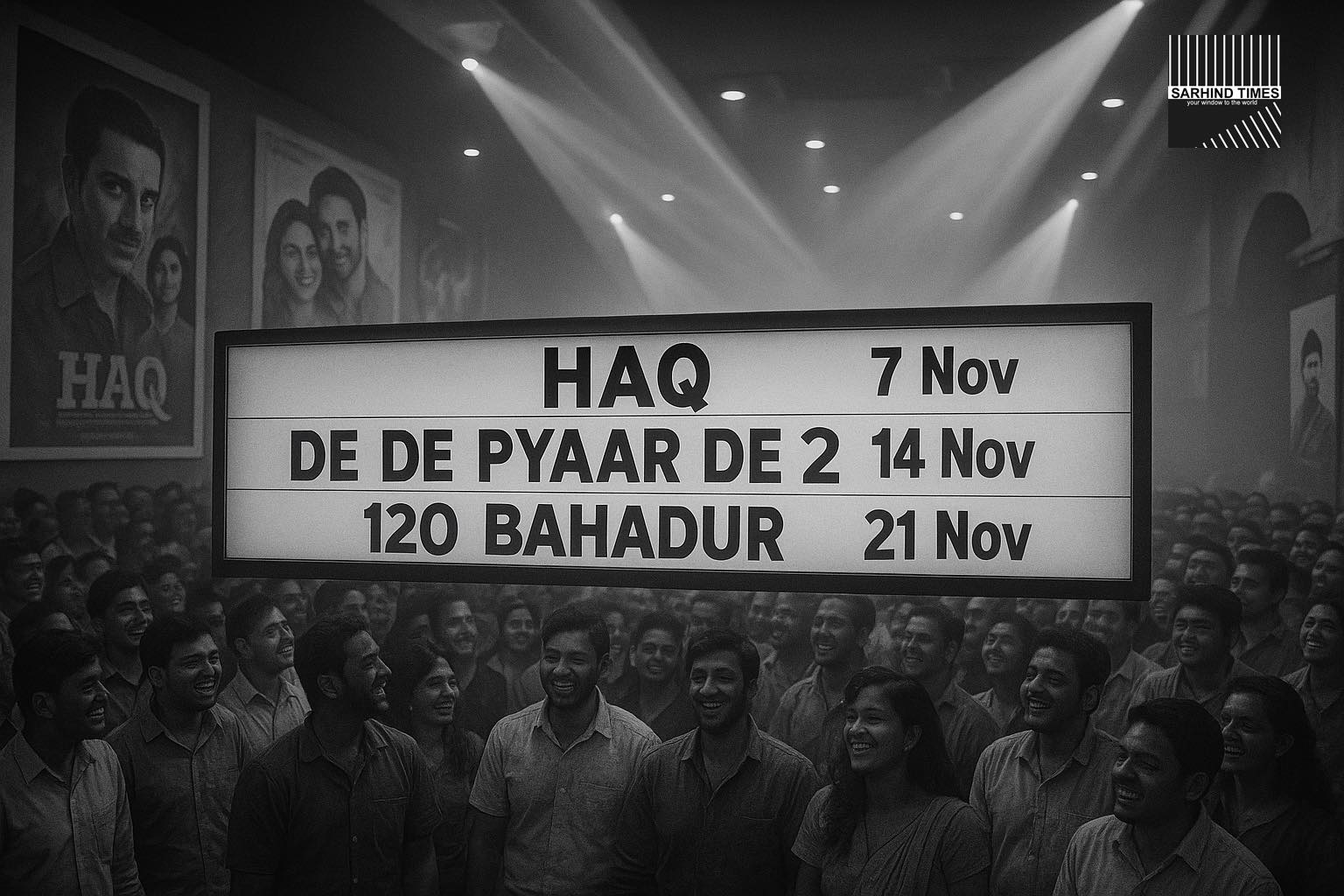
November 2025 brings a dynamic film slate across genres—from intense social-justice drama to patriotic war-epic and star-studded romance—underscoring Bollywood’s strategic push toward diversified storytelling and wide-release timing.
Dateline: Mumbai | 2 November 2025
Summary: As the Indian festive season transitions into winter, Bollywood is gearing up for a high-stakes release window in November 2025. Leading titles include HAQ (7 November) starring Emraan Hashmi and Yami Gautam in a courtroom drama rooted in social justice; De De Pyaar De 2 (14 November) bringing a light-hearted romantic-comedy sequel; and 120 Bahadur (21 November) featuring Farhan Akhtar in a war-epic reflecting India’s military valor. Adding emotional depth is Tere Ishk Mein (28 November) starring Dhanush and Kriti Sanon, directed by Aanand L Rai. Together, these films mark Bollywood’s attempt to span genre, scale and audience appeal, signalling a confident end-of-year push.
The Strategic Release Window
November has emerged in recent years as a critical release window for Indian cinema. With the festive carry-over from Diwali, school vacations in many states and an appetite for marquee content before year-end, filmmakers view this month as ideal for both wide releases and genre experimentation.
This year, studios and distributors appear to be orchestrating a layered release strategy: the month begins with a serious and socially resonant film, moves into commercial-friendly territory mid-month, peaks with a large-scale war epic in the third week and closes with an emotionally rich romance. This sequencing appears designed to keep momentum and media attention high, allowing audiences to engage across different mood-zones.
Film 1: HAQ (7 November) — A Courtroom Reckoning
HAQ, starring Emraan Hashmi and Yami Gautam, is scheduled to release on 7 November. The film draws inspiration from a landmark legal case and centres on issues of justice, gender rights and social norms. The legal dispute on which the plot is based has been referenced in press reports and generates substantial pre-release buzz.
What stands out in HAQ is Bollywood’s increasing willingness to delve into judicial-social narratives rather than purely commercial escapism. The presence of veteran actors in a serious drama signals confidence that audiences are ready for impactful subject matter alongside entertainment. Additionally, the early-November release places HAQ ahead of heavier holiday fare, giving it a chance to establish legs and word-of-mouth before blockbuster competition.
From a production and marketing standpoint, HAQ has leveraged its real-life case connection, strong star casting and a special certificate classification that suggests broader-audience suitability (i.e., UA rather than strict adult rating). The film’s distributor and promotional campaign are banking on critical reception and social-media resonance to drive attendance, especially in urban multiplexes.
Film 2: De De Pyaar De 2 (14 November) — Romance, Comedy and Franchise Value
Where HAQ opts for weight, De De Pyaar De 2 represents the kind of commercial mid-range comedy-romance that Bollywood leans on for broad-market draw. Scheduled for 14 November, the sequel brings back a known franchise with star-power, humour and mass-appeal. The timing—just a week after HAQ—allows the marketplace to shift gears from serious drama into lighter fare, catering to families and multiplex-audiences eager for entertainment.
From a strategic viewpoint, the sequel format provides studios with a built-in audience, reducing marketing risk. It also gives front-row exhibitors a strong proposition in the pre-holiday tilt, before marquee releases saturate screens. The film’s mid-month slot offers favourable window for music, promotions and audience engagement in the lead-up to its launch.
Film 3: 120 Bahadur (21 November) — Patriotic War Epic and Casting Scale
120 Bahadur, set for release on 21 November, occupies the third-week slot and represents the biggest production among the four highlighted titles. With Farhan Akhtar in a war-hero role depicting the Battle of Rezang La of the 1962 conflict, the film taps into India’s enduring appetite for military-valor narratives, patriotism and scale cinema.
The choice of release date aligns with the anniversary of the battle and allows the film to benefit from national-mood alignment. Production houses are promoting IMAX screenings, scaled-up visuals, high-spec VFX and immersive sound—indicating a push beyond the usual Bollywood formula into spectacle territory. This film also signals the growing trend where Indian studios invest in large-budget war dramas that can travel overseas (to diaspora markets) and appeal to premium formats.
From a commercial lens, placing such a film mid-week may allow extended weekend runs, premium ticketing (IMAX, luxury screens) and anchor the larger cinemas ahead of year-end competition (which may include Hollywood releases or year-close Indian films). Occupying the third week also maximises screen-share before the month closes, and allows the sequel from the previous week to settle into routine run-time reductions.
Film 4: Tere Ishk Mein (28 November) — Emotional Depth and Cross-Market Appeal
Closing the month is Tere Ishk Mein, releasing 28 November, starring Dhanush and Kriti Sanon and directed by Aanand L Rai. Positioned as a romance with emotional-psychological layers and cross-market appeal (Hindi and Tamil markets are referenced), this film caters to both the commercial-urban-youth segment and the South-India star-influence audience.
The late-November slot allows promotional build-up (teasers, music drops, cross-media campaigns) after the earlier releases in the month. It also targets the initial holiday-period crowd (as December approaches) while avoiding immediate clash with late-november heavyweights or year-end epic releases. The cross-regional casting suggests strategic intent to draw from pan-India audiences, not just Hindi-belt markets.
Genre and Audience Spread — A Diversified Slate
This slate demonstrates Bollywood’s more considered genre-spread: from social-drama (HAQ) to mass-rom-com (De De Pyaar De 2), war-epic (120 Bahadur) and cross-regional romance (Tere Ishk Mein). The release spacing is designed to keep the month lively. Studios appear to be calibrating for varied audience segments—multiplexes, tier-two theatres, diaspora locations—as well as leveraging the festive/down-time window when movie-going spikes.
The month’s strategy also indicates commercial programme design: early-month drama may attract critics and multiplex audiences, mid-month comedy appeals to families and mass markets, third-week spectacle targets broad screens and events, and final-week romance hacks into youth and multiplex repeats. This layered roll-out can sustain conversation and keep cinema-attendance momentum flowing across the month.
Marketing, Box-Office Expectations and Risks
From a business perspective, the success of this window depends on sustained box-office momentum, effective promotions and clear screen-allocation. Each film carries its own risk-profile:
- HAQ risks: While socially relevant dramas have grown in appeal, performance still hinges on word-of-mouth, urban-multiplex traction and critical reception. Without strong pre-release buzz beyond initial announcements, the film may struggle to scale into tier-two markets.
- De De Pyaar De 2 risks: Sequels bring expectation but also comparatives. If the humour or franchise-energy is weaker than predecessor, audience may drift. Mid-month slot helps but competition may emerge.
- 120 Bahadur risks: War-epics are high-investment and screen-demand intensive. They require strong marketing, premium-format traction and broad audience buy-in. Any negative word-of-mouth can amplify losses. Also timing may matter if other blockbusters crowd the slot.
- Tere Ishk Mein risks: Positioned cross-regionally, the film must deliver in multiple language markets. Romantic-drama genres often rely heavily on music and youth response; if the content fails to differentiate, box-office may plateau.
On the upside, the month’s lineup benefits from favourable macro-factors: audiences are likely to have greater leisure time, multiplex occupancy historically improves in late-year, and studios may price premium formats to enhance revenues. Strategic TV and digital-tie-ups (music rights, OTT after run) further bolster revenues.
Implications for Bollywood and Indian Film Market
This release pattern signals Bollywood’s maturation: strategically spaced releases, genre-diversity, cross-regional star power and investment in spectacle. It reflects a shift from undifferentiated ‘one-size-fits-all’ Hindi-film strategy toward nuanced positioning. The prominence of social-drama, war-epic and pan-India romance in one month suggests studios are placing bets across risk-profiles rather than relying only on mass-masala formulas.
For the Indian film industry, this may mark the continuing evolution of release windows, audience segmentation, marketing sophistication and revenue diversification—including premium formats, overseas markets, digital roll-outs and multi-language versions. If the films perform as expected, this could reinforce November as a key pillar of annual film-business calendars.
What Audiences Should Look Out For
Cine-goers in India may keep an eye on several factors: early box-office performance of HAQ will set tone; the mid-month shift to comedy may refresh multiplex inventory; 120 Bahadur’s performance will test appetite for large-scale war cinema mid-calendar; and Tere Ishk Mein’s cross-region appeal will indicate further pan-India momentum for Hindi-film releases with South star collaborations.
Additionally, theatres may experiment with premium pricing, IMAX/reserve-seating, extended runs and advanced bookings given the thematic variety. For streaming/digital platforms, the timing may accelerate post-theatrical windows and licensing negotiations given the clustered slate.
Conclusion
November 2025 in Bollywood is set to deliver a compelling mix of genres, star-vehicles and strategic release timing. From the serious tone of HAQ to the humour of De De Pyaar De 2, the grandeur of 120 Bahadur and the emotional depth of Tere Ishk Mein, the slate reflects an industry increasingly confident in variety and sophistication. For filmmakers, distributors and actors alike, the month offers opportunity—and challenge—to convert promise into box-office and cultural resonance. For audiences, it promises one of the more interesting film-lineups of the year.



+ There are no comments
Add yours