
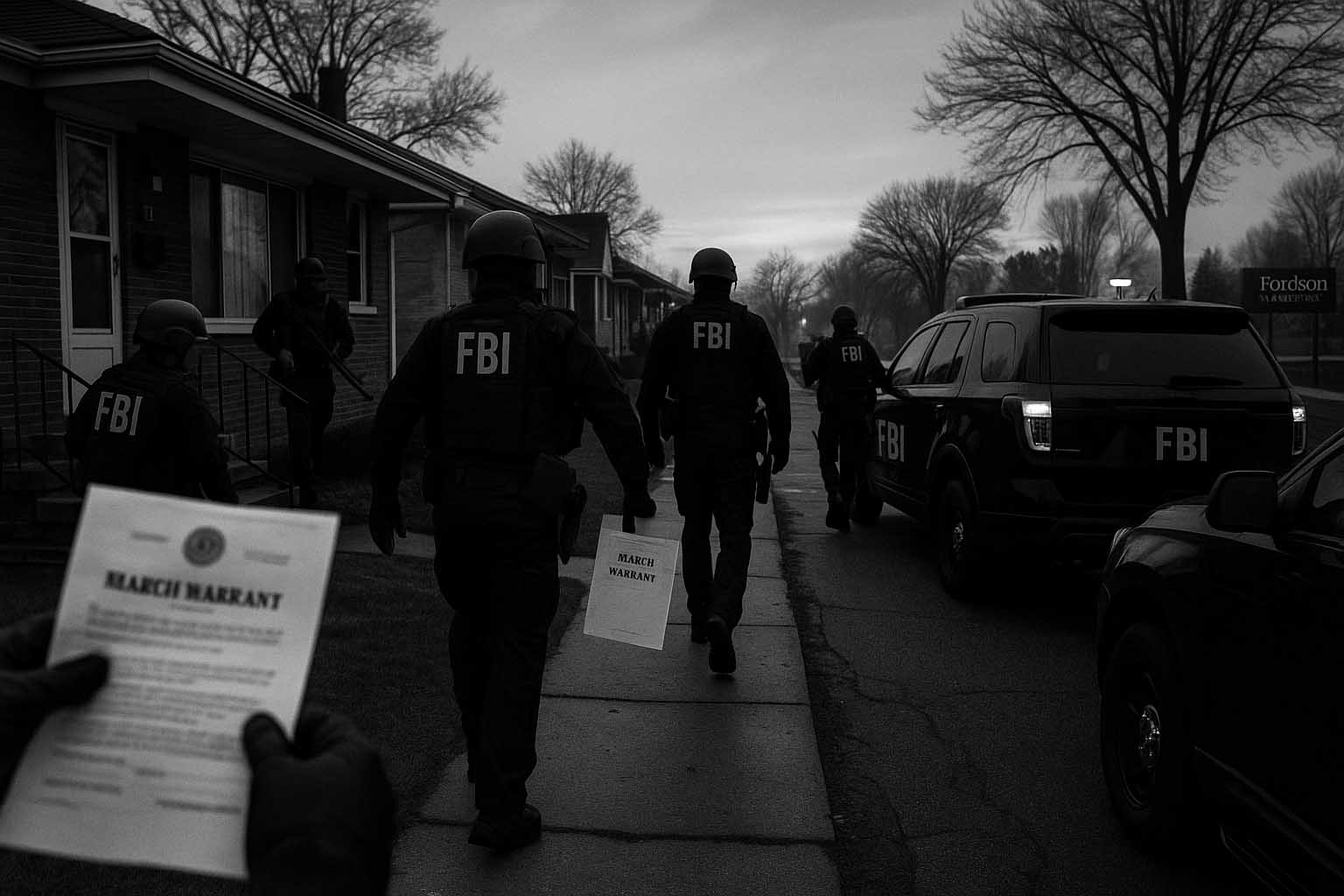
Multiple arrests in Detroit suburbs after federal agents intercept ISIS-inspired attack plan
Dateline: Washington, D.C. | 01 November 2025
Summary: The Federal Bureau of Investigation (FBI) announced that it foiled a planned violent attack in Michigan timed for Halloween weekend. Several suspects, including teenagers, were arrested in suburban Detroit after online chatter referencing “pumpkin day” triggered federal monitoring of an alleged ISIS-inspired plot.
Early morning arrests signal heightened homeland security alert
In a dramatic early-morning operation on 31 October 2025, the FBI announced the arrests of several individuals in the Detroit suburbs of Dearborn and Inkster. Federal agents, acting on intelligence that identified an emerging domestic terror threat tied to extremist ideology, moved in just hours before Halloween festivities were set to begin. According to FBI Director Kash Patel, the suspects were allegedly plotting an act of violence scheduled “over Halloween weekend.”
The raid came after investigators monitoring online chatrooms observed references to “pumpkin day,” a coded mention that authorities interpreted as time-sensitive to the holiday. The phrase raised alarm bells within the FBI’s Joint Terrorism Task Force operating in the Detroit metropolitan area.
“This morning the FBI thwarted a potential terrorist attack and arrested multiple subjects in Michigan who were allegedly plotting a violent attack over Halloween weekend,” Director Patel posted on social media. “Thanks to the men and women of the FBI and law enforcement everywhere standing guard 24/7 and crushing our mission to defend the homeland.”
Details of the Missouri-Michigan operation and evidence collected
Federal and local law enforcement agents executed search warrants at a residence in Dearborn near Fordson High School and at a storage facility in Inkster. Surveillance footage and neighbor accounts describe vehicles arriving before dawn, agents in tactical gear entering homes, and evidence being transported out.
A Michigan State Police spokesperson confirmed that while no immediate threat to public safety persisted, the operation was the culmination of months of monitoring and intelligence-gathering. Arrests included juveniles and young adults aged between 16 and 20. Reports indicate the group had engaged in firearms training, including at shooting ranges, and were inspired by extremist content linked to the Islamic State of Iraq and Syria (ISIS).
One law-enforcement source told investigators: the suspects had explored the possibility of plotting an assault, though no specific target, time or location has been officially disclosed. The online group had argued over readiness and weapon procurement when references to “pumpkin day” surfaced, prompting swift action to prevent escalation.
Home-grown radicalisation and the “pumpkin day” code
Analysts say the Michigan foiled plot underscores a growing trend of domestic radicalisation influenced by international terror organisations, yet executed by largely unsophisticated individuals within the U.S. One of the key triggers for the FBI in this case was the choice of a seasonal reference to Halloween—“pumpkin day”—which served as a cryptic timeline marker.
Investigators believe the group used encrypted online chat rooms or social-media platforms to coordinate. During the probe, the FBI engaged undercover operatives and monitored suspicious communications that referenced extremist ideologies and holiday-related code words. One commenter referenced the earlier 2025 Michigan case where a former Michigan Army National Guard member was arrested for an ISIS-linked attack plot.
While the term “pumpkin day” may appear innocuous, officials warn that such innocuous-sounding phrases are deliberately employed by extremist cells seeking to evade detection. Homeland-security experts say the use of cultural events—such as Halloween in this survey—provides a masked timeline and festive cover for potential attacks.
Community response and local impact
Residents of the Dearborn neighbourhood described waking to a large presence of federal and state vehicles, marked evidence vans, and agents escorting occupants from homes. One neighbour said: “It’s really scary because we have a lot of relatives around this neighbourhood.” Another noted the early morning sense of urgency: “Place looked like a full-scale operation though we still haven’t got official details.”
Michigan Governor Gretchen Whitmer tweeted her appreciation for the swift action taken by the FBI and Michigan State Police, writing she was “gratified for the swift action of the FBI and MSP protecting Michiganders.” Local law-enforcement spokespeople emphasised that the Halloween events scheduled for the weekend in Detroit would proceed, citing the “no current threat” assessment by federal agents.
National security implications and policy questions
The incident raises broader questions about the scale and nature of domestic terror threats in the U.S. While official statements avoid naming the conspiracy as a fully developed plot with a confirmed target, the FBI’s decision to move early indicates that threshold was reached where preventative action was considered imperative.
Counter-terrorism experts point out that modern extremist actors are increasingly leveraging accessible online platforms, live chats, encrypted messenger services, and social-media forums to communicate, monitor and radicalise new recruits. The Michigan case typifies this trend where youth, firearms access and extremist ideology converge. In public remarks, the FBI and Department of Justice officials emphasised that “home-grown radicalisation remains a top priority” and that early detection via digital channels must continue to evolve.
For India and global partners, the case underscores the transnational dimension of extremist threats—even when plots remain domestic. As the world grapples with hybrid threats from ideology, state actors and lone individuals, the Michigan example may spur enhanced intelligence sharing, cross-border tracking of online extremist content, and local law-enforcement readiness for loosely connected plots.
Timeline, methodology and investigative challenges
The publicly available timeline is sketchy but indicates that the probe began weeks ago when intelligence units noted talk of a violent event scheduled around Halloween. After the “pumpkin day” reference emerged, joint task-force units flagged the discussion, tracked participants, identified physical locations (shooting range training, storage facility), and secured search warrants.
Investigators faced the usual challenge of distinguishing between vague extremist talk—which might not advance to action—and imminent threat. The rapid escalation from chat-room discussion to search-warrant execution reflects the agents’ assessment that the break-point had been reached: a plot moving from rhetoric to procurement and readiness.
In this case, arrests included minors, highlighting the difficulty in oversight when radicalisation happens in private spaces and digital bubbles. Officials say the weapons involved were legally owned firearms, and investigators are exploring whether the group included elements of foreign support or purely domestic radicalisation. The disclosure of arrests before full public briefing has triggered internal debate on the balance between transparency and operational integrity.
Legal, judicial and constitutional facets
From a legal perspective, the Michigan case underscores how U.S. law handles domestic terrorism, especially when suspects are minors or young adults and where controversial issues around entrapment, free speech, and warrant-less surveillance may arise. Federal statutes relating to material support for terrorism, conspiracy to commit acts of violence, and state law provisions for gang or extremism-related offences all interplay.
Some civil-liberties advocates have voiced concern that broad monitoring of online chat forums could encroach on privacy rights—especially when the threshold of “planning” versus “talk” remains ambiguous. On the other hand, law-enforcement officials argue that the evolving modus operandi of extremist actors demands proactive intervention and that the legal system must adapt accordingly.
Global perspective: what this means beyond U.S. borders
While the event occurred in Michigan, the implications ripple across international relations and homeland-security frameworks globally. For countries like India, Australia, the UK and the EU, the notion of loosely networked home-grown extremists drawing inspiration from global ideologies rather than clear command-and-control structures is a growing challenge.
Indian security analysts note that the same dynamic—youth radicalised online and equipped with locally available weapons—has emerged in various countries. The Michigan case reinforces the need for cross-border cooperation in tracking extremist content, sharing best practices in prevention, and strengthening domestic legal frameworks for radicalisation.
Looking ahead: prevention, policy and vigilance
In the wake of the foil, questions now centre on how authorities will refine their early-warning systems. Suggestions include enhanced monitoring of online extremist-ideology forums, improved federal-state coordination, community outreach to vulnerable populations (especially youth), and better firearms-control linkages that flag potential extremism risk. There is also discussion about school-based programmes to counter online radicalisation and increase awareness among educators and parents.
Critically, the incident demonstrates that Halloween, a cultural moment characterised by large crowds and festive roaming, can become a potential cover for violent acts. Authorities may now reassess event-day security planning, even for widely held celebrations deemed routine.
Conclusion
The foiling of this plot in Michigan is a clear reminder that homeland-security threats are evolving: they are less likely to stem from organised terrorist networks abroad and more from small, locally mobilised groups drawing inspiration from global ideologies. The use of symbolic events, coded language like “pumpkin day,” and easily accessible firearms complicates detection and prevention.
For Indian and global audiences alike, the incident prompts reflection on domestic-terrorism vulnerabilities, digital-radicalisation pathways, and the importance of robust intelligence and community resilience. While details remain limited publicly, the swift action by the FBI prevented what could have been a tragic event. The challenge now is to learn from the case, strengthen systems, and stay vigilant.



+ There are no comments
Add yours