
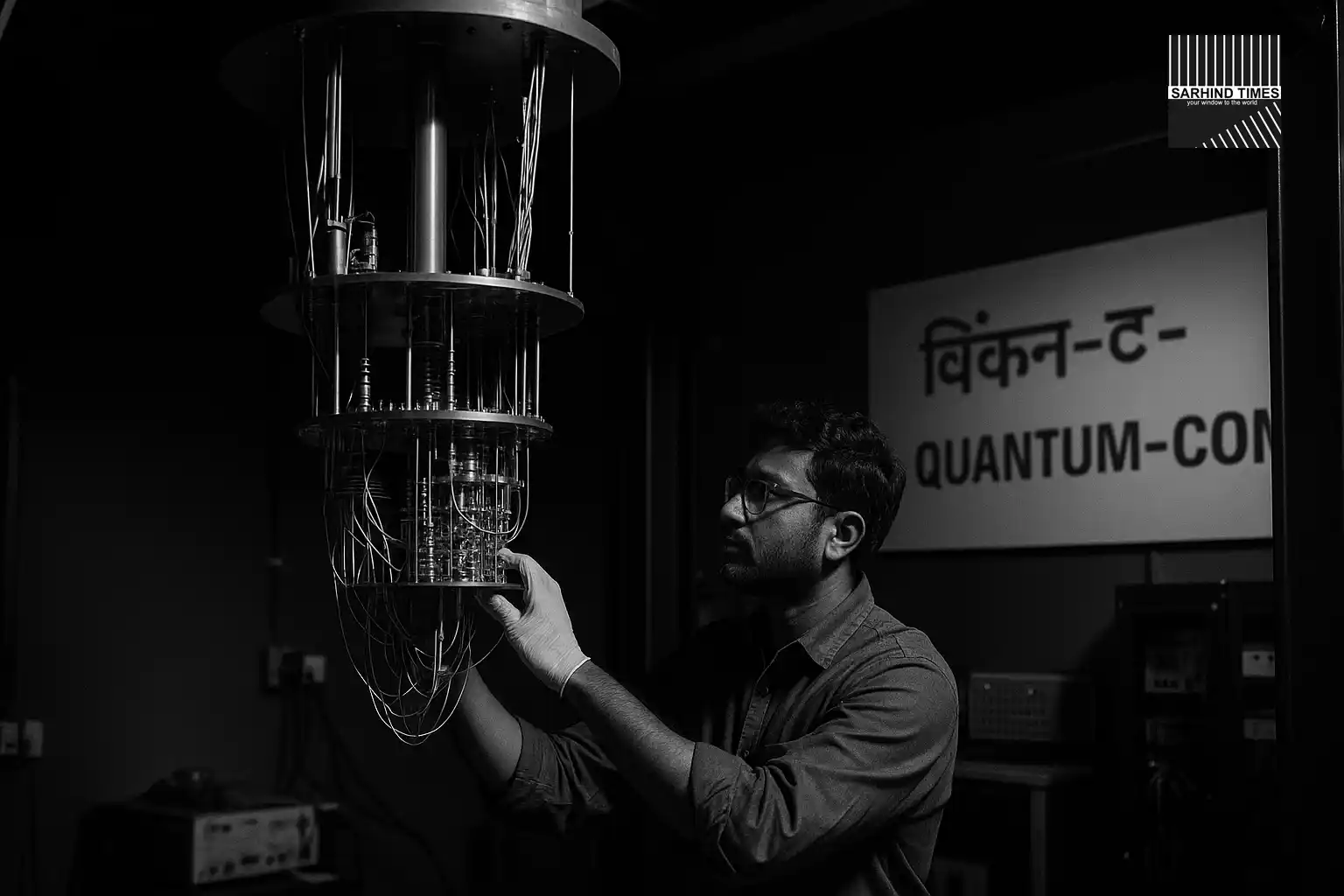
From new state-level hubs to regulator-led readiness plans, India positions itself for the quantum era
Dateline: New Delhi | 31 October 2025
Summary: India’s quantum technology ecosystem is gaining momentum via two converging developments: the Securities and Exchange Board of India (SEBI) has unveiled an action plan to ensure “quantum-safe” readiness of the financial markets. Meanwhile, states such as Amaravati (Andhra Pradesh) and Bengaluru (Karnataka) are investing in large-scale quantum-tech infrastructure, including reference-facilities and science parks. These developments signal that India is now actively preparing for the quantum computing age — both from the research-manufacturing side and from regulatory/market-risk governance.
Quantum computing: what it is and why it matters
Quantum computing uses the principles of quantum mechanics — superposition, entanglement, and quantum gates — to process information in fundamentally different ways than classical computers. Problems that would take classical machines millennia (such as certain optimisations, cryptographic breaking, large-scale simulations of chemistry or materials) could, in theory, be solved much faster by quantum machines.
The implications extend beyond research labs: in finance, cryptography, logistics, drug discovery, materials science and national security. A quantum computer that breaks existing cryptographic systems could render traditional cybersecurity obsolete, making investments in “quantum-safe” cryptography urgent. For this reason regulators and technology-policymakers globally are preparing frameworks to manage quantum risk and opportunity.
India’s twin strategy: Infrastructure + market security
India’s emerging approach to quantum can be dissected into two strands:
- Infrastructure and manufacturing build-out: For example, the Andhra Pradesh government announced a ₹40 crore reference facility at Amaravati’s Quantum Valley: this facility will allow testing, benchmarking and characterisation of quantum components — a step toward indigenous hardware manufacturing.
- Regulatory and market-security readiness: SEBI’s chairman, Tuhin Kanta Pandey, noted that quantum computing could in future break strong passwords and cryptographic systems — and the financial-market ecosystem must be prepared. SEBI is developing an action plan to help regulated entities become “quantum ready” by 2028-29.
Infrastructure push: what’s happening on the ground
The infrastructure thrust is bearing visible results:
- In Andhra Pradesh’s Amaravati region, the state government is positioning the so-called “Quantum Valley” as a hub for quantum hardware and measurement science — aiming to reduce reliance on imports and build a domestic quantum-tech ecosystem.
- According to Indian business-media tracking, India is preparing to ramp up quantum hardware capability via its national mission (the National Quantum Mission) and associated ecosystem.
- The electronics-hardware, cryogenics and component-supply segments are being targeted: e.g., the cryogenic-components facility announced (₹200 crore investment) underlines the heavy-engineering backbone needed for quantum systems.
Market-security focus: why SEBI’s role matters
The financial-markets regulator’s interest in quantum is notable for several reasons:
- Quantum attacks may render existing public-key cryptography vulnerable, threatening transaction security, digital-asset security and financial stability. SEBI’s recognition of this risk puts India ahead of many peer jurisdictions in proactive market regulation.
- SEBI’s planned “quantum-safe” roadmap suggests deadlines (circa 2028–29) for regulated entities (exchanges, brokers, custodians) to adopt or test quantum-resistant cryptographic frameworks.
- By signalling this early, regulators send strong signals to the Indian fintech, banking and capital-markets ecosystem: quantum-security isn’t just research-lab hype but a governance imperative. This could influence vendor-selection, system-hardening budgets and audit frameworks. Analysts at Indian media interpret this as “quantum computing may break passwords in a jiffy” and hence systems must adapt.
Interlinking infrastructure and regulation: the macro-economic picture
These developments feed into larger strategic aims:
- Technological sovereignty: India’s heavy dependence on imported semiconductors, quantum-components and high-end hardware has been a longstanding pain-point. Building domestic quantum hardware and reference labs helps reduce that dependency and supports the “Make in India” narrative for deep-tech.
- Deep-tech ecosystem growth: Quantum-computing hardware, cryogenics, calibration services, quantum-software and start-ups all form high-value segments. By investing early, India can capture parts of the value-chain rather than only consumer-tech.
- Economic value-capture and job creation: If India succeeds in building viable quantum hubs, it opens up opportunities in academic-industry linkages, start-ups, skilled-jobs, manufacturing clusters, export of quantum-components and services. These moves align with India’s transition to a knowledge-economy.
- Risk mitigation in digital economy: As India’s economy becomes increasingly digital (payments, fintech, capital-markets, cloud-services), the quantum-security angle is key to safeguarding that infrastructure. The regulator’s readiness plan reflects the importance of linking research to systemic resilience.
Challenges ahead: scale, talent and timeline
Despite the strategic momentum, significant challenges remain:
-
- Timeline and execution gaps: Quantum computing is still at a nascent stage worldwide. Being “quantum ready” by 2028–29 is aggressive and depends on hardware maturity, cryptographic transition, and systemic readiness. Some observers caution that quantum-hardware breakthroughs may lag.
- Talent-and-skills shortage: Quantum hardware, superconducting qubits, cryogenics, error-correction, quantum-software all demand highly specialised talent. Building a large enough talent-pool will take time and policy-attention. The state-level hubs must be matched by national training pipelines.
- Cost-and-capital intensity: Building quantum labs, reference-facilities, cryogenics, precision manufacturing is capital-intensive. Ensuring funding beyond announcements and translating them into working infrastructure is a key risk.
- Inter-operability and standards: For quantum-safe cryptography, global standards are still evolving. Indian regulators and industry must align with international frameworks (e.g., NIST quantum-cryptography transitions), else risk fragmentation.
- Market-expectation vs hype: Quantum computing headlines generate excitement, but realistic time-horizons (5-10 years) and constraints (error-rates, qubit coherence, scale) remain. The ecosystem must balance ambition with realistic planning.
Implications for stakeholders
Start-ups and academia: The policy environment now offers startups opportunities to build quantum-hardware prototypes, software tool-chains, cryogenic systems, high-performance computing integrations. Academic institutions may see increased funding and partnerships.
Industry and corporates: Companies in fintech, cloud-services, enterprise-software must begin “quantum-readiness” assessments: reviewing cryptography, identity systems, vendor risk, infrastructure resilience and long-term upgrade paths.
Government and regulators: Line ministries (MeitY, DST), state governments (Andhra Pradesh, Karnataka) and regulators (SEBI, RBI) must coordinate policy-alignment: manufacturing incentives, skills skilling, regulatory guidance and infrastructure funding must converge.
Investors: Deep-tech funds may now view Indian quantum-ecosystem as investible earlier. Hardware-startups, cryogenic-components, software frameworks and adjacent sectors (quantum-sensing, quantum-materials) may attract capital.
What to watch in the next 12–24 months
- Roll-out of state quantum hubs: e.g., when the Amaravati Quantum Valley begins full operations, first hardware commissioning, anchor startup launches.
- Cryptography/market-security updates: SEBI, RBI or MeitY may release guidelines for implementing quantum-safe cryptography in regulated entities (exchanges, banks, custodians).
- Start-up funding and commercialization: whether Indian quantum-hardware companies secure Series A/B rounds, partnerships with global vendors, export orders.
- Talent pipeline metrics: enrolment numbers in quantum-computing programmes, academic publications, hardware-patent filings, international collaborations.
Conclusion
India’s push into quantum computing is no longer just a statement of intent — it is progressing into concrete infrastructure and regulatory readiness. The intersection of building quantum-hardware capability and preparing market systems for quantum-era risks places India ahead of many emerging economy peers. That said, the road is long, the challenges real and the timelines ambitious.
For India, the goal is not merely to build quantum-chips or labs, but to integrate quantum-capability with economic-value, digital-security, and systemic resilience. As regulators call for quantum-safe readiness, and states build quantum valleys, India appears to be turning theory into strategy. Whether the ambitions are matched by execution will determine how this quantum chapter unfolds in the coming years.



+ There are no comments
Add yours