
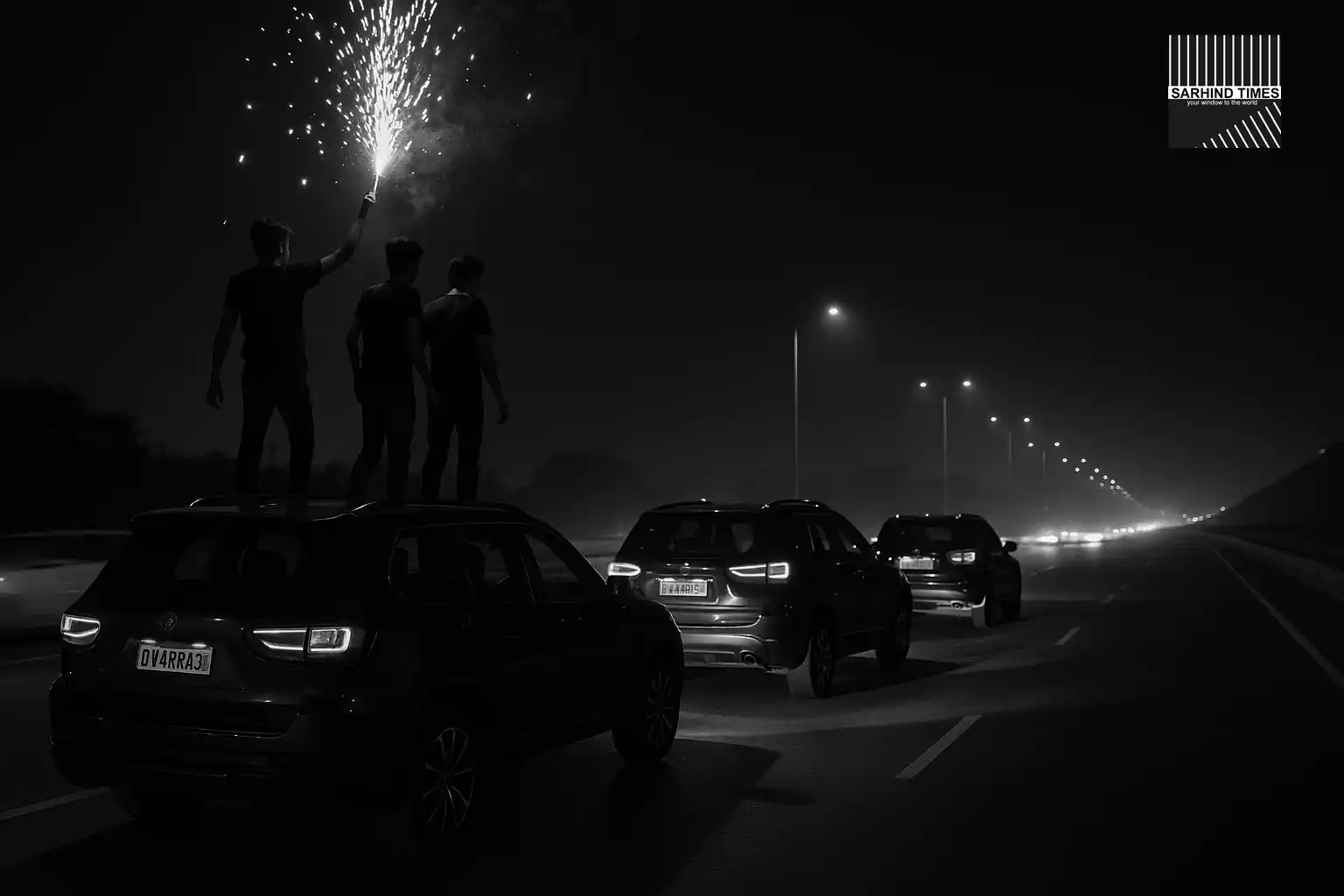
Social-media video triggers swift police action under dangerous-driving and public-safety laws
Dateline: Gurugram | 31 October 2025
Summary: A 32-year-old resident of Bajghera, Gurugram, has been arrested after a video went viral showing three black SUVs moving on the Dwarka Expressway while occupants sat on their roofs and burst fire-crackers. The incident has prompted police to invoke strict provisions relating to negligent driving and public endangerment and has raised concerns about traffic safety in Gurugram’s high-speed corridors.
The video that triggered the arrest
On the night of 23 October 2025, a short clip began circulating on social-media platforms which captured a group of men riding in three SUVs along the Dwarka Expressway in Gurugram. In the video one man is seen atop the roof of a Scorpio vehicle lighting fire-crackers; another individual is visible leaning out of a window of a second vehicle and waving spark-ler boxes, while a third vehicle follows closely. The footage, posted to Instagram reels and WhatsApp groups, immediately caught public attention and prompted the local police to act.
The video was traced by the Gurugram Police Bajghera police team. After sorting through vehicle registration numbers visible in the video, the team zeroed in on a 32-year-old man, Mr. Kapil Rana, resident of Bajghera village, who owns one of the three SUVs. A case was filed on 23 October at Bajghera police station under sections of negligent and dangerous driving and endangering lives.
Sequence of events and police case details
According to the FIR details provided to the police, the incident occurred on the Outer Ring Road – Dwarka Expressway stretch. At approximately 10:00 p.m., the convoy of three black SUVs was seen driving at speed; one of the vehicles pulled ahead and its occupant climbed to the roof, lit large fire-cracker rockets and let them off into the sky above. The second vehicle’s occupant extended his hand out of the window and ignited sparklers and fire-cracker boxes while the vehicle was in motion. The police registrar noted the offences under relevant sections of the Bharatiya Nyaya Sanhita (BNS) pertaining to “endangering life and property” (Section 125), “rash and negligent driving” (Section 281) and “abetment” or collusion (Section 57) of a public offence.
Mr. Kapil Rana was arrested on 30 October, following verification of CCTV footage and witness statements. The vehicle was seized as evidentiary material. The accused claimed that he had lent the SUV to friends for the night and was not present during the incident. However, investigations revealed that the vehicle was registered under his name and driven by his friend at the time of the act. The police spokesperson, ASI Ashok Kumar, said: “The act of bursting fire-crackers from a moving vehicle not only endangers the lives of occupants but also poses a serious threat to others on the road.”
Why this matters: Traffic safety and urban risk in Gurugram
Gurugram’s rapid urban expansion, heavy traffic volumes and high-speed expressway corridors like Dwarka Expressway have created a peculiar risk profile. Leisure stunts, high-performance vehicles and social-media inspired “viral moments” are increasingly overlapping with real-world traffic hazards. The incident underlines how youth culture, social-media visibility and dangerous driving behaviours can converge with high-density road corridors to create serious public-safety risks.
Traffic experts warn that stunts like this—occupants on the roof, ignition of explosive devices while in motion—reverse decades of progress in road-safety policy. The risk is not just to the participants but to oncoming vehicles, two-wheelers, pedestrians and roadside populations. One mis-fired rocket or shift of weight could have caused a fatal rollover or missile-strike into a crowd or roadway divider.
Police reaction and enforcement posture in Gurugram
The Gurugram Police have indicated that this arrest will be followed by a tougher clamp-down on “social-media influenced traffic stunts” and high-speed gatherings. According to ASI Kumar, “We have nabbed many such people in the past few months for performing stunts on city roads.”
Earlier, for example, on 16 July, the DLF-1 police registered a case after a video of a Lamborghini performing stunts near Golf Course Road went viral. The latest case analyses show that the force is increasingly combining CCTV, toll-camera footage and social-media leads to identify offenders in real time.
Legal consequences and penalties ahead
The accused faces the following charges: endangering life under BNS Section 125, negligent driving (281), abetment (57), and relevant provisions under the Motor Vehicles Act, 1988 for dangerous driving on public roads. If convicted, the penalties could involve imprisonment, heavy fines, and cancellation of licence. The seizure of the vehicle also signals the police‘s intent to follow through on asset-based deterrence.
Legal analysts point out that the use of BNS (which replaced older penal code sections) allows for tighter sanctions, faster processing and greater deterrent value. It also lowers thresholds for police action in high-risk incidents. This may raise the stakes for vehicle-owners who hand over control to friends for social stunts without formal licence or risk-management obligations.
Cultural and social-media dimension
The incident is emblematic of a broader trend: young men in urban-peripheral zones of Gurugram seeking visibility through thrill-seeking, cars, and social-media stunts. The moment of lighting rockets from atop SUVs was evidently designed for social-media virality—it was posted within hours, climbed views, and thereby invited law-enforcement attention.
While social-media offers creative expression, it also lowers the barrier for dangerous acts: instant documentation, sharing, peer approval and return-view metrics. In this sense, the police say they are seeing an “amplified risk” environment where what might have been a local stunt is now staged for global reach. The challenge for urban governance is how to anticipate and act upon such risk-amplified behaviour before it becomes normalized.
What residents and road-users should know
For commuters and residents of Gurugram, this case offers several lessons:
- If you spot stunts, signal-horn hijinks or vehicles performing dangerous manoeuvres, record the incident and report it to the nearest police station. Police have increased their monitoring of expressway corridors.
- Road-safety is collective: high-speed roads like Dwarka Expressway traverse residential, industrial and express-urban zones; any competition, stunt or reckless driving affects more than just the participants.
- Social-media virality cannot override public-safety norms. Participation in such acts can lead to arrest, vehicle seizure, licence suspension, insurance invalidation and public-scandal.
Urban-mobility governance and systemic response
Gurugram’s municipal authorities and traffic-police departments are now considering a three-pronged approach to manage such incidents:
- Data-driven hot-spot patrols: Mapping of expressway segments and timing where stunts are more likely (hours of low enforcement, festive nights) to deploy mobile police units.
- Surveillance and footage correlation: Linking CCTV, toll-plaza imagery, smartphone recordings and social-media intelligence to anticipate or rapidly respond to incidents.
- Public-awareness and deterrence campaigns: Urging youth to avoid high-risk social stunts, and pushing local vehicle-owners to understand liability. Police spokespersons say several high-profile seizure cases are in pipeline.
Conclusion
This incident on Dwarka Expressway – and the swift arrest that followed – serves as a warning. The fusion of social-media thrills, high-speed vehicles and urban expressways creates new categories of risk. Gurugram now faces the challenge of not only building physical mobility infrastructure but also curbing behavioural excesses and enforcing norms of public safety.
For residents, the message is clear: spectacle on the wheels may garner likes, but it can also invite penal consequences, danger and damage. For authorities, the recent case offers a template for how real-time digital evidence and expressway surveillance can work together. Ultimately, the goal must be a safe, liveable, mobile city—not a viral showdown on asphalt.



+ There are no comments
Add yours