
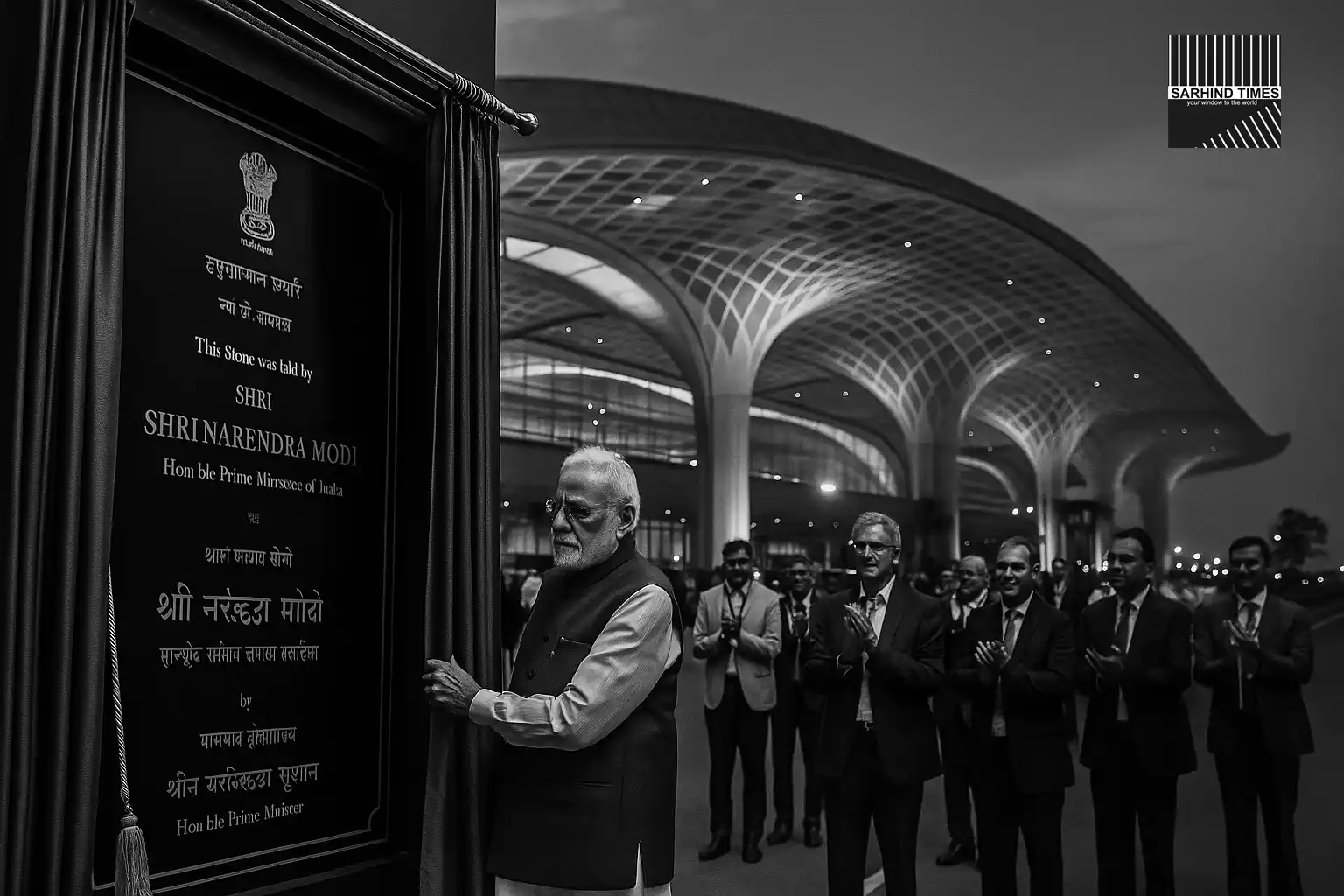
Major public-private projects worth more than ₹31,850 crore launched, signalling new phase for urban connectivity
Dateline: Mumbai | 28 October 2025
Summary: In a landmark infrastructure push, Prime Minister Narendra Modi inaugurated projects in Maharashtra worth approximately ₹31,850 crore — the first phase of the Navi Mumbai International Airport and the second phase of the Mumbai Metro Line 3. These developments aim to significantly enhance connectivity, relieve congestion in Mumbai’s transport network and support economic growth in the region.
Overview of the projects
Inauguration included two major pieces of infrastructure that stand out for their scale and strategic importance. The first is the Navi Mumbai International Airport (NMIA), a project developed under public-private partnership between Adani Airport Holdings (74 %) and the City & Industrial Development Corporation (CIDCO) of Maharashtra (26 %). The initial phase, with a cost of ₹19,650 crore, covers one runway and one terminal with capacity for 20 million passengers annually; the full planned build-out envisions four runways and up to 90 million annual passengers.The second is the Mumbai Metro Line 3 (also known as the Aqua Line), an underground metro corridor stretching 33.5 km with 27 stations, connecting Cuffe Parade in South Mumbai to Aarey JVLR in the north-centre. The portion inaugurated (phase 2) carries a budget of around ₹12,200 crore. Collectively, these projects represent major investments in Maharashtra’s mobility infrastructure, both air and urban rail, and mark a shift toward multi-modal connectivity and capacity expansion in one of India’s busiest metropolitan regions.
Strategic importance for Maharashtra and India
From a strategic perspective, the infrastructure upgrades respond to several pressing needs:
– **Relieving congestion and unlocking capacity**: Mumbai’s existing Chhatrapati Shivaji Maharaj International Airport is operating near capacity; the NMIA is designed to provide relief and future-proof Delhi-Mumbai air connectivity. The metro line similarly addresses acute congestion on Mumbai’s suburban network and the Western Line corridor.
– **Economic multiplier effects**: These projects are expected to generate jobs, stimulate ancillary industries (construction, services, logistics), and bolster Maharashtra’s GDP growth. For example, the airport alone is projected to raise the state’s GDP by about 1 % as per official comments.
– **Connectivity and regional linkages**: The NMIA will enable increased cargo throughput, international routing and better access for peripheral regions; the metro enhances intra-city mobility, reduces travel times and improves commuter experience.
– **Vision for “Viksit Bharat”**: Government messaging emphasised that such infrastructure underpins India’s ambition to become a developed nation by 2047, with modern transport, strong urban systems and global-scale gateways.
These factors together highlight the dual role of infrastructure: operational utility (moving people/goods) and symbolic significance (modern nation-building).
Details: Navi Mumbai International Airport – what’s new
The NMIA project stands out in several dimensions:
– The terminal design is noted for its scale (2,866 acres in phase-1) and digital/automation orientation — described in media reports as “India’s first fully digitised airport”.
– It will include a cargo hub (3.2 million tonnes eventual capacity) alongside passenger capacity.
– Multi-modal access features are planned: road, metro, water-taxi links, and multimodal connectivity were emphasised by project proponents.
– The project completion time is impressive: under 50 months to the first phase, according to statements.
From a policy viewpoint, the airport model exemplifies how PPPs are being used for large-scale infrastructure, leveraging private capital and expertise for public impact. It also positions Maharashtra (and India) as a global aviation hub, not just domestically but regionally for South Asia.
Details: Mumbai Metro Line 3 – underground urban rail for a mega-city
Metro Line 3 is significant for the following reasons:
– It is Mumbai’s first fully underground major line, reducing land-surface conflicts and preserving urban continuity.
– The line has 27 stations and is designed to serve approximately 1.3 million passengers daily once fully operational (specifically noted in the Aqua Line project description)
– Phase 2’s inauguration marks further integration; earlier phases had already opened, but the 8 October launch completed a significant stretch connecting South Mumbai to new corridors.
– It alleviates pressure on major corridors (e.g., Western Line), diminishes road-traffic reliance and supports sustainable urban mobility.
In urban planning terms, the metro line represents a “future-city” model: dense station spacing, underground alignment, city-centre connectivity and reduced commute times for a city struggling with congestion, pollution and the mobility burden of 20 million+ population.
Challenges and caveats
While the projects are impressive, analysts and commentators point out that such mega-infrastructure carries risks and operational challenges:
– **Execution and delivery**: Large projects often face delays, cost overruns, and quality issues. While phase-1 reports are positive, full realisation (e.g., four runways at NMIA, full line of Metro 3) will require sustained focus.
– **Maintenance and operational capacity**: Building large assets is one step; operating and maintaining them efficiently over decades is another. Airports and underground metros have high capital and operating cost burdens.
– **Land acquisition and environmental concerns**: Especially for metro projects that pass through dense urban fabric or sensitive zones, acquiring land, shifting utilities and handling ecological concerns requires social licence and regulatory compliance.
– **Integration with last-mile connectivity**: Infrastructure is only as good as the network of access points — road links, feeder services, public transport interchanges — that make stations and terminals usable for all segments.
– **Demand risk**: While projections are positive, usage has to materialise — passenger growth, cargo usage, ridership, and revenue must align with business assumptions. Economic slowdowns or external shocks could reduce utilisation.
Policymakers and analysts stress that success metrics over the next 3-5 years will determine whether the infrastructure becomes transformative or just expensive monuments.
Implementation timeline and next steps
The inauguration marks the beginning of operational rollout — but several steps remain:
– For NMIA: the next phases (runways 2–4, expanded terminals, full cargo hub) must be commissioned. Work on supporting infrastructure (access roads, metro link, utilities) must continue.
– For Metro 3: full line completion, linking with other metro lines and suburban rail, completion of depots, remaining stations and commissioning of services are priorities.
– Both projects require coordination of city/state/central agencies, monitoring of construction/operations, and stakeholder engagement (residents, commuters, industries).
– The Government of Maharashtra has flagged forthcoming projects such as Vadhavan Port, offshore airports and large logistics nodes.
For citizens, commuters and industry, the benefits are expected to accrue gradually: reduced travel times, lower logistics costs, improved export access, job creation, and better quality of urban life.
Broader implications for India’s infrastructure strategy
These projects reflect India’s broader infrastructure agenda:
– **Connectivity first**: Aligning with the national “PM Gati Shakti” initiative, which emphasises multimodal connectivity and integrated infrastructure planning.
– **Urban-plus-national**: While much focus earlier was on highways and rural connectivity, these projects show urban infrastructure (airport, metro) are now getting scale focus — important for India’s rapidly urbanising future.
– **Global-scale ambitions**: The airport aims to be a regional hub; the metro aims to offer world-class urban mobility. India’s infrastructure is not just for domestic needs but for global positioning.
– **PPP and private-sector leverage**: Engaging large-cap private players (Adani, etc) and international capital helps bridge financing gaps, though governance and oversight remain critical.
– **Sustainability impetus**: Underground metro lines, multimodal access, airport cargo hubs, water-taxi links – these elements reflect an environmentally savvy approach, albeit execution matters.
The Maharashtra examples thus serve as markers of what India’s infrastructure of the 2030s could look like: high capacity, integrated, urban-centric, globally connected.
Voices and reactions
In the inauguration event, PM Modi said the airport will turn the Mumbai region into “Asia’s largest connectivity hub”, directly benefiting farmers, small businesses and exporters. Maharashtra Chief Minister Devendra Fadnavis observed that infrastructure rollout is unlocking a “fourth Mumbai” and future-ready growth zone. But independent urban analysts noted that while the projects are landmark, the challenge lies in sustaining momentum and ensuring inclusive access across income segments.
Industry voices welcomed the airport for export logistics, noting that Mumbai’s cargo handling has long been constrained by capacity bottlenecks. Commuter groups welcomed the metro as a long-awaited relief for South Mumbai commuters, especially along the high-density business districts.
Conclusion
The inauguration of the Navi Mumbai International Airport’s first phase and the extension of Mumbai Metro Line 3 represent a bold step in India’s infrastructure journey. They bridge multiple facets: regional connectivity, urban mobility, economic growth and global positioning.
Yet, infrastructure is a marathon not a sprint. The next few years will test whether these assets deliver on promise—not just aesthetically but operationally, reliably, inclusively. For Maharashtra, and India broadly, the hope is that this day marks the transition from building big to building well.


+ There are no comments
Add yours