
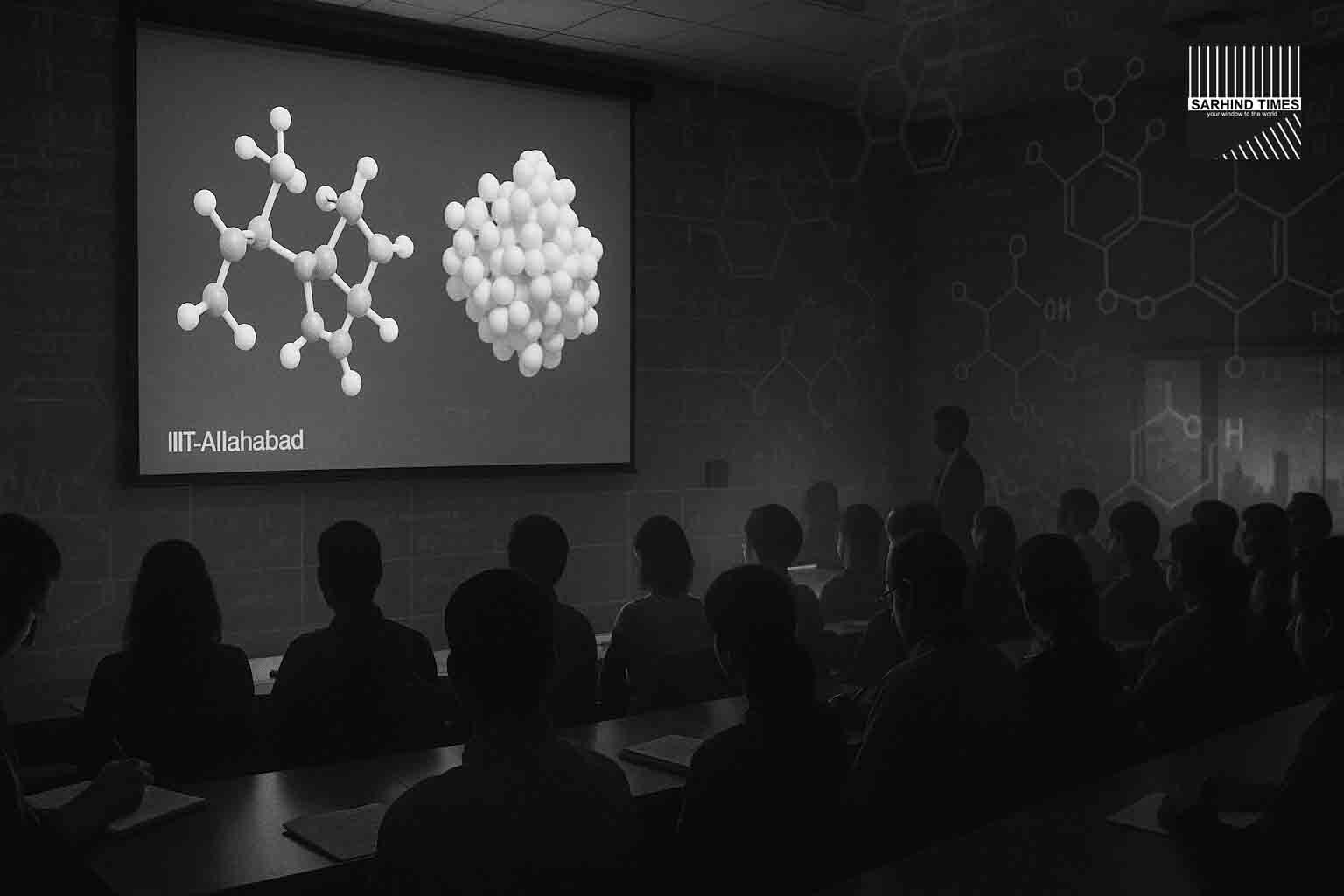
The program brings together researchers, clinicians, and AI specialists to explore how artificial intelligence can revolutionize drug discovery, clinical validation, and healthcare innovation in India.
The Indian Institute of Information Technology (IIIT) Allahabad inaugurated a six-day Faculty Development Program (FDP) focused on Artificial Intelligence in Drug Development and Clinical Trials, marking a milestone in the intersection of AI, life sciences, and data-driven medicine. The workshop brings together scientists, educators, and industry experts to train faculty and researchers in AI tools used for molecular modelling, biomarker identification, and patient data analytics.
📍 Allahabad, October 13 — A New Chapter in AI-Driven Healthcare
In an era where the cost and time of developing new drugs stretch into billions and decades, the Indian Institute of Information Technology (IIIT) Allahabad has taken a timely step: launching a six-day Faculty Development Program (FDP) on “Artificial Intelligence in Drug Development and Clinical Trials.”
The program—organized by the Department of Applied Sciences—aims to build capacity among faculty, researchers, and postgraduate scholars in the use of AI for pharmaceutical research, clinical trial analytics, and regulatory innovations.
“Drug discovery today is as much about data as it is about molecules,”
— said Prof. Mukesh Kumar, Director of IIIT-Allahabad, during the inaugural address.
“Through this FDP, we want to empower educators and researchers to understand how algorithms can shorten discovery cycles and make healthcare more affordable.”
The event, which runs from October 13–18, has drawn participants from over 30 universities, AI labs, and medical institutes across India.
🧬 From Lab to Laptop: The Rise of AI in Drug Discovery
Globally, the field of drug discovery has witnessed a paradigm shift over the past decade. Artificial intelligence, machine learning, and generative modelling now play pivotal roles in:
- Predicting molecular structures and drug-protein interactions
- Identifying new therapeutic compounds
- Accelerating pre-clinical screening
- Optimizing clinical trial designs
- Reducing failure rates in late-stage testing
At the FDP, experts are demonstrating how AI-driven molecular docking, virtual screening, and predictive toxicology can drastically reduce development time and cost—turning years of wet-lab work into months of computation.
“AI helps us predict how a molecule will behave even before it touches a test tube,”
— explained Dr. Ruchi Sharma, Head of Computational Biology at IIIT-Allahabad.
“That predictive power saves lives, money, and time.”
🏛️ The Academic Vision: Interdisciplinary Collaboration
The initiative is part of IIIT-Allahabad’s broader vision to foster interdisciplinary collaboration between information technology, biotechnology, and medical sciences.
The program’s opening day saw sessions led by experts from:
- CSIR–Central Drug Research Institute (CDRI), Lucknow
- National Institute of Pharmaceutical Education and Research (NIPER)
- AIIMS Delhi (Bioinformatics Division)
- Pharma.AI (Hyderabad)
The FDP curriculum includes:
- Fundamentals of AI and deep learning for life sciences
- Generative AI models in molecular design
- Neural networks for toxicity prediction
- AI-based patient stratification in clinical trials
- Regulatory and ethical aspects of data-driven medicine
“We are standing at the crossroads of biology and computation,”
— said Dr. Vivek Agarwal, Dean (Research).
“This FDP is about building educators who can prepare the next generation of hybrid scientists.”
💡 Why Faculty Training Matters
While AI-driven drug discovery is advancing rapidly in global research hubs, India faces a capacity-building gap in translating such innovations to classrooms and local laboratories.
The FDP addresses that gap by equipping faculty members to:
- Integrate AI modules into biotechnology and pharmacy curricula
- Conduct interdisciplinary research in computational pharmacology
- Collaborate with industry for real-world problem-solving
“Our aim is not just to teach tools but to nurture translational thinking,”
— said Prof. Seema Verma, Program Coordinator.
“We need teachers who can guide students from code to clinic.”
The event also features hands-on coding sessions using Python-based AI frameworks such as TensorFlow, PyTorch, and Scikit-learn, customized for bioinformatics datasets.
🧠 AI Tools in Focus
During the first technical session, speakers introduced participants to practical applications of AI in pharmaceutical innovation, including:
- Generative models (like AlphaFold2 and MolGPT) for protein-structure prediction
- Reinforcement learning for molecule optimization
- AI-powered biomarker discovery using patient genomic data
- Natural Language Processing (NLP) for mining medical literature and trial data
The demonstrations showcased how tools like DeepChem, BioBERT, and RDKit are reshaping computational pharmacology.
“Earlier, identifying a potential lead compound could take years,”
— noted Dr. Ananya Sinha, Bioinformatics Scientist at CDRI.
“With AI-based screening, we can narrow down millions of molecules to a few hundred in days.”
⚙️ Clinical Trials: The AI Edge
The second phase of the FDP focuses on clinical trial design and post-market analytics, areas traditionally plagued by inefficiencies and data overload.
Experts highlighted how AI models can optimize patient recruitment, simulate trial outcomes, and detect adverse events early—increasing success rates while maintaining ethical compliance.
“AI doesn’t replace human judgment—it enhances it,”
— said Dr. Pradeep Nair, Senior Biostatistician from NIPER.
“Machine learning can identify hidden patterns in patient response data that even large human teams might miss.”
With India’s growing role as a global clinical trial destination, such knowledge is vital for both academic researchers and regulatory agencies.
📊 India’s AI-in-Pharma Push
The launch of the FDP coincides with India’s national efforts to integrate AI into healthcare research through initiatives like:
- National Biomedical Resource Indigenization Mission (NBRIM)
- IndiaAI Mission (2025–2030)
- National Digital Health Mission (NDHM)
According to NITI Aayog, AI adoption in healthcare could save $10 billion annually by improving clinical outcomes and streamlining research workflows.
IIIT-Allahabad’s program, therefore, complements this national agenda by training human capital—the critical link between policy vision and practical implementation.
“For every AI policy, we need 1,000 trained minds to make it real,”
— emphasized Prof. Mukesh Kumar.
“That’s the true measure of success.”
🔬 Industry Voices: Academia Meets Application
The FDP’s industry sessions featured collaborations with Pharma.AI, TCS Research, and Novartis India, which presented live case studies on how AI is transforming R&D pipelines.
One notable discussion focused on repurposing existing drugs using AI-driven molecular similarity mapping—a process that helped identify potential COVID-19 treatments within weeks in 2020.
“AI has changed how we think about innovation,”
— said Vikas Gupta, Head of AI Strategy at Pharma.AI.
“It’s no longer trial-and-error—it’s prediction and precision.”
Another panel discussed how AI ethics must evolve alongside innovation, particularly in clinical data privacy and algorithmic transparency.
“The goal is not just smarter drugs but safer systems,”
— added Dr. Swati Bansal, Ethics Fellow at AIIMS.
“Transparency in AI decisions is as important as accuracy.”
🏥 The Healthcare Context
India’s healthcare system faces the dual challenge of high disease burden and resource scarcity. AI offers scalable solutions—particularly in drug development for neglected tropical diseases, oncology, and rare disorders.
IIIT-Allahabad’s FDP seeks to create a pipeline of AI-literate biomedical professionals who can collaborate with pharma, regulators, and hospitals.
“The next pandemic won’t wait for peer review,”
— said Dr. Sinha, echoing the urgency.
“We must build systems that respond in real-time.”
🧾 Policy and Ethical Framework
As AI penetrates deeper into regulated industries like pharmaceuticals, ethical and policy frameworks must evolve.
Sessions at the FDP include lectures on:
- The Digital Personal Data Protection (DPDP) Act, 2023
- Global regulatory norms (FDA, EMA) for AI-enabled drug submissions
- Responsible AI principles under UNESCO and WHO
Participants will simulate mock regulatory filings where AI-generated data supports new drug applications.
“AI is not just science—it’s governance,”
— said Dr. Karan Mehta, Regulatory Affairs Expert at Novartis.
“Academia must prepare future scientists to navigate both the lab and the law.”
🎓 Participant Perspectives
For young researchers, the FDP offers both inspiration and direction.
Many attendees expressed how the program reshaped their perception of AI—from a tech buzzword to a scientific collaborator.
“I realized AI is not competing with chemists—it’s complementing them,”
— said Shivani Patel, a PhD scholar from Gujarat University.
“It’s like having a tireless assistant who reads every paper and remembers every molecule.”
Faculty participants plan to integrate AI modules into their courses starting the next semester, supported by open-source tools demonstrated during the workshop.
🔍 The Bigger Picture: Academia as Innovation Catalyst
Experts believe that India’s higher education institutions are emerging as the new R&D frontiers for AI adoption in pharmaceuticals.
With limited industry research budgets, public institutions like IIITs and IITs can bridge the innovation gap through collaborative consortia and open research platforms.
“Innovation in the public domain ensures access for all,”
— said Prof. Agarwal.
“If India can develop AI models for generic drug discovery, we redefine global healthcare economics.”
⚙️ Towards a Sustainable AI-Education Model
The FDP’s concluding sessions will focus on building sustainable academic ecosystems for AI research.
Planned outcomes include:
- Creating AI-Pharma curriculum modules for engineering and life sciences colleges.
- Establishing collaborative research cells linking IIIT-Allahabad with other national institutes.
- Publishing a white paper summarizing the FDP’s findings and policy recommendations.
“This is not an event—it’s a seed,”
— said Prof. Seema Verma, closing the day’s proceedings.
“When these participants return to their institutions, the ecosystem will grow.”
📊 The Road Ahead
IIIT-Allahabad’s initiative signals a growing academic movement—where AI literacy becomes as essential as chemistry or biology in the medical sciences.
Over time, experts expect such programs to influence not just teaching but national drug regulation, startup incubation, and medical innovation.
As the world eyes the fusion of data and biology, India’s education system is quietly preparing its foot soldiers for the next revolution—AI in life sciences.
“The next Nobel in Medicine,”
— joked a senior professor,
“might be shared between a biologist—and an algorithm.”
🔚 Conclusion: Code Meets Cure
The six-day FDP at IIIT-Allahabad exemplifies India’s growing ability to connect computation with compassion.
In bringing together engineers, biologists, and educators under one roof, it underscores a fundamental truth:
AI in healthcare is not about replacing humans—it’s about restoring humanity.
As India builds the next generation of AI-literate scientists, IIIT-Allahabad’s effort stands as a model for how academia can lead the charge toward ethical, impactful innovation.
#AI #IIITAllahabad #DrugDiscovery #ClinicalTrials #Academia #HealthcareInnovation #TechInEducation #SarhindTimes #Research





+ There are no comments
Add yours