
20 sep 2025
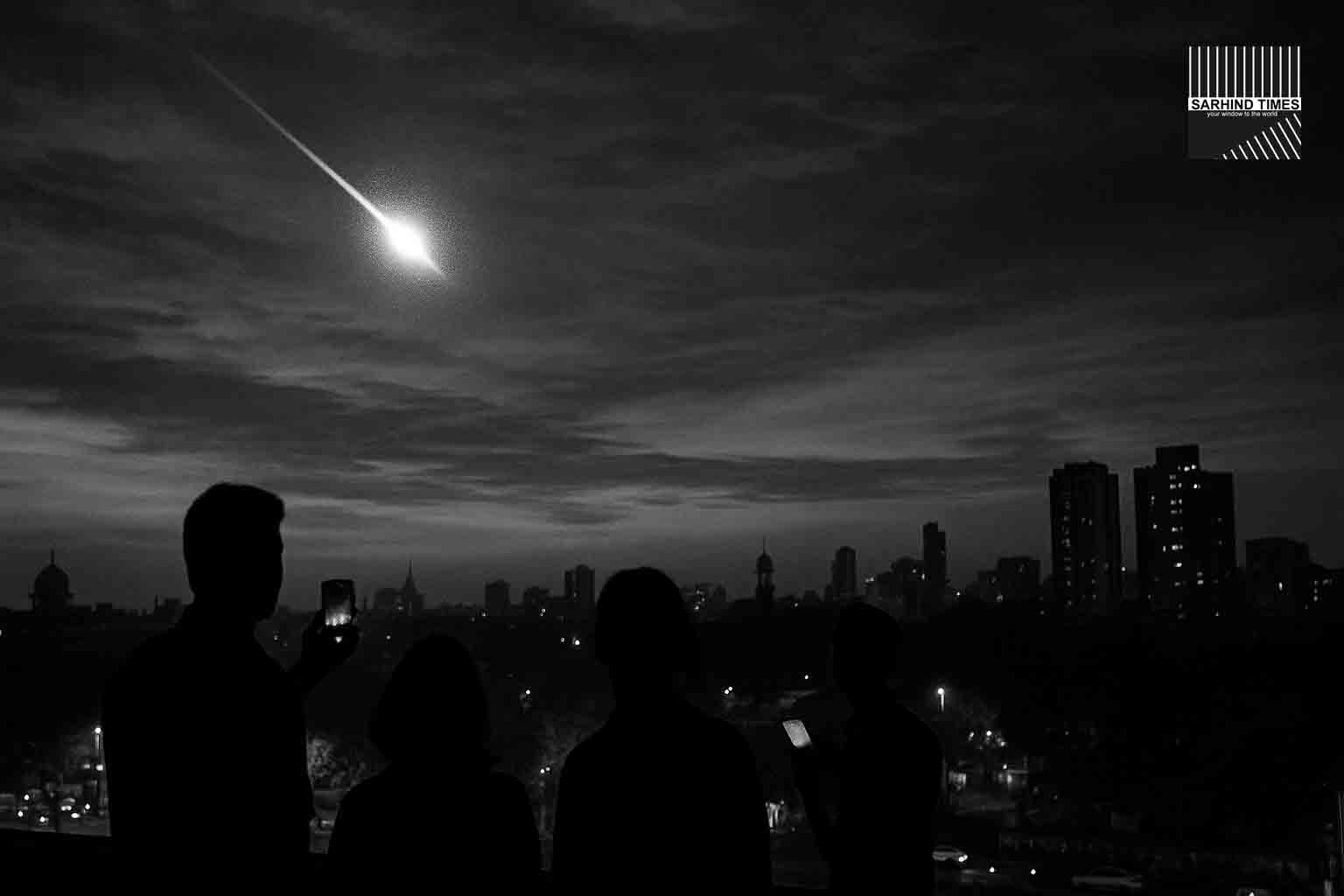
Residents across Delhi, Gurugram, and Noida awoke to social media buzzing with excitement early this morning after a sudden, brilliant flash lit up the pre-dawn sky. The event, tentatively attributed to a small meteor breaking up in the atmosphere, lasted only a few seconds but left a strong impression on those who witnessed it.
While no damage or debris has been reported so far, astronomers say such bolide events—meteors exploding in Earth’s atmosphere—are not unusual. Still, for a region as densely populated as the National Capital Region (NCR), the sight was dramatic, and it reignited public interest in space phenomena and near-Earth objects.
The Event as Witnessed
Eyewitnesses described the flash as brighter than nearby streetlights, illuminating the skyline briefly before fading. Some reported a faint rumbling sound that followed, though this may have been unrelated background noise.
- A Gurugram resident: “For a second I thought it was lightning, but there were no clouds. It was a single, bright streak.”
- A student in Noida: “The sky lit up like a firework. It was both beautiful and a little frightening.”
Dozens of videos have surfaced online, many timestamped between 4:45–5:15 a.m., helping experts triangulate the trajectory.
What the Experts Say
Astronomers believe the flash was caused by a small meteor entering Earth’s atmosphere, disintegrating due to friction before it could reach the ground. Key points:
- Most meteors burn up completely in the atmosphere.
- Only a small percentage result in recoverable fragments (meteorites).
- Bright flashes are often referred to as “fireballs” or “bolides.”
Experts urged residents to share timestamped footage with local observatories to help refine trajectory modeling.
Why It Matters
Though no damage occurred, such events remind us of Earth’s constant exposure to cosmic debris. Globally, scientists track thousands of near-Earth objects (NEOs), some large enough to pose risks. Smaller meteors like this one, however, typically burn up harmlessly.
Still, the Delhi–NCR sighting adds to India’s growing catalogue of observed bolide events. Each record helps researchers improve models of atmospheric entry, fragmentation, and potential risks.
Public Interest in Space Grows
The incident has sparked renewed curiosity among citizens:
- Schools are already planning astronomy sessions around the event.
- Planetariums in Delhi have invited residents to share observations.
- Social media hashtags like #DelhiMeteor and #NCRMeteor trended through the morning.
Astronomy enthusiasts highlight the importance of citizen science networks—ordinary people capturing and sharing sky events that experts can analyze.
India’s Role in Global Meteor Research
India is expanding its role in tracking space phenomena:
- ISRO operates telescopes and tracking facilities.
- Universities collaborate with international groups on NEO tracking.
- Citizen observatories in Pune, Bengaluru, and Delhi feed valuable data into global databases.
Events like today’s highlight the need for a coordinated national observation network, linking professional astronomers with hobbyists and everyday skywatchers.
Comparisons with Past Events
- 2019, Rajasthan: A meteor fragment weighing 2.8 kg was recovered near Sanchore.
- 2020, Assam: Villagers reported a loud explosion from a suspected bolide event.
- 2022, Gujarat: Bright streaks across the night sky went viral on social media.
The Delhi–NCR event appears to fall into the category of non-damaging fireball flashes, but its occurrence over such a heavily populated region made it especially visible.
Science Behind the Flash
When meteors enter Earth’s atmosphere, they travel at speeds of 11–72 km per second. Friction causes intense heating, creating the bright streak known as a shooting star. Larger meteors (bolides) may explode, producing a flash brighter than the full moon.
In this case, experts believe the object was relatively small, likely no larger than a basketball, but enough to create a visible fireball.
Safety Considerations
Authorities confirmed there was no impact or damage. Still, officials advise residents:
- Do not chase rumors of debris without expert guidance.
- Report any unusual fragments to local authorities.
- Share verified photos or videos with scientific institutions.
Conclusion
The pre-dawn meteor flash over Delhi–NCR was a fleeting spectacle—harmless yet awe-inspiring. For many residents, it was a reminder of Earth’s place in the cosmos and the wonders that occasionally light up our skies.
As scientists analyze data and refine trajectory models, one thing is certain: such events bridge everyday life with cosmic phenomena, sparking curiosity that transcends boundaries.
#DelhiNCR #Meteor #Space #Science #Gurugram #Astronomy #SarhindTimes



+ There are no comments
Add yours